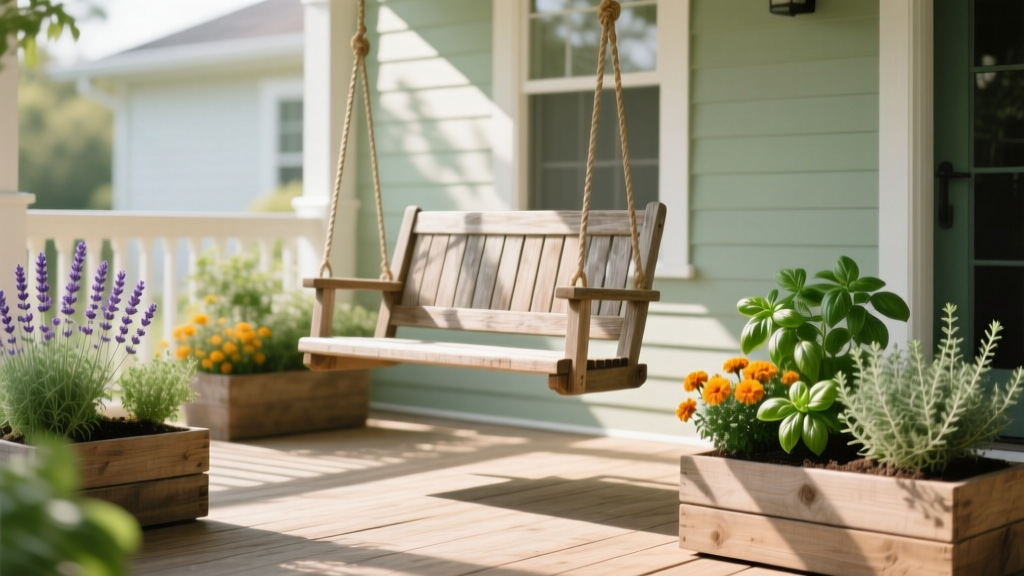
Porch Swing Companion Planting Ideas
The swing is hung, the chains are level, and you’ve finally got that gentle creak you wanted. Then you sit down and notice the problem: the view is flat, the breeze is dusty, and the porch feels a little exposed—like you’re on display instead of tucked into a garden room. Companion planting around a porch swing isn’t about stuffing in “pretty plants.” It’s about shaping what you see, smell, and feel from a seat that doesn’t move very far. The best porch-swing planting acts like a friendly entourage: it frames the swing, softens hard edges, cools the air, welcomes pollinators, and keeps maintenance realistic.
Below is a landscape-designer style walk-through: layout principles first (so your swing still swings), then plant pairings that behave well at porch scale, plus three real-world setups—from rental containers to sunny cottage porches.
Start with the swing as your “focal chair”
Designing around a porch swing works best when you treat it like a fixed viewpoint. Your eyes will land in the same zone every time, so you can be intentional with height, fragrance, and seasonal interest.
Clearance rules that keep the swing usable
Before buying plants, mark the swing’s movement zone. Most porch swings are 4–5 ft long and need space to move without brushing foliage.
- Front-to-back clearance: allow at least 30 inches from the swing’s furthest forward arc to the nearest pot/bed edge.
- Side clearance: keep 18–24 inches clear on each side for legs, side tables, and safe entry.
- Planting depth: a narrow bed of 18–24 inches deep can still hold layered planting if you use vertical elements (trellis, obelisk, railing planters).
If you’re not sure where the arc is, hang a ribbon from the front rail of the swing and gently push the swing forward; the ribbon shows the “no-plant zone.”
Sun and heat: read the porch like a microclimate
Porches are often brighter and drier than nearby ground beds due to reflected heat and roof protection. Track sunlight for a day:
- Full sun: 6–8+ hours
- Part sun/part shade: 3–6 hours
- Shade: under 3 hours
Those hour ranges align with common horticultural standards used in extension guidance (e.g., University of Minnesota Extension, 2020).
Layout strategies: frame, layer, and “edit” the view
Use a three-layer planting recipe (low, mid, vertical)
From the swing seat, the most comfortable composition is layered. Think of it as a staged photo: foreground texture, mid-level color, and a gentle backdrop.
- Low layer (6–12 inches tall): spillers and edge plants soften the porch line and hide pot rims.
- Mid layer (12–30 inches): bloom and fragrance live here—right at nose level when you’re seated.
- Vertical layer (4–6 ft): trellised vines, tall planters, or narrow shrubs create privacy without blocking airflow.
Repeat plants for calm (and easier care)
Instead of twelve different plants, repeat three or four in a rhythm. Repetition looks intentional and reduces maintenance because you’re learning fewer personalities. A practical target is 60–70% repeat plants and 30–40% seasonal accents.
Plan for scent and pollinators—without inviting trouble
Fragrant companions are porch-swing gold, but choose scents that don’t overpower and plants that don’t drop sticky berries onto cushions. Also, keep very bee-attractive blooms slightly to the side rather than directly at knee level if anyone in the household is sensitive.
“People experience landscapes at human speed—standing, walking, sitting. The details closest to the body and face matter most at seating areas.” — Clare Cooper Marcus, landscape architect and author, People Places (1998)
Step-by-step setup: a designer’s sequence that avoids do-overs
- Measure the swing zone: mark 30 inches in front of the swing’s forward arc as a clear corridor.
- Pick your planting footprint: choose either (a) two large pots flanking the swing, (b) a continuous narrow bed along the porch edge, or (c) railing boxes plus a corner planter.
- Match plants to light: confirm sun hours (aim to observe at 9 a.m., 12 p.m., and 3 p.m.).
- Choose a simple palette: 2 foliage plants + 2 bloomers + 1 vertical element is plenty for a tight porch scene.
- Place verticals first: trellis/obelisk or tall planters go behind or beside the swing—not in front.
- Install irrigation shortcuts: in containers, add saucers or self-watering inserts; in beds, consider a simple soaker hose.
- Plant and mulch: in beds, mulch 2 inches deep to reduce splash and dust.
Plant selection: companion pairings that behave beautifully near a swing
These combinations are chosen for porch realities: constrained roots, reflected heat, foot traffic, and the desire for fragrance. Spacing notes assume mature size; for containers, you can plant slightly tighter for a fuller look, then trim.
Sunny porch (6–8+ hours): silver foliage + herbs + long bloom
Design goal: cooling color, low watering stress, and fragrance that reads in heat.
- Lavender (Lavandula angustifolia ‘Hidcote’): compact habit, fragrant, strong structure. Spacing: 18–24 inches. Great in large pots (at least 16–18 inches diameter).
- Salvia ‘Caradonna’: upright purple spikes; pollinator magnet without being floppy. Spacing: 18 inches.
- Artemisia ‘Powis Castle’: soft silver foliage, heat-tough, acts like a “visual air conditioner.” Spacing: 24–30 inches (or keep trimmed in a pot).
- Thyme ‘Doone Valley’ (variegated creeping thyme): spills over edges, aromatic when brushed. Spacing: 10–12 inches.
- Lantana ‘New Gold’: nonstop bloom, handles heat, good in pots. Spacing: 18–24 inches.
Why this works together: lavender + thyme reinforce fragrance, salvia stretches the vertical line, and artemisia/lantana keep color even during hot weeks. If your porch is windy, these plants stay relatively sturdy compared to taller, hollow-stemmed options.
Part shade porch (3–6 hours): big leaf texture + shade bloom + trailing softness
Design goal: make a sheltered, lush “reading nook” without high water demands.
- Hydrangea (Hydrangea macrophylla ‘Endless Summer’): porch-scale shrub in ground or a very large pot. Spacing: 3–4 ft in beds; pot size 20–24 inches wide for long-term.
- Heuchera ‘Caramel’ or ‘Obsidian’: evergreen-ish color in many climates; tidy mounds. Spacing: 12–18 inches.
- Begonia ‘Dragon Wing Red’: reliable bloom in part shade, doesn’t need deadheading. Spacing: 12–16 inches.
- Sweet potato vine (Ipomoea batatas) ‘Margarita’: chartreuse trailing accent that brightens shade. Spacing: 12–18 inches; excellent spiller from railing boxes.
- Fuchsia ‘Gartenmeister Bonstedt’: hummingbird-friendly, elegant pendants. Spacing: 12–18 inches; best where afternoons aren’t blazing hot.
Why this works together: hydrangea gives you a backdrop behind one side of the swing, heuchera repeats color at seat height, begonia/fuchsia provide steady blooms, and sweet potato vine ties everything together with a simple drape.
Shade porch (under 3 hours): calm greens + white flowers + movement
Design goal: brighten low light and create texture you can enjoy up close.
- Hosta ‘Halcyon’ (blue leaves): strong substance, slug-resistant compared with thinner-leaf types. Spacing: 24–30 inches.
- Japanese forest grass (Hakonechloa macra) ‘Aureola’: arching movement, gold striping. Spacing: 18–24 inches.
- Astilbe ‘Bridal Veil’: creamy plumes that glow in shade. Spacing: 18 inches; likes consistent moisture.
- Impatiens (New Guinea types for bigger leaves): dependable bloom color in shade. Spacing: 10–12 inches.
- Climbing hydrangea (Hydrangea anomala subsp. petiolaris): for a shady vertical surface; slow at first, then strong. Provide a trellis; keep it off delicate siding.
Why this works together: hosta and hakonechloa deliver “green luxury” even without flowers. Astilbe and impatiens add brightness at eye level from the swing.
Comparison table: fast picks for common porch conditions
| Porch condition | Best companion combo | Container size (minimum) | Weekly water (summer) | Maintenance notes |
|---|---|---|---|---|
| Full sun, hot reflect | Lavender ‘Hidcote’ + Salvia ‘Caradonna’ + Thyme | 18" pot for lavender; 14–16" for salvia | 1–2 deep waterings | Shear lavender after bloom; avoid soggy soil |
| Part shade, bright mornings | Heuchera + Begonia ‘Dragon Wing’ + Sweet potato vine | 12–14" pots; railing boxes 24–30" long | 2–3 waterings | Pinch vines; fertilize monthly for blooms |
| Deep shade, damp air | Hosta ‘Halcyon’ + Hakonechloa ‘Aureola’ + Astilbe | 16–20" pots or ground bed | 2 waterings (more if in pots) | Watch slugs; cut back perennials in late fall |
Three real-world porch swing scenarios (and how to plant them)
Scenario 1: Rental porch with no digging—two big pots and railing boxes
Problem: You can’t change the landscape, but the swing feels exposed and the porch looks sparse.
Layout: Place two 18-inch diameter planters at the swing’s outer corners, set back so they’re 24 inches behind the swing’s side edges. Add two 30-inch railing boxes on the rail opposite the swing for a “floating garden wall.”
Plant recipe (part sun): In each large pot: 1 hydrangea ‘Little Lime’ (more sun-tolerant than bigleaf types) or 1 compact dwarf lilac ‘Bloomerang Dwarf Purple’ (if you have 6+ hours). Underplant with 2 heucheras (‘Caramel’) and 2 begonias (‘Dragon Wing Red’). In railing boxes: sweet potato vine ‘Margarita’ + trailing lobelia ‘Sapphire’.
Budget range: expect about $160–$320 total depending on planter quality (two large planters can be $35–$90 each; shrubs often $25–$60 each). DIY alternative: use food-safe 5-gallon buckets inside a decorative basket sleeve—cheap, light, and renter-friendly.
Scenario 2: Narrow porch edge bed—18 inches deep, long and skinny
Problem: There’s a sliver of soil along the porch, but you’re worried plants will snag the swing or feel messy.
Layout: Keep the first 12 inches nearest the porch edge as low plants only (6–10 inches tall). Place mid-height plants in a staggered line so nothing crowds the swing arc. Add one vertical feature at an end: a slim trellis set 8–12 inches from the wall.
Plant recipe (sun): Front edge: creeping thyme ‘Doone Valley’ at 12-inch spacing. Mid layer: salvia ‘Caradonna’ at 18-inch spacing, alternating with catmint (Nepeta) ‘Walker’s Low’ at 24-inch spacing. Vertical end: clematis ‘Rooguchi’ on a trellis (polite size, long bloom). This mix provides long flowering and a soft haze that won’t flop into the swing if trimmed once in midsummer.
Cost tip: buy smaller perennials in 1-quart pots (often $6–$10 each) instead of gallons for a longer bed—your first-year look will be lighter, but by year two it knits together.
Scenario 3: Busy family porch—durable plants that don’t mind bumping
Problem: Kids, pets, and daily traffic mean delicate blooms get crushed and pots get knocked.
Layout: Anchor with heavier containers (ceramic or concrete-look resin) and choose plants with resilient stems. Keep the main traffic lane at least 36 inches wide from door to steps.
Plant recipe (part shade): Use tough foliage as the backbone: hosta ‘Halcyon’ (if shade) or dwarf panicle hydrangea ‘Bobo’ (if more sun). Add coleus ‘ColorBlaze Rediculous’ for bold color (handles part shade and casual bruising), plus trailing bacopa ‘Snowtopia’ for white spill. These are forgiving if a soccer ball clips them.
DIY alternative: build a simple wooden planter bench to flank the swing using exterior screws and a 2x12 frame; line it with landscape fabric and drop nursery pots inside. It looks built-in, but you can take it with you.
Companion planting “roles” to mix and match
Privacy companions (without turning your porch into a hedge)
- Star jasmine (Trachelospermum jasminoides) on a trellis: evergreen in warmer zones, fragrant. Keep it trained so it doesn’t grab the swing chain.
- Clumping bamboo alternatives: try Fargesia in large tubs where hardy; otherwise use tall grasses like switchgrass ‘Northwind’ (upright, narrow).
Fragrance companions (best placed just off-center)
- Lavender ‘Munstead’: slightly smaller than ‘Hidcote,’ good in pots.
- Scented geranium (rose or lemon types): brush the leaves as you sit; ideal for containers.
- Nicotiana ‘Fragrant Cloud’: evening scent; place 24 inches away from the swing’s edge to avoid sticky leaves brushing fabric.
Pollinator companions that stay tidy
If you want butterflies and bees, choose plants with strong stems and a neat habit. The Xerces Society highlights that pollinators benefit from a sequence of blooms across seasons (Xerces Society, 2022). On a porch, that translates to long-blooming perennials plus a few annual refreshers.
- Salvia ‘Caradonna’ (spring to midsummer; reblooms with trimming)
- Compact zinnia ‘Profusion’ series (summer to frost; tidy)
- Coreopsis ‘Moonbeam’ (light, airy, long bloom)
Maintenance expectations: what it really takes
For most porch swing companion plantings, plan on 30–45 minutes per week during the growing season. Containers push that toward 45–60 minutes in hot weather because watering is more frequent.
Weekly rhythm (growing season)
- Water: check pots every 1–2 days during heat waves; beds 1–2 deep soakings per week depending on rainfall.
- Groom: deadhead or shear bloomers (10 minutes) to keep the area looking porch-neat.
- Sweep: quick sweep under the swing; choose plants that don’t drop messy petals if you hate daily cleanup.
Seasonal tasks
- Spring (1–2 hours total): refresh mulch to 2 inches, cut back perennials, top-dress containers with compost.
- Midsummer (30 minutes): shear catmint/salvia after first bloom for a clean second flush.
- Fall (1 hour): cut back frost-killed annuals; move tender pots near the house for a little extra warmth.
- Winter (15 minutes): in cold climates, cluster pots and wrap with burlap if you’re overwintering perennials.
Budget-minded design: where to spend and where to improvise
If you only spend money in two places, make it (1) the largest containers (they stabilize the composition and reduce watering stress) and (2) one strong vertical element for privacy. Everything else can be economical repeats.
- Spend: two large planters ($70–$180 total if you choose mid-range resin) and a sturdy trellis ($25–$60).
- Save: buy plug trays of annuals for fillers; split perennials from friends; use pine bark mulch instead of decorative stone for a softer look and easier edits.
- DIY self-watering hack: in a large pot, set a perforated nursery pot upside down as a reservoir platform, then add soil around it—this reduces drought stress without buying special inserts.
Once the plants are in, sit on the swing at three different times of day. Notice what you look at first, where the breeze carries scent, and whether anything scratches your shoulders on the back swing. A porch swing is a moving seat in a small room—companion planting is how you make that room feel finished, personal, and easy to live with.
Sources: University of Minnesota Extension (2020) guidance on interpreting sun/shade exposure for plant selection; Xerces Society (2022) recommendations on providing season-long floral resources for pollinators.