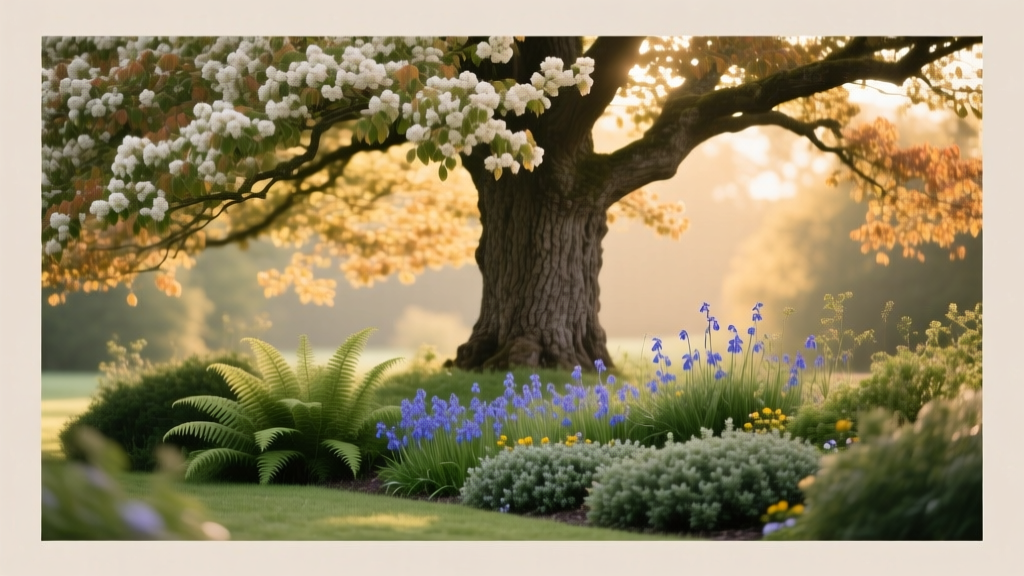
Front Year Heritage Oak Underplanting
The oak is perfect—until you try to plant under it. You stand in the front yard with a shovel, hoping for a friendly patch of soil, and hit a web of roots two inches down. It’s dry in summer, soggy in winter, and the light changes by the hour as the canopy sways. Meanwhile, the “mulch donut” around the trunk has become a dusty ring that makes your beautiful heritage tree feel oddly unfinished. The goal with heritage oak underplanting isn’t to fight the tree; it’s to design with it—root protection, shade patterns, and year-round curb appeal, all in a layout that looks intentional from the street.
This walkthrough is written like I’d talk you through it on-site: we’ll map the root zone, decide on a layout that respects the oak’s health, then pick plants that thrive in the exact conditions an established oak creates. You’ll get spacing, sizes, and costs you can use immediately, plus real-world scenarios for different front yards and different levels of commitment.
Start with the oak: the “no-dig” mindset and the root zone map
A mature oak’s feeder roots live close to the surface, often in the top 6–12 inches of soil. Digging aggressively can damage roots that the tree depends on for water and stability. That’s why the best front-yard underplanting plans start with two actions: measure, then build soil upward rather than excavating downward.
Measure your canopy and define three planting rings
Grab a tape measure and mark the canopy dripline (the outer edge of where rain drips from leaves). For many heritage oaks in front yards, the dripline radius might be 12–25 ft; in a smaller lot, you may only have 8–15 ft to work with. Then divide the area into three rings:
- Ring 1: Trunk protection zone — 0 to 3 ft from trunk. Keep this simple and open; think leaf litter, low groundcover, and no hard edging.
- Ring 2: Root-friendly planting zone — 3 ft to about 2/3 of the dripline radius. This is your main underplanting area: shade-tolerant perennials, sedges, ferns, and bulbs installed with minimal digging.
- Ring 3: The “light edge” zone — outer 1/3 near the dripline where you often get more sun and a bit more rainfall penetration. This is where you can add flowering shrubs or tougher perennials for curb appeal.
Concrete example: If your oak’s dripline radius is 18 ft, Ring 1 is 0–3 ft, Ring 2 is 3–12 ft, and Ring 3 is 12–18 ft. That’s a clear framework that keeps the design from turning into random clusters.
Respect soil biology: mulch and leaf litter aren’t “mess,” they’re strategy
Oaks evolved with a blanket of leaves and decomposing organic matter. Research-based guidance supports mulch as a tool for moderating soil moisture and temperature when used correctly. The International Society of Arboriculture recommends wood-chip mulch applied in a thin, even layer—kept away from direct trunk contact—to protect roots and reduce mower damage (ISA, 2019).
“Maintain a mulch-free area of 1–2 inches next to the trunk and keep mulch depth to about 2–4 inches.” — International Society of Arboriculture (ISA), mulch guidance (2019)
For a front yard, you can make leaf litter look deliberate by using a low, invisible edging line (or a crisp mowing edge) to define where leaves are welcomed versus where lawn is kept clean.
Design principles and layout strategies that look finished from the street
Underplanting has two jobs in the front yard: it needs to survive, and it needs to read as “designed.” You’re building an understory that frames the oak without competing with it.
Principle 1: Keep the trunk visually clear to honor the heritage tree
A heritage oak is the main character. Keep plant heights lowest near the trunk (3–10 inches), then step up gradually as you move outward (12–24 inches), saving anything taller for the dripline edge (30–48 inches). This creates a clean sightline to the trunk and prevents a cluttered look.
Principle 2: Repeat shapes and textures more than you repeat colors
Under oaks, flowers can be seasonal and subtle; texture is what holds the design all year. A repeating rhythm—arching sedges, broad-leaved groundcovers, fern fronds—reads cohesive even when blooms are brief.
Principle 3: Build in a “maintenance lane” so the bed stays realistic
If you can’t comfortably reach it, it won’t get weeded. Leave a 18–24 inch stepping lane (mulch or flat stones) that loops through Ring 2. This is especially helpful for renters or busy homeowners: it turns maintenance from a chore into a quick circuit.
Principle 4: Use drift-style planting for calm, not a polka-dot collection
Instead of one of everything, plant in drifts of 3, 5, or 7 of the same plant. Under a canopy, grouped plants help each other hold moisture and look intentional from the curb.
A practical layout you can copy (with dimensions)
Here’s a front-yard layout that works in many climates where oaks thrive. Adjust plant choices to your region, but keep the structure.
Sample plan for a 20 ft diameter bed (about 314 sq ft)
Bed size: 20 ft diameter circle (radius 10 ft). This is a manageable size for a typical front yard while still feeling generous around a mature tree.
- Ring 1 (0–3 ft): 2–3 inches of arborist wood chips; optional low groundcover in small patches, kept sparse.
- Ring 2 (3–7 ft): Primary underplanting drifts (sedges, ferns, tough perennials).
- Ring 3 (7–10 ft): Accent plants for curb appeal—shade-tolerant flowering shrubs or bolder perennials where light is strongest.
Sunlight expectation: Under a mature oak you’ll commonly get 2–4 hours of dappled sun in Ring 2, and 4–6 hours near the dripline edge depending on orientation and canopy density. That’s enough for many “part shade” plants, but not enough for full-sun perennials that demand 6+ hours.
Step-by-step setup instructions (oak-safe)
This process avoids heavy digging and works even when roots are close to the surface.
- Call before you dig. Even if you plan to “no-dig,” you may place edging or stones. Use your local utility marking service.
- Define the bed line. Use a hose to draw a circle or an oval that faces the street (ovals often look more natural in front yards). Mark it with flour or landscape paint.
- Remove turf gently. Cut sod into strips with a flat spade where possible; where roots stop you, scalp the grass and smother it with cardboard.
- Lay cardboard (optional but effective). Overlap seams by 6 inches. Keep cardboard 6–12 inches away from the trunk to avoid moisture against bark.
- Add compost lightly. Spread 1 inch of compost over the bed (skip if your soil is already rich). This is a top-dressing, not a dig-in.
- Mulch with wood chips. Apply 2–4 inches of chips; keep a 2–3 inch bare ring right next to the trunk. (ISA, 2019)
- Plant using root-friendly holes. For perennials, cut an X in the cardboard, pull it back, and dig only as deep as the pot. If you hit roots, shift the planting spot rather than cutting roots.
- Water deeply to establish. For the first 6–8 weeks, water 1–2 times per week if rainfall is low, soaking the planted zones slowly.
- Add a simple edge. A crisp spade-cut edge (re-cut 2–3 times per year) often looks better than plastic edging and costs $0.
Plant selection that actually works under a heritage oak (with varieties)
The best plants for oak underplanting share a few traits: shade tolerance, resilience to root competition, and the ability to handle dry spells once established. Many also perform well in “woodland” soils and benefit from leaf mulch.
Reliable groundcovers (low height, big payoff)
1) Epimedium x rubrum (Barrenwort)
Why it works: Deep shade tolerant, handles dry shade once established, and doesn’t mind root competition. Spring flowers are a bonus; the heart-shaped foliage is the real asset.
Spacing: 12–18 inches apart; expect fill-in in 2–3 seasons.
2) Geranium macrorrhizum ‘Bevan’s Variety’ (Bigroot geranium)
Why it works: Aromatic foliage, tough as nails, and one of the best performers in dry shade. It knits together to suppress weeds.
Spacing: 18 inches apart in drifts of 5–7.
3) Asarum canadense (Wild ginger)
Why it works: A native woodland groundcover in many regions, excellent for shade with consistent moisture. Use it where your oak bed stays a bit cooler (often north/east side).
Spacing: 12 inches apart.
Sedges and grasses (the design “glue”)
4) Carex pensylvanica (Pennsylvania sedge)
Why it works: A lawn-like sedge that tolerates shade and competition; it looks tidy and softens the whole bed. It’s also a great transition plant between lawn and woodland bed.
Spacing: 8–12 inches apart.
5) Carex oshimensis ‘Evergold’
Why it works: Bright variegation lifts shady spaces, and the arching form repeats beautifully. Use it as a highlight in Ring 3 where light is slightly better.
Spacing: 12 inches apart.
Perennials for seasonal bloom without fuss
6) Helleborus x hybridus (Lenten rose)
Why it works: Evergreen to semi-evergreen in many climates, blooms late winter to early spring when your front yard needs it most. Handles dry shade once established.
Spacing: 18–24 inches apart; place where you’ll see it from the front walk.
7) Heuchera ‘Caramel’ or ‘Obsidian’ (Coral bells)
Why it works: Colorful foliage for shade; choose one variety and repeat it to avoid a “collector” look. Best with some morning sun and summer irrigation.
Spacing: 12–16 inches apart.
8) Polygonatum odoratum ‘Variegatum’ (Variegated Solomon’s seal)
Why it works: Elegant arching stems, white spring flowers, and strong presence without being bulky. Tolerates shade and root competition well once established.
Spacing: 18–24 inches apart.
Ferns for structure and a woodland feel
9) Dryopteris erythrosora (Autumn fern)
Why it works: Coppery new fronds brighten shade; evergreen-ish in milder climates. Great in Ring 2 with consistent mulch.
Spacing: 18 inches apart.
10) Polystichum munitum (Western sword fern)
Why it works: Excellent structure and durability in suitable regions; stands up to front-yard visibility and reads “established.”
Spacing: 24 inches apart.
Small shrubs for the dripline edge (Ring 3)
11) Hydrangea quercifolia ‘Pee Wee’ or ‘Ruby Slippers’ (Oakleaf hydrangea)
Why it works: It belongs visually with oaks, tolerates part shade, and provides summer flowers plus fall color. Best near the outer edge where it gets 4–6 hours of light.
Spacing: 3–4 ft apart depending on cultivar size.
12) Ilex glabra ‘Shamrock’ (Inkberry holly)
Why it works: Evergreen structure for winter curb appeal, tolerates moisture swings better than many shrubs. Use in pairs to anchor the bed near the walkway or driveway.
Spacing: 3 ft apart.
Quick comparison: top performers for dry shade under oaks
| Plant | Best light under oak | Water once established | Spacing | What it does for the design |
|---|---|---|---|---|
| Epimedium x rubrum | Full shade to part shade | Low | 12–18 in | Dense groundcover, spring interest |
| Geranium macrorrhizum ‘Bevan’s Variety’ | Part shade | Low | 18 in | Weed suppression, fragrant foliage |
| Carex pensylvanica | Dappled shade | Low to medium | 8–12 in | Soft “meadow” look, tidy edges |
| Helleborus x hybridus | Part shade | Low to medium | 18–24 in | Winter/early spring bloom, evergreen presence |
| Dryopteris erythrosora | Shade to part shade | Medium | 18 in | Structure, coppery new fronds |
Budget planning: what it costs and where to save
A front-yard underplanting can be done in phases. Below is a realistic cost sketch for a 314 sq ft bed (20 ft diameter), assuming you’re buying mid-size perennials and mulch locally. Prices vary by region; treat these as planning numbers.
- Mulch: 3 cubic yards of arborist chips to cover ~300 sq ft at 3 inches deep. Often $0–$60 if delivered from a tree service; bagged mulch would cost more.
- Compost: 1 cubic yard (top-dress ~300 sq ft at 1 inch). Roughly $40–$90.
- Plants: 35–55 plants total depending on spacing and how full you want it year one. If average plant cost is $8–$14, expect $280–$770.
- Edging (optional): DIY spade edge is $0; steel edging for a front-yard crisp line might run $2–$4 per linear foot. A 20 ft diameter circle is ~63 linear ft, so $126–$252.
- Soaker hose/drip line (highly recommended): $25–$80, depending on length and fittings.
DIY alternative that still looks professional: Spend on repetition instead of rarity. Choose 3 “workhorse” plants (for example: Carex pensylvanica, Epimedium, and hellebores) and repeat them generously. Your design will look more intentional than a bed of 20 different “special” plants.
Three real-world scenarios (and how the design shifts)
Every oak and front yard is a little different. Here are three situations I see constantly, and how I’d adjust the same basic framework.
Scenario 1: The dry, south-facing oak with thirsty lawn nearby
What it looks like: The lawn struggles under the canopy, the soil is hard by July, and you might get only 2–3 hours of broken sunlight beneath dense leaves. This is classic “dry shade,” especially if the tree is near pavement that reflects heat.
Design moves:
- Increase mulch depth to a consistent 3 inches (still keeping it off the trunk) to reduce evaporation.
- Choose drought-tolerant underplanting: Epimedium, Geranium macrorrhizum, Carex pensylvanica, and hellebores.
- Keep shrubs mostly in Ring 3 where they’ll get more light and rainfall.
Case example planting list (approx. 20 ft diameter bed): 15 Carex pensylvanica, 10 Epimedium, 7 bigroot geraniums, 5 hellebores, and 3 autumn ferns for punctuation.
Scenario 2: The shady oak with a downspout nearby (surprisingly moist)
What it looks like: The canopy is dense, but a roofline or downspout sends water toward the tree. You get soggy pockets in winter and decent moisture in summer. This is where people accidentally rot plants that prefer it dry.
Design moves:
- Direct downspout water away with a simple splash block or buried drain line if pooling occurs (a basic extension can be $15–$35).
- Use moisture-tolerant plants in the wetter pocket: wild ginger, certain ferns, and sedges.
- Place drought-tolerant plants (epimedium, bigroot geranium) on the higher, drier side for balance.
Case example: One front yard I worked on had a persistent wet crescent on the north side of the trunk. We treated it like a feature: wild ginger at 12-inch spacing, then a drift of autumn ferns at 18-inch spacing behind it. The rest stayed “dry shade tough.” The bed looked cohesive because the texture repeated even though moisture differed.
Scenario 3: Rental-friendly underplanting with minimal investment and easy reversal
What it looks like: You want curb appeal, but you may move in 1–3 years. You can’t justify expensive shrubs or permanent edging.
Design moves:
- Skip shrubs; use perennials and sedges that transplant easily.
- Create definition with a spade-cut edge and a simple mulch ring—instant “kept” look.
- Use bulbs for seasonal punch without long-term commitment.
Case example budget approach (under $250): Free arborist chips, one flat of Carex pensylvanica (often sold in plugs), 5 hellebores (or swap to cheaper coral bells), and a bag of spring bulbs. The oak looks cared for, the yard looks designed, and you can take most of it with you.
Oak-friendly bulbs and seasonal layering
Bulbs are a designer’s best trick under deciduous oaks because they bloom before the canopy fully leafs out. That means they can thrive even where summer shade is heavy.
- Narcissus ‘Thalia’ (daffodil): Reliable, deer-resistant in many areas. Plant 6 inches deep, 6 inches apart in groups of 12–20.
- Galanthus nivalis (snowdrops): Early and delicate; best in moisture-retentive leaf mold pockets. Plant 3 inches deep.
- Crocus tommasinianus: Naturalizes well; plant 3–4 inches deep in clusters.
Keep bulbs mostly in Ring 2 and Ring 3, where you can tuck them between perennials without disturbing roots later.
Maintenance expectations (honest and doable)
A well-designed oak underplanting bed should get easier each year, not harder. Your first year is about establishment; after that, it’s mostly editing and seasonal cleanup.
Time per week (growing season): Plan on 20–40 minutes per week for the first 8–10 weeks (watering and quick weeding). After establishment, many homeowners drop to 10–20 minutes per week on average—often less if the groundcover has filled in.
Seasonal task list
- Late winter: Cut back battered fern fronds; remove last year’s hellebore leaves right before bloom for cleaner flowers. Top up mulch if it’s below 2 inches.
- Spring: Spot-weed early (this is where you win the year). Add compost only if plants look hungry; otherwise, let leaf litter feed the soil.
- Summer: Deep water during drought—slow soak beats frequent sprinkles. Check new plantings weekly. Avoid high-nitrogen fertilizer; it can push weak growth.
- Fall: Let oak leaves stay in the bed. If they form a thick mat, shred them with a mower first or lightly rake to keep crowns from smothering.
Details that separate “nice plants” from a designed front yard
1) A crisp edge: The fastest way to make underplanting look intentional is a clean bed line. A spade-cut edge is free and looks better than most plastic products.
2) A focal drift near the walkway: Place your best-looking plants where you’ll see them up close—hellebores, variegated Solomon’s seal, or a trio of ‘Evergold’ sedge—then repeat a simpler palette deeper under the canopy.
3) Avoid the volcano mulch: Mulch piled against the trunk can contribute to bark issues and encourages roots to grow where they shouldn’t. Keep mulch pulled back, always. The ISA’s guidance on proper mulch depth and keeping it off the trunk is a solid standard to follow (ISA, 2019).
4) Keep fertilizer minimal: Most established oaks don’t need fertilizing, and over-fertilizing can stress plants and alter soil biology. For tree-care best practices, extension resources commonly emphasize correct mulching and watering over routine fertilization for mature trees (see University of Minnesota Extension’s mulch guidance, 2020).
Where homeowners get stuck—and how to move forward
If you’re hesitating because you’re worried about harming the tree, start small: build a 10 ft diameter bed this season (about 78 sq ft), then expand outward next year. Underplanting is naturally modular. The oak will tell you where it’s happiest—where plants take off, where soil stays dry, where shade deepens. Respond to that reality, and the design will feel like it belongs.
When the bed is in, the front yard changes in a quiet way. The oak stops floating in lawn like a leftover thought and becomes the anchor it was always meant to be—framed with soft groundcover, a few winter-strong shapes, and spring blooms that arrive right as the neighborhood shakes off winter. The best part is that you didn’t have to wrestle the roots to get there; you simply built a woodland floor that makes sense under a heritage canopy.
Citations: International Society of Arboriculture (ISA), “Mulching” guidance (2019). University of Minnesota Extension, “Mulch: The good and the bad” (2020).