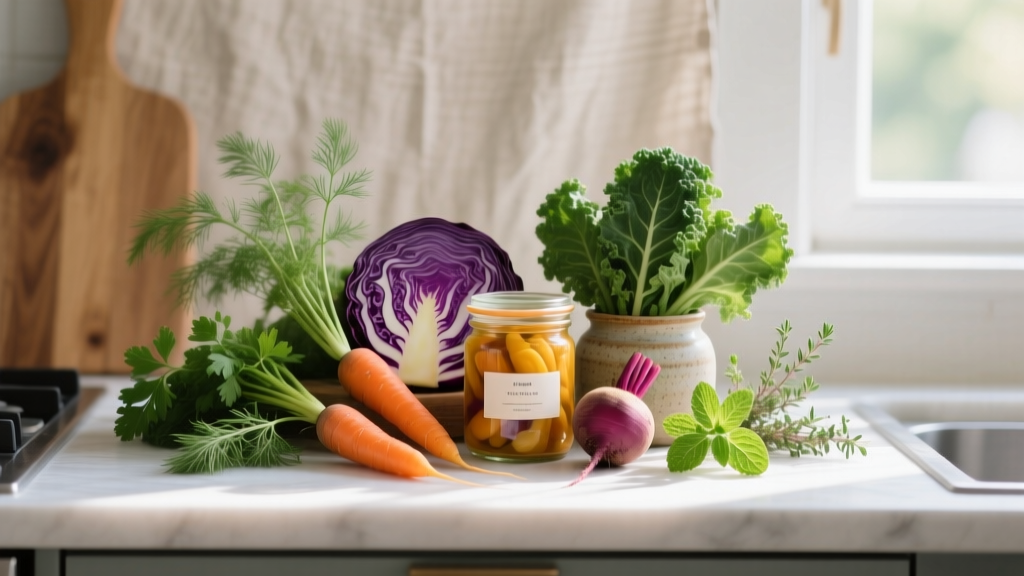
Kitchen Fermented Veggie Garden Herbs
The first time you start a jar of sauerkraut at home, you realize the “recipe” isn’t really the hard part—it’s the timing. You’ve got cabbage shredded and salted, but you’re missing the dill that makes it taste like your favorite deli. The garlic is sprouting in the pantry. The chili flakes are stale. And the one herb you really want—fresh bay—doesn’t live in your spice rack. The easiest fix isn’t a bigger grocery run. It’s a small, intentional herb garden designed around fermentation days, built so you can harvest a handful of clean, potent herbs in under two minutes.
This project lays out a “fermented veggie herb garden”: a compact planting plan that prioritizes herbs and aromatics used in kraut, pickles, kimchi-style ferments, curtido, and brined vegetables. Think dill umbrellas, garlic chives, mustard greens for kick, and a bay plant you can keep for years. I’ll walk you through layout strategies for three common living situations—small patio renters, suburban raised beds, and sunny windows/balconies—so you can match the design to your space instead of forcing your space to match a design.
Start With the Fermentation Workflow (Not the Plant List)
Good garden design starts with how you move. Fermentation herbs are harvested in bursts: you’ll take a lot of dill at once, snip chives weekly, and strip a bay leaf occasionally. Build around those rhythms and you’ll waste less, replant less, and cook more.
Design Principle 1: Put “Jar-Day Herbs” Closest to the Door
On the day you salt cabbage or pack pickles, you’ll want quick access. Place the high-volume, high-frequency herbs within 6–10 feet of your kitchen door if you can. That’s typically:
- Dill (fronds and flower heads)
- Chives/garlic chives
- Parsley (often added to brines and kraut blends)
- Hot peppers (for kimchi-style heat)
Design Principle 2: Grow “Clean Harvest” Herbs Where Soil Splash Won’t Hit
Fermentation favors clean, fresh produce. While you don’t need sterile herbs (in fact, fermentation relies on naturally occurring microbes), you do want to avoid gritty leaves and soil splatter. Put tender herbs in containers, raised beds, or along the edge with mulch. A 2-inch layer of straw or fine bark mulch reduces splash dramatically.
Design Principle 3: Succession-Sow Dill and Mustards
Dill bolts fast in heat. Mustard greens can go from perfect to spicy and tough in a week. The design solution is built-in replanting space: a “sowing strip” where you plant a small patch every 2–3 weeks during the best season. It’s less romantic than a cottage border, but it keeps your jars tasting consistent.
Layout Strategies That Fit Real Spaces
Below are three layout frameworks I use again and again. Choose one, then customize the plant list to match your sun and your fermenting style.
Layout A: The 4' x 8' Raised Bed “Pickle & Kraut Station”
If you have even a small backyard, a single 4-foot by 8-foot raised bed is an ideal fermentation hub. It’s reachable from both sides, easy to net, and it produces enough herbs to support weekly jars.
Sun target: 6–8 hours/day. Most fermentation herbs will still grow at 5 hours, but dill and peppers really perform with 6+.
Bed zoning:
- North edge (taller): dill, nasturtium trellis, or a compact pepper
- Center: parsley, cilantro (cool seasons), mustard greens
- South edge (low): thyme, chives, scallions
Spacing anchors (use these numbers): dill at 10–12 inches apart; parsley at 8–10 inches; peppers at 18 inches; chives clumps at 8 inches.
Layout B: The Renter-Friendly 3-Container “Balcony Brine Bar”
No yard? You can still grow fermentation herbs with three containers placed like a mini bar: one tall pot, one medium, one shallow trough. The secret is dedicating each pot to a job instead of mixing everything together.
- Container 1 (tall, 12–14" diameter): dill + parsley (cooler months) or dill alone in summer
- Container 2 (medium, 10–12" diameter): garlic chives + common chives (cut-and-come-again)
- Container 3 (trough, 24" long x ~8" deep): mustard greens + scallions in bands for succession sowing
Sun target: 4–6 hours/day. If you only have 3–4 hours, focus on chives, parsley, and mint (in a separate pot so it can’t take over).
Layout C: The “Windowsill + One Big Pot” Indoor/Outdoor Hybrid
If your light is limited, design a hybrid: keep a bay plant outdoors (or on a bright balcony) and run a windowsill nursery for fast herbs you can cut weekly.
Minimum workable light: a bright south- or west-facing window that delivers roughly 5+ hours of strong daylight. Supplemental grow lights can replace missing sun; a simple LED strip setup often costs $25–$60.
Keep these indoors:
- garlic chives
- parsley (slow, steady)
- cilantro (cool window, frequent sowing)
Keep this in one larger container outdoors:
- Bay laurel (Laurus nobilis) in a 14–18 inch pot; overwinter indoors in cold climates
Step-by-Step Setup: Build the Fermentation Herb Zone
This is the practical sequence I’d follow on a Saturday, with the least backtracking.
- Measure your harvest path. Stand at your kitchen door and pick a spot you can reach in under 30 seconds. If it’s a balcony, choose the corner with the longest sun window.
- Confirm sunlight. Track direct sun for one day. Aim for 6 hours if you want strong dill and peppers; accept 4 hours for chives/parsley.
- Choose your layout type. 4' x 8' bed, 3 containers, or hybrid. Commit to one so your plant choices stay focused.
- Prep soil for “leafy + aromatic” growth. In beds: mix in 2–3 inches of compost. In pots: use quality potting mix and add 10–20% compost for biology.
- Install irrigation you’ll actually use. A $12 hose-end timer is better than a $200 drip system you never finish. For containers, a simple watering can plus saucers works.
- Plant per the spacing anchors. Resist crowding—tight planting reduces airflow and increases aphids on dill and mustard.
- Mulch and label. Add 2 inches of mulch and label varieties. You’ll thank yourself when dill reseeds and you’re trying to remember what was where.
Plant Selection: Varieties That Earn Their Space
These are fermentation workhorses—varieties chosen for flavor, productivity, and how well they behave in small layouts.
Dill (Pickles, kraut, fermented carrots)
- ‘Bouquet’ dill: classic pickling dill with reliable flower heads; great for harvesting umbels for jars.
- ‘Fernleaf’ dill: compact (often ~18–24" tall), better for containers and windier balconies.
Design note: Plant dill in a dedicated strip so you can pull whole plants when they’re perfect. Succession sow every 2–3 weeks in spring/early summer.
Garlic chives and chives (Brines, kimchi-style ferments, garnish)
- Allium tuberosum (garlic chives): flat leaves, garlicky punch; perennial in many regions.
- Allium schoenoprasum (‘Staro’ chives): cold-hardy, tidy clumps, consistent regrowth.
Spacing: clumps at 8 inches. In pots, one clump per 10–12 inch container keeps it lush.
Parsley (Brines, kraut blends, bright finish)
- ‘Giant of Italy’: large flat leaves; productive for repeated cutting.
- ‘Darki’: compact and dense; great for containers with steady regrowth.
Parsley prefers consistent moisture; in hot zones, give it afternoon shade if possible.
Mustard greens (Heat, tang, kimchi-inspired ferments)
- ‘Red Giant’ mustard: bold color and spice; excellent shredded into ferments.
- ‘Mizuna’: feathery texture, quick growth, more forgiving in partial shade.
Spacing: thin to 6–8 inches for baby leaf; 10–12 inches for larger leaves.
Hot peppers (Fermented hot sauce, kimchi heat)
- ‘Jalapeño M’: dependable yields; great for pepper ferments.
- ‘Shishito’: lower heat, high productivity; ideal if you like mild ferments.
Spacing: 18 inches in beds; one plant per 12–14 inch pot.
Bay laurel (Pickle brine, fermented beans, long-term pantry flavor)
- Laurus nobilis (bay): one plant can supply years of leaves; container-friendly.
Pot size: start at 14 inches and move up as needed. Bay likes sun and dries down beautifully for winter use.
Comparison Table: Best Herbs for Fermented Veggies by Space and Habit
| Plant | Best Use in Ferments | Sun Needs | Spacing / Pot Size | Best For |
|---|---|---|---|---|
| Dill (‘Bouquet’, ‘Fernleaf’) | Pickles, kraut, carrots (fronds + umbels) | 6–8 hrs | 10–12" apart / 12–14" pot | Raised beds, sunny balconies |
| Garlic chives | Kimchi-style ferments, brines | 4–6 hrs | 8" clumps / 10–12" pot | Containers, low-maintenance corners |
| Parsley (‘Giant of Italy’) | Brines, fresh finish | 4–6+ hrs | 8–10" apart / 10–12" pot | Patios, edges of beds |
| Mustard (‘Red Giant’, mizuna) | Spice + crunch in mixed ferments | 4–6 hrs (cooler better) | 6–12" depending on harvest | Succession sowing in troughs |
| Bay laurel | Brines, beans, long storage | 6+ hrs | 14–18" pot | One “anchor” plant for years |
Real-World Scenarios: Three Spaces, Three Solutions
Scenario 1: The Renter With a Windy 6' x 10' Balcony
Wind is the silent herb killer—especially for tall dill. On a balcony, I’d place the tall dill pot in the most sheltered corner, backed by a wall or railing. Use ‘Fernleaf’ dill instead of taller types, and stake it early with a 24-inch bamboo stake.
Shopping list cost: three containers plus potting mix typically runs $45–$120 depending on whether you buy new pots or repurpose buckets. A DIY alternative is food-safe 5-gallon buckets (often $5–$8 each) with drainage holes drilled.
Fermentation payoff: weekly chive cuts, a steady trickle of mustard greens, and periodic dill harvests for jar days.
Scenario 2: The Homeowner With One 4' x 8' Bed and Hungry Deer
If deer browse your yard, fermentation herbs can disappear overnight. Design response: add a simple barrier. A basic 7–8 foot deer fence is ideal, but even a temporary solution helps—like a ring of stakes and netting over the dill and parsley during peak browsing.
I’d also “hide” flavor: deer often sample tender greens first, so put chives and thyme along the outer edge (less attractive), and keep parsley and mustards closer to the center under lightweight netting.
Budget tip: instead of building a full enclosure, try a $20–$35 roll of garden netting with a few sturdy stakes. It’s not permanent, but it protects your most vulnerable plants when they’re at their best.
Scenario 3: The Busy Cook With Only Morning Sun (About 4 Hours)
Four hours of sun is workable if you pick the right plants. Skip peppers and focus on chives, parsley, mint (in its own pot), and mizuna. For dill, try spring and fall crops instead of mid-summer, when low light and heat make it bolt.
Design tweak: paint containers a light color or use reflective surfaces near the plants to increase usable light. If you add a small grow light indoors, you can keep cilantro and parsley producing through shoulder seasons.
Design Details That Make the Garden Feel Intentional
Use a “Flavor Edge” for Neatness
A garden can be tiny and still look designed. Create a clean edge: a single row of chives or thyme along the front of a bed, or a line of matching pots on a balcony. It reads as intentional, even when the dill behind it is doing its floppy, wonderful thing.
Plan for the “Dill Gap”
Dill often fails in the hottest weeks. Rather than fighting it, design around it. Put a warm-season plant behind the dill strip—like a pepper—so when dill is pulled, your bed doesn’t look empty.
“Right plant, right place is the cornerstone of sustainable garden design—matching species to site conditions reduces inputs and increases success.” — Royal Horticultural Society (RHS), 2021
Food Safety Notes for Fermentation Gardeners
Fermentation is forgiving, but clean harvesting matters. The U.S. Department of Agriculture emphasizes using fresh, high-quality produce and clean equipment for safe fermented and pickled products (USDA, 2015). Harvest herbs in the morning, shake off insects, and rinse if needed—then dry well so you’re not diluting brines.
Also, salt accuracy matters. Many home ferments work best around 2% salt by weight (that’s 20 grams per 1,000 grams of shredded vegetables), which is why a small kitchen scale is one of the best “garden tools” you can own for this style of cooking.
Sources: USDA, 2015; Royal Horticultural Society (RHS), 2021.
Budget Planning and DIY Alternatives
Here are realistic budget tiers that still look good.
- Lean setup ($35–$70): repurposed buckets, basic potting mix, seed packets (dill, mustard, chives). Add a $10 bag of compost if possible.
- Midrange setup ($80–$160): matching containers, better potting mix, starter plants for chives and bay, plus a hose timer or watering can upgrade.
- Polished setup ($180–$350): raised bed kit, compost delivery, drip line, and a bay laurel in a larger pot as a design anchor.
DIY upgrades that actually help: make your own trellis from pruned branches (for nasturtiums or peas), reuse nursery pots inside decorative cachepots, and save jars from store-bought pickles for your next batch.
Maintenance Expectations: What It Takes to Keep It Productive
This garden is designed to be used, not fussed over. Still, you’ll get better flavor with small, regular attention.
- Weekly time: plan on 20–40 minutes total for containers (watering + harvesting) and 30–60 minutes for a 4' x 8' bed (weeding + thinning + harvest).
- Watering: containers may need water 3–5 times/week in hot weather; beds often need 1–2 deep waterings/week depending on rainfall and mulch.
- Succession sowing: sow dill and mustard every 2–3 weeks in their season for steady supply.
- Pruning: cut chives down to 2 inches when they get tough; they’ll regrow tender.
- Seasonal tasks: in fall, pot up bay and move it indoors before hard frost; in spring, refresh containers with 1–2 inches of compost and replant dill.
If you do nothing else, keep harvesting. Regular cutting is what turns herbs into a system rather than a one-time crop. A dill plant allowed to flower is useful for umbels, yes—but a whole patch allowed to flower at once means your next pickle day arrives with no fronds left. Stagger your harvest the way you stagger your sowing.
When this garden is working, it changes how you cook: a jar gets started because the herbs are right there, not because you planned an errand. You’ll step outside with a bowl, snip a handful of chives and parsley, pull a few mustard leaves, and grab one perfect dill head—then head back in to salt, pack, and wait for that first satisfying hiss when the ferment turns alive.