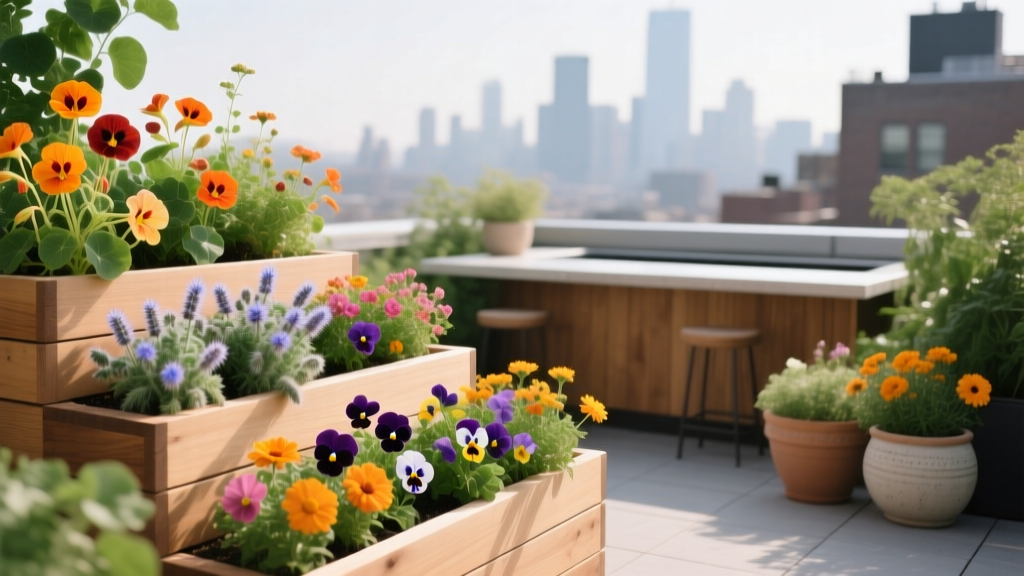
Terrace Edible Flower Bar Setup
The chairs are out, the lights are strung, and the terrace finally feels like a room—but every time you step outside with a drink, you’re staring at a bare corner, a couple of tired pots, and a railing that’s doing nothing for you. You want color. You want fragrance. You want something you can actually use. And you want it to work in the real world: wind, heat, curious pets, neighbors above who water whenever they feel like it, and a space that might be 6 feet wide on a good day.
That’s where an edible flower bar comes in: part micro-garden, part serving station, part sensory installation. Done well, it functions like a compact outdoor “kitchen” for garnishes—picking petals for salads, herbal ice cubes, cocktails, cakes, and tea—without sacrificing the comfort of the terrace itself.
Start with the “bar” first: a layout that serves you
Pick a footprint you can live with (and walk around)
The mistake I see most often is designing the planting first and then trying to wedge a usable surface into what’s left. Flip that. Choose the bar size based on how you actually move on the terrace.
A practical working size is 48 inches long x 18 inches deep for the surface. That’s wide enough for a tray, a cutting board, and a small bowl of harvested blooms—without dominating the terrace. If you can go a touch longer, 60 inches feels luxurious, but only if you still have a clear path.
Plan on at least 30 inches of walkway clearance in front of the bar. If your terrace is narrow, you can drop to 24 inches of clearance, but it will feel tighter when two people pass.
Sun, wind, and heat: three forces that decide everything
Most edible flowers want sun. Aim for 6+ hours of direct light for the best bloom production. If you only get 3–4 hours, you can still build a flower bar—just lean on shade-tolerant edibles like violas and certain herbs (more on that below).
Wind matters more on terraces than in-ground gardens. If your railing is open, assume gusts will dry containers quickly and snap taller stems. Use one of these wind-smart moves:
- Place the tallest pots closest to the wall (a built-in windbreak).
- Add a trellis panel (even a 2x4 ft screen) behind climbing nasturtiums or runner beans.
- Choose squat containers (12–16 inches tall) and avoid ultra-light plastic where you can.
Think in zones: display, production, and utility
I like to divide a terrace edible flower bar into three zones that repeat on any size space:
- Display zone: the blooms you see first—color, scent, pollinator action.
- Production zone: reliable, high-yield edible flowers you’ll harvest weekly.
- Utility zone: tools, watering can, snips, a small tub for harvest, and a place to set a glass down.
On a 48-inch bar, that can look like this: 18 inches for display (left), 18 inches for production (center), 12 inches for utility (right). The point is not symmetry—it’s habit. You’ll keep harvesting if the snips are always where your hand expects them.
Three terrace layouts that work (and what they’re good at)
Layout A: The railing run (best for narrow terraces)
If your terrace is long and skinny, run the flower bar parallel to the railing. Use railing planters for “eye-level blooms” and a narrow console table behind them for prep. Keep the table depth to 12–16 inches so you don’t steal the walkway.
Case example: A renter with a 3 ft x 12 ft terrace used a 55-inch folding console table and three railing planters. The table holds a cutting board and a small tub; the planters carry violas, thyme, and compact nasturtiums. Result: garnish harvest without rearranging furniture every time.
Layout B: The corner L (best for wind and privacy)
An L-shape tucks plants into shelter and creates a “room” feeling. Place the bar surface on one leg of the L, and the tallest containers on the back leg to break wind.
Case example: A homeowner with a 7 ft x 7 ft corner terrace used two benches: one 48 inches long for seating and one 36 inches long as the bar. Large containers (15–18 inch diameter) in the back corner anchor the space so it doesn’t feel temporary or flimsy in storms.
Layout C: The rolling cart bar (best for renters and micro-spaces)
No drilling, no heavy furniture—just a weatherproof cart with containers on the lower shelf and a work surface up top. You can roll it to chase sun, or pull it in during extreme heat.
Case example: A studio apartment terrace barely 4 ft x 6 ft used a 30-inch wide metal cart. The owner planted calendula and violas in a single rectangular trough and kept herbs in 6-inch pots on the lower shelf. Total watering time: under 10 minutes most days.
Step-by-step: build the terrace edible flower bar
- Measure your “use zone.” Mark out a rectangle on the terrace with painter’s tape: bar depth (target 18 inches) and walkway clearance (target 30 inches).
- Choose a surface height. A bar/prep surface at 36 inches tall is comfortable for most adults (similar to a kitchen counter). If you prefer standing cocktails, 40–42 inches feels more like a true bar.
- Select containers with purpose. Use at least one larger “anchor” container (16–20 inch diameter) for steady moisture and fewer drought crashes, plus smaller pots for rotation.
- Use a soil mix that won’t collapse. For most containers, blend potting mix with 20–30% compost for nutrition and structure. Avoid straight garden soil—it compacts in pots.
- Place plants by height and harvest frequency. Put frequent cutters (violas, calendula, borage) closest to your snips; put tall or trailing plants where they won’t snag sleeves.
- Add irrigation simplicity. If you’re busy, install a basic drip kit with a small timer. If not, dedicate one attractive watering can that lives under the bar so watering doesn’t become a scavenger hunt.
- Finish with a sanitation habit. Keep a small lidded container for harvested blooms and rinse them inside. Terrace dust is real; so are urban pollutants.
Plant selection: edible flowers that behave well in containers
Before we talk varieties, one non-negotiable: edible flowers must be grown without pesticides intended for ornamentals. The UC Master Gardeners note that flowers intended for eating should be grown without chemical pesticides and only consumed if correctly identified (University of California Agriculture and Natural Resources, 2020).
Also, if anyone using the terrace has allergies or is pregnant, be conservative with new edible flowers. Introduce one at a time—treat them like any new food.
High-yield, forgiving choices (my “production zone” staples)
- Nasturtium (Tropaeolum majus) – Peppery flavor, fast growth, thrives in containers, and trails beautifully over edges. Try ‘Empress of India’ (deep leaves, rich blooms) or ‘Alaska’ (variegated foliage that looks designed even between blooms). Space about 10–12 inches apart in larger troughs.
- Calendula (Calendula officinalis) – Reliable, long blooming, petals hold color in salads and rice. Try ‘Pacific Beauty’ (big, bold) or ‘Resina’ (often grown for resin content; aromatic). Space 8–10 inches apart.
- Borage (Borago officinalis) – Blue star flowers that taste faintly like cucumber; excellent for ice cubes. One plant can fill a pot; give it a container at least 12 inches wide. It can flop—support with a small ring or tuck against a wall.
- Viola / Johnny-jump-up (Viola cornuta, V. tricolor) – Cool-season champion; great for partial sun terraces. Try ‘Penny Mix’ or ‘Sorbet’ series. Space 6–8 inches apart for a dense “living garnish tray.”
Fragrance-forward choices (your “display zone” heroes)
- Lavender (Lavandula angustifolia) – Use sparingly in food, but it’s unbeatable for scent. Try ‘Hidcote’ (compact) in a 12–14 inch pot with gritty drainage.
- Rose (Rosa) – Petals can be candied or infused, and the plant adds structure. Choose a compact patio rose like ‘Sweet Drift’ or ‘Ketchup & Mustard’ in a 18–20 inch container. Only eat petals from plants not sprayed with ornamental chemicals.
- Pineapple sage (Salvia elegans) – Red edible blooms and aromatic leaves; great in teas. Needs sun and warmth; pinch to keep bushy.
Heat-tough options for brutal terraces
If your terrace reflects heat (light concrete, glass railings), choose plants that won’t sulk when temperatures spike:
- Marigold (Tagetes tenuifolia) – The signet types are better for eating than big bedding marigolds. Try ‘Lemon Gem’ or ‘Tangerine Gem’. They’re floriferous and compact.
- Chive blossoms (Allium schoenoprasum) – Oniony purple pom-poms; tough and perennial in many climates. A 6–8 inch pot is enough for a small bar setup.
“Edible flowers should be fresh, clean, and correctly identified; avoid flowers from florists, garden centers, or roadsides because they may have been treated with pesticides not labeled for food use.” — Colorado State University Extension, 2022
That CSU Extension guidance is exactly how I think about terrace flower bars: you’re designing beauty, but you’re also designing a safe food-adjacent workspace (Colorado State University Extension, 2022).
A comparison table: pick plants based on your terrace conditions
| Edible flower | Sun needs | Container size | Spacing | Best use at the bar |
|---|---|---|---|---|
| Nasturtium ‘Empress of India’ | 6+ hours | 10–12 in pot (or trough) | 10–12 in | Salads, savory garnishes, trailing edge |
| Calendula ‘Pacific Beauty’ | 6+ hours | 8–10 in pot | 8–10 in | Petals for rice, baked goods, color |
| Viola ‘Sorbet’ | 3–6 hours | 6–8 in pot | 6–8 in | Desserts, drinks, quick snips |
| Borage | 6+ hours | 12–14 in pot | 1 plant/pot | Ice cubes, cucumber note, pollinators |
| Chive blossoms | 4–6 hours | 6–8 in pot | Clump | Savory finishing, perennial backbone |
Budgeting the flower bar: realistic costs and smart swaps
You can build this to match your life. Below is a practical mid-range budget, plus DIY alternatives.
- Bar surface: $80–$250 (folding console, narrow outdoor table, or potting bench). DIY: use two stacked concrete blocks and a 60-inch cedar fence board top (~$25–$45 in lumber depending on region).
- Containers: $12–$40 each. A stable setup often uses 6–10 pots. DIY: food-safe 5-gallon buckets (drill drainage holes) with a simple wrap or painted exterior.
- Soil and compost: $20–$60 total for a starter set. Expect a 2 cu ft bag of potting mix to fill roughly two medium pots, depending on size.
- Seeds/starts: $3–$6 per seed packet, or $5–$12 per plant start. For fast gratification, buy 4 starts (calendula, viola, borage, nasturtium) and seed the rest.
- Snips + harvest bowl: $12–$30. DIY: repurpose small kitchen shears, but keep them dedicated to the terrace for hygiene.
If you want one concrete target: a tidy, fully functioning terrace edible flower bar can be done around $150–$300 with DIY containers and seeds, and around $400–$700 with premium pots, a drip timer, and mature plants.
Three real-world setups (and what I’d plant in each)
Scenario 1: South-facing, windy, 6+ sun hours (the “bright roof terrace”)
This is the dream—and also the hardest on containers. Use heavier pots and drought-tolerant edibles. I’d anchor with a patio rose in an 18-inch pot and surround it with nasturtiums trailing downwind. Add signet marigolds and chive blossoms for heat resilience.
Design move: mulch container tops with a 1-inch layer of fine bark or straw to slow evaporation, and group pots tightly so they shade each other’s soil.
Scenario 2: East-facing, 3–4 sun hours (the “morning coffee terrace”)
Lean into violas, chive blossoms, and leafy herbs that flower (thyme, oregano). Add calendula if you can give it the sunniest spot. Your bar will feel softer, more “garden room” than “sun deck,” and that’s a win.
Design move: use lighter-colored pots to brighten the shady feel, and position blooms at eye level with railing planters so the garden reads lush even if growth is slower.
Scenario 3: Renter setup with strict rules (no drilling, no permanent changes)
Use a rolling cart and a mix of 6–8 inch pots you can carry to a sink. Focus on quick success: violas, calendula, nasturtium (in a compact variety), and pineapple sage if you have warmth.
Design move: one rectangular trough on the top shelf becomes your “garnish tray,” planted tightly with violas at 6-inch spacing for a dense, harvestable mat.
Maintenance expectations: keep it lush without turning it into a chore
For most terrace flower bars, plan on 30–60 minutes per week of hands-on care once established, plus quick watering checks. In hot weather, watering can be a 5-minute daily habit—especially for smaller pots.
Weekly rhythm (the difference between thriving and struggling)
- Deadhead and harvest: 10–15 minutes. Picking blooms is not just for eating—it triggers more flowering in calendula and nasturtium.
- Watering check: 5 minutes, 3–7 times a week depending on heat and pot size. Water deeply until it runs out the drainage holes.
- Quick pest scan: 5 minutes. Aphids love tender flower growth; blast them off with water early rather than reaching for sprays.
- Light feed: every 2–4 weeks during heavy bloom. A gentle organic liquid fertilizer at label rates keeps containers productive.
Seasonal tasks that keep the bar looking designed
- Spring: refresh the top 2 inches of potting mix with compost; re-seed calendula and nasturtiums if you want waves of bloom.
- Summer: add shade cloth on extreme heat days if blooms scorch; prune back leggy plants by 1/3 to push fresh growth.
- Fall: switch to cool-season violas; let a few herbs flower for late pollinators.
- Winter (mild climates): keep violas going; in cold climates, store pots against a wall and reduce watering drastically.
Small design details that make it feel like a “bar” (not just pots)
Think like a host. The most successful edible flower bars include a few deliberate human touches:
- A washable serving tray that lives on the surface (so you can clear the bar fast).
- One vertical element (a trellis, obelisk, or slim screen) to give the eye a place to land.
- A dedicated harvest vessel—a small stainless bowl or lidded container—so flowers aren’t carried inside in a handful.
- Lighting at hand level (warm string lights or a small rechargeable lamp) so evening harvesting is easy and safe.
If you want this to look polished year-round, keep a “rotation pot” or two—containers where you swap in whatever is peaking: violas in cool months, marigolds in heat, a small flowering herb when it’s in bloom. That rotation is what makes the setup look intentional instead of accidental.
Once your bar is planted, give it one evening to settle in. Water everything deeply, wipe down the surface, and snip just a few blooms—enough to float in a glass or scatter over dinner. That first harvest changes the way you see the terrace. It stops being an outdoor storage zone and starts being a living part of how you eat, host, and unwind—one petal at a time.
Sources: University of California Agriculture and Natural Resources (UC ANR), “Edible Flowers” guidance (2020); Colorado State University Extension, edible flowers food-safety guidance (2022).