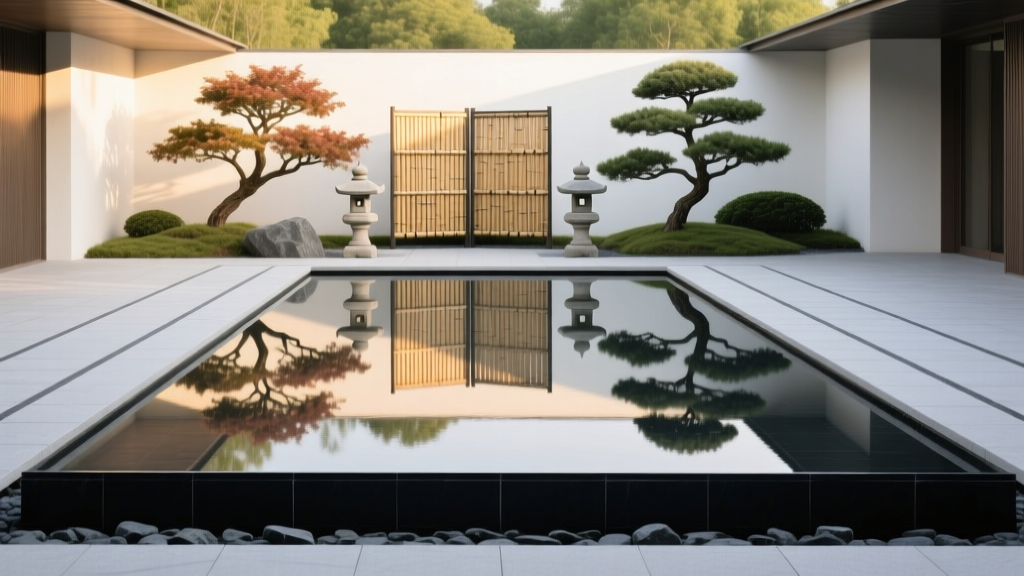
Courtyard Reflection Pool Garden Design
You step outside with a cup of coffee, hoping for a quiet five minutes—and the courtyard gives you… glare off the paving, a view of the trash bins, and a wind tunnel that somehow finds your chair every time. The space is technically “outdoor,” but it doesn’t feel like a garden. This is exactly where a reflection pool earns its keep: it calms the visual noise, bounces light into darker corners, and gives the courtyard a center of gravity so the whole space finally makes sense.
I’m going to walk you through a courtyard reflection pool layout the way I’d design it for a client: starting with proportion and circulation, then placing water and hardscape, and finishing with plants that behave in containers and tight beds. Along the way you’ll see three real-world scenarios—rental-friendly, narrow townhouse, and a sunnier modern courtyard—so you can adapt the plan to your own constraints.
Start with the courtyard’s “quiet geometry”
Reflection pools work best when the layout feels intentional and still. In a courtyard, that usually means you’re designing with rectangles, strong lines, and a restrained plant palette. A pool doesn’t need to be large, but it does need to be visually uninterrupted: fewer competing materials, fewer fussy shapes.
Measure first: three dimensions that decide everything
Before you buy anything, take ten minutes with a tape measure and write down:
- Overall courtyard width and length (e.g., 12 ft × 18 ft).
- Door swing and walking path: keep a clear route of at least 36 inches wide from door to seating or gate.
- Sun hours in summer: reflection pools look best with 4–6 hours of direct sun, but you can design for shade if you manage algae and plant choices.
As a rule of thumb, I like the pool to occupy 8–15% of the courtyard footprint. In a 12 ft × 18 ft courtyard (216 sq ft), that’s a pool surface area of roughly 17–32 sq ft. A clean, buildable size is 3 ft × 8 ft (24 sq ft), which reads elegant without stealing circulation.
Set the pool where it can “borrow” the best view
A reflection pool is a visual amplifier. Place it where it reflects something you want more of: a small tree canopy, a sky slice, a sculptural pot, or even a lit wall at night. In cramped courtyards, putting the pool parallel to the longest wall usually makes the space feel longer and calmer.
Keep the pool at least 18 inches from walls for maintenance access, and 24 inches if you plan to plant behind it. If the courtyard is extremely tight, you can go closer to the wall on one long side, but keep one accessible side comfortable.
Layout strategies that make a small courtyard feel intentional
Use one “spine” and two “soft edges”
Think of the pool as the spine. Then give it two edges:
- A hard edge for walking: large-format pavers or gravel strip, 36–42 inches wide.
- A planted edge for softness: containers or a narrow bed, 18–30 inches wide.
This is how you avoid the common courtyard problem where everything is pushed to the perimeter and the center feels empty—or worse, cluttered with random pots.
Keep water depth shallow (and safer)
For a true reflection effect, you don’t need depth—you need stillness. A practical depth for a courtyard reflection pool is 10–14 inches. Shallow water warms faster, which can increase algae, but you can manage that with shade, circulation, and plant cover (more on that below).
If children or pets use the space, shallow design matters. Consider a submerged safety shelf at 6 inches deep along one side, hidden under dark stone, so the pool reads sleek but offers a margin of safety.
Choose materials that don’t fight the water
Reflection pools look best with dark interiors. A black EPDM liner, dark mosaic, or charcoal plaster deepens the reflection and hides minor debris. For coping (the edge), I like honed stone or a smooth porcelain coping with a softened edge—comfortable for sitting and less likely to chip.
“Water is best experienced as a horizontal plane—calm, reflective, and legible—especially in confined spaces where visual order is essential.” — James Corner, landscape architect, The Landscape Imagination (2014)
That idea—water as a “legible plane”—is your north star. Avoid busy pebble interiors or high-contrast tiles that break the reflection.
Three courtyard scenarios (and how the same design adapts)
Scenario 1: The rental courtyard (no digging, low risk)
Space: 8 ft × 12 ft patio with walls on three sides, part sun (3–4 hours).
Design move: Use a raised, self-contained reflection trough instead of an in-ground pool. A fiberglass or stock-tank style basin, clad with wood slats or composite panels, gives the same calm surface with zero excavation. Aim for 18–24 inches height so it reads as furniture and doubles as an edge to lean on.
Typical cost: A preformed basin plus a small pump and filter often lands around $300–$900, depending on finish level and size.
Scenario 2: A narrow townhouse courtyard (make it feel wider)
Space: 10 ft × 25 ft, bright at the far end, shaded near the door.
Design move: Place a 2.5 ft × 10 ft pool along one long wall, with a 42-inch path opposite it. Use a single, light-toned paving material on the path to bounce light, and plant the pool-side with darker foliage to “pull” the wall back visually.
Key trick: Put a simple focal element at the far end—one multi-stem tree or a tall pot—so the pool reflects it and draws the eye through the length of the space.
Scenario 3: A modern sun courtyard (lean into reflection and shadow)
Space: 14 ft × 16 ft, full sun (6–8 hours), heat from walls and paving.
Design move: Use a centered 4 ft × 8 ft pool with a thin coping and two symmetrical planting bands. Add a discreet recirculation system so the water stays clear without a fountain (fountains break reflection). Integrate a bench on the shadier side to extend sitting time.
Heat management: Add a pergola slat screen or a single small tree to cast moving shadow; this reduces algae pressure and makes the space feel lived-in rather than glaring.
Step-by-step setup: a practical build sequence
This sequence assumes a small in-ground courtyard pool (the most classic look). If you’re renting, follow the same steps but skip excavation and build a raised basin on a level base.
- Mark the footprint with painter’s tape or string. Confirm you still have a 36-inch clear path and that doors open freely.
- Call utility locating services before digging. Even courtyards can hide gas or electrical lines.
- Excavate to pool depth plus base layers: for a 12-inch water depth, excavate about 18–20 inches to allow for base sand, underlayment, and liner folds.
- Build a level base: compacted gravel (about 4 inches) plus a sand bed (about 2 inches). Take time here—reflection water shows every out-of-level edge.
- Add underlayment and liner (EPDM is common). Fold corners neatly; avoid stretching tight.
- Install a small pump sized for gentle turnover. In tight pools, a pump around 200–400 GPH often works, but choose based on your pool volume and filter style.
- Set coping on mortar or a stable adhesive system. Keep a slight inward tilt so splashes return to the pool.
- Fill and test for 48 hours. Check level, leaks, and pump function before finishing paving edges.
- Finish the surrounding surfaces: pavers, gravel bands, and planting zones. Keep soil and mulch from washing into the pool.
- Plant last, and water plants thoroughly so you’re not rinsing soil into the waterline later.
Plant selection: varieties that behave near still water
A courtyard reflection pool garden is mostly about disciplined planting. You want leaves that read well in reflection, plants that don’t constantly shed, and forms that look good from above (because courtyards are often viewed from windows).
Go-to plants for the pool edge (low litter, strong shape)
- Japanese forest grass (Hakonechloa macra ‘Aureola’): soft movement without messy leaf drop; great in part shade. Space clumps 18–24 inches apart.
- Dwarf mondo grass (Ophiopogon japonicus ‘Nana’): dense, clean edging that doesn’t flop into water. Space 6–8 inches apart for a tight line.
- Boxwood alternatives for modern courtyards: Ilex crenata ‘Soft Touch’ (soft, rounded evergreen) or Hebe ‘Green Globe’ (mild climates). Space 24–30 inches apart.
- Evergreen fern (Polystichum setiferum): excellent in shade; fronds reflect beautifully and soften walls. Space 24 inches apart.
Signature courtyard trees (choose one, place it with intent)
A single small tree can do more than ten random pots. Keep it scaled: mature height around 8–15 ft is usually right for courtyards.
- Amelanchier (Amelanchier lamarckii): airy canopy, spring bloom, good autumn color; light leaf drop compared to many trees. Plant 3–5 ft from the pool edge.
- Japanese maple (Acer palmatum ‘Sango-kaku’ or ‘Bloodgood’): exquisite reflection value; choose cultivar based on sun exposure (many prefer morning sun/afternoon shade). Keep 4–6 ft from the pool to reduce leaf litter in fall.
- Olive (Olea europaea ‘Arbequina’): strong Mediterranean look in sun courtyards; very drought tolerant once established. Note: can drop small leaves and flowers—place it so the pool doesn’t sit directly under the canopy.
Water and marginal plants (kept minimal for a true reflection surface)
If your goal is mirror-still water, keep aquatic planting restrained. A single pot of a well-behaved aquatic can be enough to stabilize water quality without turning the pool into a pond garden.
- Dwarf papyrus (Cyperus haspan): architectural, controlled, good in containers; place in a submerged pot on a hidden shelf.
- Water lily (Nymphaea ‘Pygmaea Helvola’): small pads and flowers; use one variety only. In very small pools, lilies can cover too much surface—aim for 25–40% coverage, not more.
- Sweet flag (Acorus gramineus ‘Ogon’): grassy, bright, and tidy; excellent for part shade margins.
For renters using a raised basin, marginal plants in pots are your best friend: they soften edges and help with nutrient uptake without committing to permanent aquatic infrastructure.
A quick comparison: three pool approaches for courtyards
| Option | Typical footprint | Best for | Approx. cost range (USD) | Notes |
|---|---|---|---|---|
| Raised basin (fiberglass/stock tank) | 2 ft × 4 ft to 3 ft × 6 ft | Renters, no-dig spaces | $300–$900 | Fast install; easier to remove; can be clad for a built-in look |
| In-ground liner pool (EPDM) | 3 ft × 8 ft to 4 ft × 10 ft | Most homeowners | $1,200–$4,500 | Classic reflection look; needs careful leveling and edging |
| Concrete/plaster reflection pool | Custom (often 4 ft × 8 ft+) | High-finish modern courtyards | $6,000–$15,000+ | Most durable and precise; higher labor and permitting likelihood |
Budget planning and DIY alternatives (without cutting the wrong corners)
Courtyard projects can swing wildly in cost because access is hard—sometimes everything has to come through a narrow hallway. Plan for materials that can be carried in smaller loads (bagged gravel, modular pavers, liner systems).
Here are practical places to save money without sacrificing the final feel:
- Use a liner system instead of poured concrete. A quality EPDM liner, properly installed, lasts well and is repairable.
- Choose one great coping material, then keep surrounding paving simpler (gravel bands or standard concrete pavers).
- Limit plant varieties to 5–7 key plants repeated. Repetition looks designed and is cheaper than collecting specimens.
- Skip the fountain if reflection is the point. A small circulation pump and filter does the functional work without visual noise.
As a ballpark, a DIY-friendly courtyard build with a 3 ft × 8 ft liner pool, basic coping, and a modest plant scheme often lands around $1,500–$3,500 in materials—less if you already have pavers or can reuse stone, more if access requires specialty hauling.
Sun, water quality, and the algae conversation (practical, not precious)
Still water plus sun equals algae if nutrients build up. The goal is to keep the water clear enough for reflection most days, without turning your courtyard into a chemistry lab.
The U.S. Environmental Protection Agency notes that excess nutrients (nitrogen and phosphorus) fuel algae growth in water bodies (EPA, 2023). In a small courtyard pool, those nutrients usually come from windblown soil, decaying leaves, and overfeeding fish (if you add them—often unnecessary for reflection pools).
And if you’re thinking of including lilies or other aquatics, the Royal Horticultural Society recommends planting aquatics in baskets with aquatic compost and topping with gravel to reduce clouding and nutrient release (RHS, 2022). That small detail makes a big difference in tiny water volumes.
My practical approach:
- Keep debris out: a quick skim takes 2 minutes and prevents the nutrient cycle.
- Use a simple filter sized for your pool volume.
- Shade part of the surface (tree canopy, screen, or limited lily pads) if you get 6–8 hours of sun.
Maintenance expectations (so the calm stays calm)
A reflection pool garden should feel like a relief, not a chore. Plan on 20–45 minutes per week in growing season for a small courtyard pool—less in winter if you’re not dealing with heavy leaf drop.
Weekly rhythm (growing season)
- Skim debris: 2–5 minutes.
- Check water level: top up during heat; evaporation is normal in sun courtyards.
- Wipe the waterline (if needed): 5 minutes.
- Quick plant tidy: remove yellowing leaves before they fall in.
Seasonal tasks
- Spring: rinse filter media, divide grasses like Hakonechloa if crowded, refresh mulch in beds.
- Summer: watch algae—reduce nutrients (less fertilizer near pool), add partial shade if water is consistently green.
- Autumn: net the pool if you have a deciduous tree; remove fallen leaves promptly.
- Winter: in cold climates, protect the pump per manufacturer instructions; keep a small opening if freezing is an issue (local guidance varies).
Small design details that make it feel expensive (even when it isn’t)
Lighting: One warm-white uplight aimed at the feature tree, plus a low strip or two along the path edge, gives you night reflection without glare. Keep the fixtures minimal; let the water do the show.
Sound control: If noise is a problem (neighbors, street), consider a separate micro-fountain tucked in a side pot away from the reflection pool. That way you can choose stillness visually and sound masking acoustically—without breaking the mirror surface.
Seating placement: Put seating so you look across the long axis of the pool, not at its short end. In a 3 ft × 8 ft pool, a bench placed parallel to the 8 ft side feels composed and gives the best reflection view.
Make the space feel like it “belongs” to the house
The last step is the one most courtyard gardens skip: tying the palette back to the building. Pull one color from your architecture—brick warmth, black window frames, pale stucco—and repeat it once in the hardscape and once in the pots. Keep it disciplined. A courtyard reflection pool doesn’t need many ingredients; it needs the right ones placed with confidence.
If you’re standing in your courtyard right now, imagine this: the door opens, your path stays clear, the water sits like a quiet sheet of glass, and a single tree’s silhouette is doubled in the pool. The bins are screened by a clipped evergreen, the plants don’t sprawl into the walkway, and you’re not rearranging pots every weekend. That’s the moment the courtyard stops being leftover space and starts acting like a garden.
Sources: U.S. Environmental Protection Agency (EPA), “Nutrient Pollution” (2023); Royal Horticultural Society (RHS), aquatic planting guidance for ponds and water plants (2022); James Corner, The Landscape Imagination (2014).