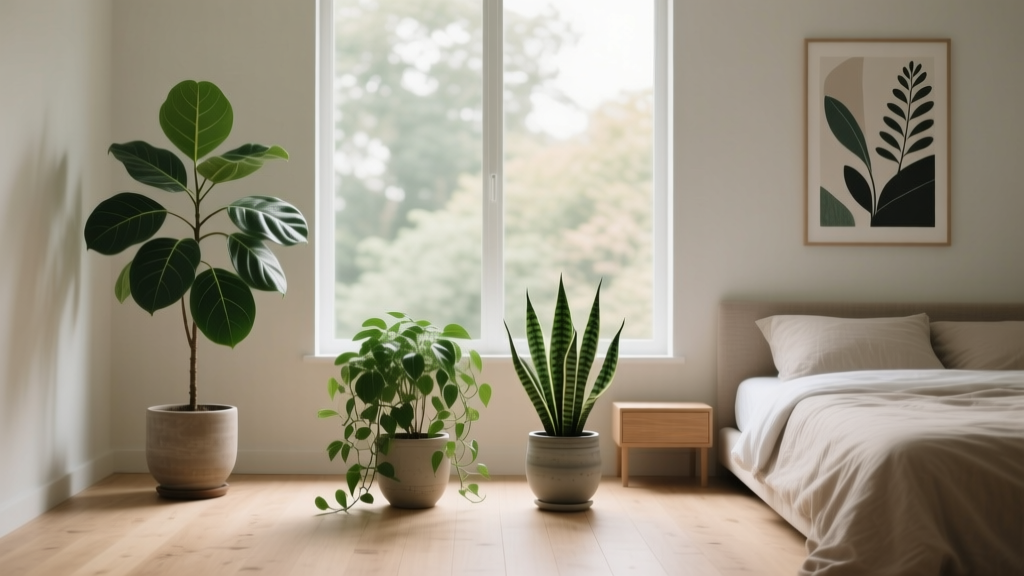
Bedroom Air-Purifying Plant Guide
It’s 11:47 p.m. The room is quiet, but it doesn’t feel fresh. The air seems a little heavy—like yesterday’s laundry, a candle you forgot you lit, and the faint “new furniture” smell all decided to camp out near your pillow. You crack the window, but traffic noise rolls in. You want cleaner air, better sleep vibes, and a calmer-looking bedroom—without turning your nightstand into a jungle or buying a complicated gadget.
This is where a small, intentional planting plan shines. Not “more plants.” Better-placed plants. Chosen for the way you actually live: how much light you get, how often you water, whether you have pets, and what surfaces you can realistically use. Think of it like designing a tiny indoor landscape—with air quality, circulation, and visual calm as the brief.
Start Like a Designer: Read the Room Before You Buy a Plant
Before plant shopping, walk your bedroom like a site visit. Your goal is to identify light zones, safe circulation paths, and the best “plant parking spots” that won’t get knocked over at 2 a.m.
Measure three things (it takes 5 minutes)
- Window light width: Measure the distance along the window where a plant could sit or stand. Even 24 inches of usable sill/ledge space is enough for a strong layout.
- Depth available near the window: You need about 10–14 inches of depth for a stable floor pot that won’t feel like it’s in your walkway.
- Clearance around the bed: Maintain at least 24 inches of walking clearance. Plants should never “steal” circulation—sleep spaces need easy movement.
Light reality check: count your sunlight hours
Most bedrooms aren’t conservatories. Typical light categories:
- Low light: 2–4 hours of indirect light, or bright shade all day.
- Medium light: 4–6 hours of bright indirect light.
- High light: 6+ hours of strong sun or very bright exposure.
Be honest here—choosing a “bright light” plant for a low-light room is the #1 reason bedrooms end up with sad sticks in pots.
Layout Strategies That Keep the Bedroom Calm (Not Cluttered)
Designing with plants in a bedroom is more like styling lighting: fewer fixtures, placed correctly, beats a crowded ceiling. Aim for 3–7 plants total depending on room size and surfaces.
Use the “Sleep Zone / Plant Zone” rule
Keep your immediate sleep zone visually quiet. That means: avoid thorny silhouettes, messy trailing vines right above your pillow, and anything that drops debris onto bedding. Put the “lush energy” in the plant zone—usually near the window, dresser, or a corner away from the headboard.
Build a simple 3-layer height composition
This is a classic landscape move: ground layer, mid layer, canopy layer—just scaled down.
- Ground layer: One floor plant in a 10–12 inch pot (or a plant stand).
- Mid layer: Two tabletop plants in 4–6 inch pots (dresser/nightstand).
- Upper layer: One hanging plant or shelf plant to draw the eye up—only if you have stable anchoring.
Spacing that prevents “fungus gnat season”
Plants need airflow indoors. Leave 6–12 inches between pots so leaves aren’t pressed together. If a corner feels stagnant, add a small oscillating fan on low for 15 minutes a day or a few times a week—simple, effective, and often cheaper than replacing plants.
Match containers to your life (and your landlord)
For renters, prioritize no-drill solutions: tension rods for hanging, freestanding plant stands, and adhesive hooks rated for weight. A typical 8-inch pot with moist soil can weigh 8–12 lb, so always check hook ratings and use lightweight plastic liners inside decorative pots.
Plant Picks That Actually Work in Bedrooms (with Specific Varieties)
Two different “air-purifying” conversations exist: (1) NASA-era studies about VOC removal, and (2) real-world ventilation rates in homes. Plants can help with certain pollutants under test conditions, but they don’t replace outdoor air exchange. Use them as part of a comfort-and-care package: greenery, humidity balance, and a cleaner-feeling room.
“When it comes to improving indoor air, ventilation is typically far more effective than plants.” — Cummings & Waring, review on indoor air and plants (2019)
That said, the right bedroom plants are still worth it—especially if you choose species that tolerate indoor conditions, don’t shed constantly, and look good with minimal fuss.
Reliable low-light performers
1) Snake Plant (Dracaena trifasciata)
Varieties to look for: ‘Laurentii’ (yellow edge), ‘Moonshine’ (silvery), ‘Hahnii’ (compact).
Why it works: Handles low light, irregular watering, and stays architecturally tidy—perfect for a bedroom corner. Often cited in indoor air discussions, including NASA’s interior plants study (Wolverton et al., 1989).
Placement: Floor pot near window wall; tolerates 2–4 hours indirect light.
Spacing: Allow 12 inches from walls so leaves don’t bend.
2) ZZ Plant (Zamioculcas zamiifolia)
Varieties: Standard green, ‘Raven’ (dark foliage).
Why it works: One of the best “I forgot to water” plants. Glossy leaves wipe clean easily (dust control matters for bedroom air feel).
Placement: Dresser end or low-light corner with 2–4 hours indirect light.
Note: Toxic if chewed—keep away from pets.
3) Cast Iron Plant (Aspidistra elatior)
Varieties: ‘Milky Way’ (speckled), standard green.
Why it works: Slow-growing, resilient, and visually calm—ideal for people who don’t want daily plant drama.
Placement: Medium to low light; keep out of harsh direct sun.
Medium-light “bedroom statement” plants
4) Peace Lily (Spathiphyllum ‘Sensation’ or ‘Domino’)
Why it works: Strong leaf mass, thrives in consistent indoor temps, and communicates clearly when thirsty (gentle droop). Included in NASA’s VOC-focused testing (Wolverton et al., 1989).
Placement: Bright indirect, about 4–6 hours equivalent light. Avoid direct sun scorch.
Spacing: Give it 10–12 inches of elbow room for airflow.
Caution: Toxic to pets; also can drop pollen—skip if you’re very allergy-sensitive.
5) Pothos (Epipremnum aureum ‘Marble Queen’ or ‘Golden’)
Why it works: Easy trailing plant for shelves; forgiving; fast aesthetic payoff. Great for softening hard furniture lines.
Placement: Bright indirect; tolerates lower light but grows slower.
Design tip: Use one vine to “underline” a mirror or picture ledge, but keep it away from bedside lamps (crispy leaves happen).
6) Rubber Plant (Ficus elastica ‘Burgundy’ or ‘Tineke’)
Why it works: Broad leaves are excellent dust catchers (wipe weekly). Tall form is ideal to balance a bed visually—like a living floor lamp.
Placement: 6+ hours bright indirect or a few hours of gentle sun; rotate monthly for even growth.
Size plan: Start in a 10-inch pot for stability.
Higher-light options if you have a sunny bedroom
7) Areca Palm (Dypsis lutescens)
Why it works: Soft, feathery texture; great for creating a “green screen” effect near a window without heaviness.
Placement: Bright indirect; can take morning sun. Needs more consistent watering than snake/ZZ.
Spacing: Keep fronds 18 inches from walls to prevent bending and pest issues.
8) Spider Plant (Chlorophytum comosum ‘Vittatum’)
Why it works: Classic, quick growth, and easy propagation for DIY plant expansion. Also frequently mentioned in indoor air discussions (Wolverton et al., 1989).
Placement: Bright indirect; tolerates some sun.
Design use: Hang it to keep it away from pets that like to chew.
Quick Comparison: Best Bedroom Picks by Light, Cost, and Care
| Plant | Light Needed | Watering Rhythm | Typical Size to Buy | Typical Cost (US) | Best Layout Role |
|---|---|---|---|---|---|
| Snake Plant (Dracaena trifasciata) | Low–Medium (2–6 hrs indirect) | Every 2–4 weeks | 8–10" pot | $20–$45 | Floor anchor / corner |
| ZZ Plant (Zamioculcas) | Low–Medium | Every 3–5 weeks | 6–10" pot | $25–$60 | Dresser or low-light corner |
| Peace Lily (Spathiphyllum) | Medium (4–6 hrs indirect) | Weekly-ish | 6–8" pot | $18–$40 | Mid-layer mass near window |
| Pothos (Epipremnum ‘Marble Queen’) | Low–Medium | Every 7–14 days | 4–6" pot | $12–$25 | Shelf/hanging softener |
| Rubber Plant (Ficus elastica) | Medium–Bright | Every 10–14 days | 10" pot | $35–$90 | Vertical statement |
Three Real-World Bedroom Layout Scenarios (with Dimensions and Plant Counts)
Below are practical “design packages” I use when a space needs to feel better fast—without turning care into a second job.
Scenario 1: Small rental bedroom with one window (10 ft x 12 ft)
Constraints: Narrow pathways, limited surfaces, no drilling, light is bright near the window but fades fast.
Goal: Fresh feel, minimal floor clutter, easy move-out.
Layout plan (5 plants):
- 1 floor anchor: Snake plant in a 10-inch pot, placed 18 inches from the window corner to avoid curtain rub.
- 2 mid-layer plants: ZZ plant + peace lily on a dresser, pots 6 inches apart.
- 1 hanging/shelf plant: Pothos on a high bookshelf with vines trained sideways (not dangling into your face).
- 1 micro plant: A 4-inch spider plant or peperomia on the far nightstand for symmetry.
Budget: Expect about $90–$180 total if you buy plants in 6–10 inch nursery pots and reuse thrifted cachepots. A basic 12-inch plant stand often runs $25–$45, but a sturdy upside-down crate can substitute.
Scenario 2: Low-light bedroom with north-facing window (12 ft x 14 ft)
Constraints: The room looks bright but the light intensity is low; many plants will stall.
Goal: Green presence without constant replacement.
Layout plan (4 plants):
- 1 cast iron plant as the main floor piece, set 12 inches off the wall for airflow.
- 1 ZZ plant ‘Raven’ on a low dresser (dark foliage reads sophisticated in low light).
- 2 snake plants ‘Hahnii’ (compact) on matching trays—one on the dresser, one on a bookcase to repeat shape.
Designer trick: Add a small LED grow bulb in a lamp you already own (look for 9–12W LED grow bulbs). Run it 8–10 hours daily on a timer. This doesn’t need to look like a greenhouse—just treat it like a task light for plants.
Budget: Plants $70–$160, timer $10–$18, grow bulb $15–$30. Still usually cheaper than cycling through sun-loving plants that decline.
Scenario 3: Sunny bedroom with space for a “green corner” (14 ft x 16 ft)
Constraints: More light and space, but too many plants can feel busy and interfere with cleaning.
Goal: One lush corner that visually “holds” the room, like a designed vignette.
Layout plan (6 plants):
- 1 areca palm in a 12-inch pot in the brightest corner, set on a saucer with wheels for easy cleaning.
- 1 rubber plant ‘Burgundy’ offset behind and to the side to create a layered canopy effect.
- 2 medium tabletop plants: Peace lily + pothos on a console under the window.
- 2 small accents: Spider plant + a compact snake plant for repetition and easy propagation.
Cost range: This is the “statement” package: $160–$350 depending on palm size. If you’d rather spend less, swap the palm for a larger snake plant (often $35–$80) and you’ll still get height without the watering demands.
Step-by-Step Bedroom Plant Setup (So It Looks Intentional on Day One)
- Choose your plant zone: Usually within 3–6 feet of the window. Mark it with painter’s tape if you need boundaries.
- Place the tallest plant first: Put it where it won’t block curtains or vents. Keep it at least 12 inches from HVAC vents to avoid dry-blast stress.
- Add the mid-layer on a stable surface: Dresser, console, or a small table. Use a waterproof tray so one overwatering doesn’t become a furniture repair project.
- Introduce one trailing plant last: Train vines sideways along a shelf edge rather than letting them tangle. This reads designed, not chaotic.
- Set a watering cue: Put a small watering can where you’ll see it (closet shelf or near the hamper). Most bedroom plant care fails because tools are stored too far away.
- Control mess: Top-dress soil with a thin layer of orchid bark or smooth pebbles to reduce splash and fungus gnats. Keep the layer under 1/2 inch so soil can still breathe.
Maintenance Expectations (Real Time, Real Tasks)
For most bedrooms, a well-chosen plant palette takes about 15–25 minutes per week. That’s it—if you design for your light and habits.
Weekly (15–25 minutes)
- Check soil moisture with a finger test down 2 inches (or use a wooden skewer).
- Water only what needs it; don’t “round up” just because the can is full.
- Wipe broad leaves (rubber plant, peace lily) with a damp cloth—dust reduction makes the room feel fresher.
- Quick pest scan: look under leaves for spider mites, especially in winter heating season.
Monthly (20–40 minutes)
- Rotate plants 1/4 turn for even growth.
- Flush salts (if you use fertilizer): water thoroughly until it drains, then empty saucers.
- Trim and shape pothos/spider plant runners so they don’t snag on lamps and drawers.
Seasonal rhythm
- Winter: Reduce watering frequency; keep plants away from cold glass by 6 inches. Watch humidity—heating dries air fast.
- Spring: Best time to repot if roots circle the pot. Usually one size up (for example, from 8-inch to 10-inch), not a dramatic jump.
- Summer: Sun angles change; check for leaf scorch on south/west windows.
- Fall: Clean up, remove yellowing leaves, and slow feeding.
Budget-Smart Design Moves (and DIY Alternatives That Still Look Good)
A bedroom plant setup doesn’t have to be expensive; it just needs to be cohesive. Here’s how I keep a plan polished on a renter-friendly budget.
Spend on the “anchors,” save on the accents
- Anchor plant (1–2 items): Spend $35–$90 for a healthy, mature snake plant, rubber plant, or palm. These define the room.
- Accent plants (2–4 items): Keep to $12–$25 each (pothos, spider plant, smaller snake plants).
DIY cachepot approach
Instead of buying expensive ceramic pots, hide nursery pots inside baskets or thrifted containers. Add a plastic saucer inside to protect the basket. A thrift-store basket is often $6–$15 versus $25–$60 for a new decorative planter.
Propagation as a design tool
Spider plants and pothos can create “matching sets” for free. Root pothos cuttings in water for 2–4 weeks, then pot them up. Repeat one plant form across the room—designers do this constantly to create unity.
Air-Purifying Claims: Helpful Context (So Expectations Stay Realistic)
Many popular recommendations trace back to the NASA Clean Air Study (Wolverton et al., 1989), which tested plants’ ability to remove certain VOCs in controlled chambers. That research helped kickstart interest in houseplants for indoor air. Later work has pointed out that real homes have different air exchange rates and volumes, so ventilation and source control matter more day-to-day.
A widely cited review by Cummings & Waring (2019) notes that while plants can remove VOCs under experimental conditions, achieving meaningful removal in real buildings would require impractically high plant densities—another reason to treat bedroom plants as part of a comfort strategy rather than a sole solution.
My practical designer take: choose plants that you’ll keep alive for years. Healthy leaf area over time beats a rotating cast of struggling plants—both for your air and your peace of mind.
Common Bedroom Design Mistakes (and Clean Fixes)
Mistake: Putting a thirsty plant where you won’t notice it.
Fix: Move higher-water plants (peace lily, areca palm) into your daily sightline—near the hamper, mirror, or dresser.
Mistake: Overcrowding the windowsill.
Fix: Limit the sill to 1–3 small pots. Put the rest on a stand beside the window to keep curtains functional and reduce accidental knocks.
Mistake: Ignoring drainage to protect furniture.
Fix: Always use a saucer or waterproof tray. If you want a no-saucer look, use a nursery pot inside a sealed cachepot and remove it to water at the sink.
Mistake: Choosing plants that clash with sleep needs (pollen, fragrance, mess).
Fix: Favor tidy foliage plants. Skip strongly fragrant blooms in the bedroom if you’re scent-sensitive.
The best bedroom air-purifying plant setup doesn’t announce itself as a “project.” It simply makes the room feel calmer, cleaner, and more alive—like the air has somewhere soft to land. Pick a light-appropriate anchor plant, give it breathing room, and let a few supporting plants echo the same shapes around the room. In a week, you’ll notice the difference when you walk in—and at night, when the room finally feels like it’s exhaling with you.
Sources: Wolverton, B.C., Johnson, A., & Bounds, K. Interior Landscape Plants for Indoor Air Pollution Abatement (NASA/ALCA study), 1989. Cummings, B.E. & Waring, M.S. “Potted plants do not improve indoor air quality: a review and analysis of reported VOC removal efficiencies,” Journal of Exposure Science & Environmental Epidemiology, 2019.