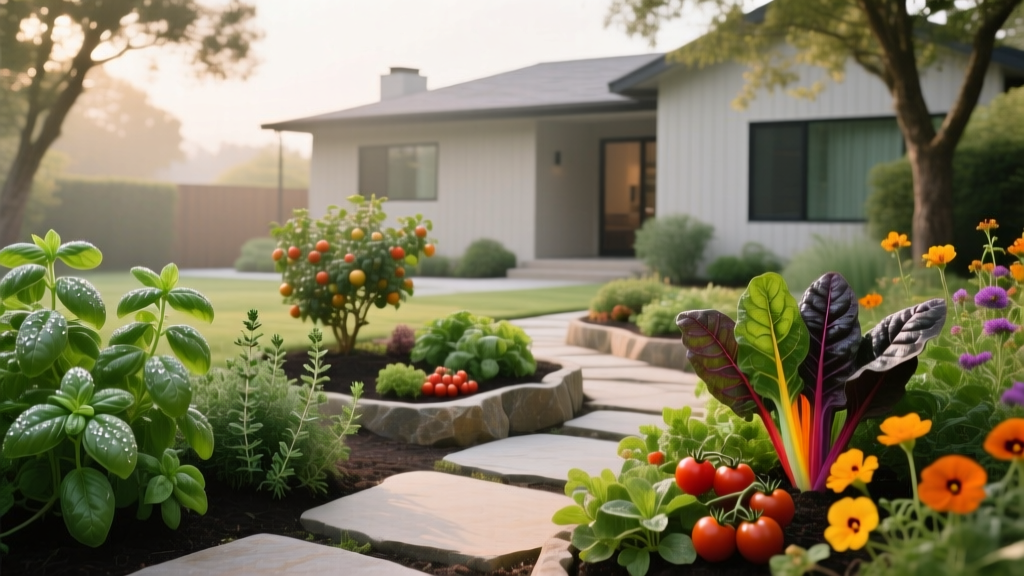
Front Yard Edible Landscape Design
You step out the front door with a coffee and notice the same thing you’ve noticed all season: a wide, thirsty rectangle of lawn you don’t use, a narrow walkway that bakes in the afternoon sun, and a porch view that’s… fine. Then you remember the grocery receipt from yesterday—$6 for a small box of herbs, $4 for lettuce that wilts by day three. The front yard is the brightest spot on the property, but it’s doing the least work.
Designing an edible front yard is less about turning your home into a farm stand and more about arranging food plants the way a landscape designer arranges shrubs: with structure, repetition, and year-round intent. The goal is a yard that reads “designed,” satisfies neighbors and HOAs, and still gives you salads, berries, and herbs within arm’s reach.
Start With the “Front Yard Rules”: Sightlines, Access, and Curb Appeal
Before we talk plants, we talk lines. Front yards are public-facing, so your design has to look purposeful from the street and feel welcoming from the walk.
Keep a clear “arrival corridor”
If your walk from sidewalk to door is tight, give it breathing room. A comfortable path is 36–48 inches wide. Keep taller edibles (like trellised peas or berry canes) at least 24 inches back from the path edge so sleeves and backpacks don’t brush foliage.
Work with sunlight hours, not wishful thinking
Most fruiting edibles want 6–8+ hours of direct sun. Leafy greens can produce with 4–6 hours (especially with afternoon shade). Track sun for a day before you plant. If the front yard gets only 3–4 hours, shift toward herbs, greens, and shade-tolerant edibles (more on that below).
Build a simple “bones-first” layout
Front yards look tidy when they have clear edges and repeated shapes. Use one or two of these “bones” elements, then tuck edibles into them:
- Low hedge line (edible or ornamental) to define spaces.
- Gravel or mulch path loop that makes beds feel intentional.
- Two matching planters flanking steps or the porch.
- One focal point (a small tree, a birdbath, or a bench) to anchor the design.
Layout Strategies That Make Edibles Look Like Landscaping
These are the same strategies I use when designing a traditional front yard—just with plants you can harvest.
Strategy 1: Layer like a shrub border
Layering keeps the view orderly and hides the “vegetable patch” look. Think in three heights:
- Back layer (3–10 ft): dwarf fruit trees, trellises, tall herbs like fennel (where appropriate).
- Middle layer (1–3 ft): berries, bush beans, chard, peppers in warmer climates.
- Front edge (4–12 in): thyme, strawberries, lettuces, scallions—plants that make clean borders.
Strategy 2: Repeat forms and colors
Design reads as “intentional” when the same plant shows up in at least three places. Example: repeat ‘Tuscan Blue’ rosemary as two porch planters plus one in a sunny bed, or repeat ‘Little Gem’ lettuce in three small clusters rather than one big row.
Strategy 3: Use raised beds sparingly—and make them match the house
Raised beds are fantastic for soil control, but a big wooden box can look abrupt in a front yard. If you use them, keep them low and crisp: 10–12 inches tall is plenty for greens and herbs. Choose stained cedar or painted boards that match trim, and align beds with the home’s geometry (parallel to the porch, not diagonal).
Strategy 4: Edge everything
Edging is the secret handshake of tidy landscapes. A defined edge—steel, brick, stone, or even a crisp spade-cut line—keeps mulch in place and makes the whole edible planting look curated. Plan a 3-inch mulch layer in beds for weed suppression and moisture control.
A Practical Template: The “60/30/10” Front Yard Plan
When homeowners are nervous about changing the front yard, I use a simple ratio that keeps the design balanced:
- 60% structure plants (edible shrubs, dwarf fruit, evergreen herbs, a small tree)
- 30% seasonal producers (greens, peppers, beans, annual herbs)
- 10% pollinator support and fillers (flowers like calendula or nasturtiums, sweet alyssum)
This prevents the “empty bed” look in winter and makes harvests feel like a bonus—not the only purpose.
Plant Selection: Specific Varieties That Behave Well in Front Yards
Front-yard edibles need three traits: they look good, they’re productive, and they don’t flop all over the sidewalk. Here are reliable choices with designer-friendly habits.
Edible “foundation” shrubs and perennials
- Blueberry (Vaccinium): Choose low-chill varieties if needed. Try ‘Sunshine Blue’ (compact, evergreen-ish in mild climates) or ‘Jelly Bean’ for a smaller footprint. Plant 4–5 ft apart. Bonus: fiery fall color.
- Rosemary ‘Arp’ or ‘Tuscan Blue’: Evergreen structure, drought-tolerant once established. Space 3 ft apart; use as a hedge substitute in sunny spots.
- Thyme ‘Elfin’ or creeping thyme: A clean edging plant that smells great when brushed. Space 8–12 inches apart along borders.
- Globe artichoke ‘Imperial Star’ (mild climates): Architectural silver foliage; looks like an ornamental. Give it 3–4 ft of space.
Small fruit trees that won’t overwhelm the space
- Dwarf apple on dwarfing rootstock (ask for M.26 or similar): Try ‘Liberty’ (disease-resistant) or ‘Honeycrisp’ where it performs well. Plan 8–10 ft spacing for dwarf trees.
- Meyer lemon (in warm climates or a large container): Use a 20–25 gallon pot for stability and root room; tuck under eaves for extra warmth.
- Fig ‘Chicago Hardy’: Good cold tolerance for a fig; can be kept pruned to 6–8 ft as a multi-stem shrub.
Front-edge crops that stay neat
- Lettuce ‘Little Gem’: Compact romaine heads that look intentional. Plant 8–10 inches apart.
- Swiss chard ‘Bright Lights’: Colorful stems read like ornamentals. Space 12–18 inches.
- Strawberry ‘Seascape’ (everbearing) or ‘Albion’: Useful as a groundcover. Space 12 inches apart; edge beds with it where you’d normally use vinca.
- Scallions: Great vertical accent in tight spaces. Plant in clumps, 2 inches apart.
Climbers for fences and trellises (vertical = tidy)
- Snap peas: Quick, charming, and easy to remove when done. Use a trellis 5–6 ft tall.
- Grapes (where appropriate): Train them formally along a fence line; choose seedless table grapes suitable for your region. Plan strong supports—grapevines get heavy.
Comparison Table: Three Front-Yard Edible Layout Styles
| Layout Style | Best For | Typical Footprint | Visual Vibe | Maintenance Level |
|---|---|---|---|---|
| Border Planting (layers along walk/house) | Most homes; wants curb appeal first | Bed depth 3–6 ft along edges | Classic landscape border | Medium (weekly tidy + seasonal swaps) |
| Potager Grid (small geometric beds) | Sunniest yards; people who like order | Two to six beds, each 3x6 ft | Formal, “designed garden” look | Medium-High (more edges, more replanting) |
| Container-Forward (planters + one small bed) | Renters; HOA limits; patios/porches | 4–10 containers (5–25 gal) + 10–30 sq ft bed | Porch-garden charm | Low-Medium (more watering, less weeding) |
Step-by-Step Setup: A Designer’s Build Order (So It Looks Good Fast)
This is the order that prevents the half-finished look that makes neighbors nervous.
- Measure and sketch. Note house width, walk width, and where you can’t dig (utilities). Mark sunny zones (6+ hours) versus part shade.
- Define bed lines with a hose. Curves should be broad; avoid squiggles. Aim for beds at least 3 ft deep so plants don’t spill onto the path.
- Install edging first. Even DIY paver edging creates instant polish.
- Sheet-mulch lawn areas you’re converting. Cardboard + 3 inches of mulch works well; let it settle for 2–4 weeks if possible.
- Place “bones” plants. Dwarf fruit, blueberries, rosemary—your structure anchors. Plant these before annuals.
- Add irrigation or a watering plan. A simple drip line is ideal. If hand-watering, keep bed width reachable: max 4 ft from one side, 8 ft if accessible from both.
- Fill with seasonal producers. Use clusters of 3–5 plants per variety for a designed look.
- Finish with mulch and a crisp edge. This is where the “landscape” feel happens.
Costs, Budgets, and Smart DIY Alternatives
Costs swing wildly by region, but here are realistic planning numbers so you can budget without guessing.
- Mulch: For a 100 sq ft bed at 3 inches deep, you need about 0.93 cubic yards. Bagged mulch often runs $4–$6 per 2 cu ft bag (you’d need ~13–14 bags). Bulk mulch may be cheaper delivered.
- Steel or aluminum edging: Commonly $2–$4 per linear foot. DIY alternative: spade-cut edge refreshed monthly.
- Drip irrigation starter kit: Often $30–$80 depending on size and brand. DIY alternative: soaker hose pinned under mulch.
- Dwarf fruit tree: Typically $40–$90 for a 3–5 gallon tree. DIY alternative: start with one tree and add next season.
- Blueberry shrubs: Often $15–$35 each. Plant two for better pollination and a fuller look.
If you’re keeping it lean, spend first on edging + mulch + two structure plants. Those three choices make even a small edible planting look intentional.
Design Notes Backed by Research (So You’re Not Just Guessing)
Healthy edible landscapes start with healthy soil—and compost is consistently shown to improve soil structure and water-holding capacity. One long-running study on organic systems found that compost additions supported soil quality and fertility over time (Rodale Institute, 2011).
Water efficiency matters too, especially in front yards that get full sun and reflected heat from sidewalks and driveways. The U.S. Environmental Protection Agency notes that WaterSense-labeled drip irrigation and efficient watering practices can reduce outdoor water waste (U.S. EPA WaterSense, 2023).
“A well-designed edible landscape uses the same visual principles as ornamental design—repetition, structure, and clear edges—so the garden reads as intentional even when plants are in peak growth.” — Adapted from edible landscape design principles widely taught in extension and professional landscape programs
Three Real-World Scenarios (And How I’d Lay Them Out)
Different front yards need different strategies. Here are designs I’ve used with clients and community gardens, adjusted for typical residential constraints.
Scenario 1: The Sunny Suburban Rectangle (30 ft wide x 20 ft deep)
Challenge: Big, flat lawn that looks empty when you remove turf.
Plan: A border planting plus one focal dwarf tree.
Layout I’d use:
- One dwarf apple centered off-axis (not dead center), about 10 ft from the porch for scale.
- Two blueberry shrubs grouped on one side, 4 ft apart, underplanted with thyme.
- Front edge lined with strawberries at 12-inch spacing for a clean border.
- Seasonal pockets of lettuce and chard closer to the walk for quick harvesting.
Why it works: From the street, it reads like a shrub border with a specimen tree—then you realize it’s edible.
Scenario 2: The Rental with a Strict HOA (No Digging, Must Look “Ornamental”)
Challenge: You need reversibility and tidy visuals.
Plan: Container-forward design with coordinated pots.
Here’s a clean approach that still yields food:
- Four 15-gallon containers near the porch: two with rosemary standards (or upright rosemary), two with compact blueberries (use acidic potting mix).
- Six 5-gallon pots along the walk: ‘Little Gem’ lettuce, basil, parsley, scallions—rotated seasonally.
- One trellis in a large pot for snap peas in spring, then a compact cucumber in summer (if allowed).
DIY upgrade: Wrap mismatched nursery pots in inexpensive wood slats or use matching saucers to unify the look without buying all-new containers.
Scenario 3: The Tiny Front Yard with Part Shade (Townhome, 12 ft x 15 ft, 4–5 hours sun)
Challenge: Not enough sun for tomatoes; limited soil area.
Plan: Shade-tolerant edibles and a “thin” layout that keeps the entry open.
My go-to palette:
- Currants or gooseberries (where permitted) in the shadiest corner; they handle less sun better than many fruits.
- Leafy greens (spinach, arugula, sorrel) in a narrow bed 3 ft deep along the foundation.
- Herbs like mint (in a pot so it doesn’t run), chives, and parsley—great in part shade.
Design trick: Use one repeating evergreen herb (like rosemary only if sunny enough; otherwise chives in clumps) to keep structure when greens come and go.
Maintenance Expectations: What It Really Takes
Edible front yards thrive with small, consistent attention rather than occasional marathon weekends. For an average front edible landscape of 80–150 sq ft of beds plus containers, plan on:
- Weekly time: 30–60 minutes (harvest, quick weed pull, check irrigation).
- Peak season time (spring planting / summer high growth): 60–90 minutes per week if you’re replanting succession crops.
- Watering: With drip, check once weekly; without drip, expect 10–20 minutes hand-watering 2–4 times per week during hot spells.
Seasonal task rhythm
- Spring: Refresh mulch, compost top-dress (½–1 inch), plant cool-season greens, set up trellises.
- Summer: Harvest often, pinch herbs, re-seed lettuce in partial shade, watch for sidewalk heat stress.
- Fall: Plant garlic or overwintering greens where climate allows; prune and tidy berry shrubs after leaf drop (varies by species).
- Winter: Protect container plants where freezes hit; review what looked messy and plan edits (design improves by subtraction).
Small Design Moves That Make a Big Difference
If you want your edible front yard to feel like it belongs in the neighborhood, borrow these classic landscape moves:
- Use a “clean frame.” Keep the first 12–18 inches along the sidewalk as low, tidy plants (thyme, strawberries, lettuces in season).
- Limit your plant palette. Choose 6–10 main plants and repeat them. A front yard with 25 different vegetables looks busy fast.
- Hide utilitarian items. Tuck compost bins and hose storage behind the house or screen them with a shrub. Front yards are for the “pretty” parts of food growing.
- Add one ornamental edible flower. Nasturtiums trail beautifully, calendula reads like a cottage garden, and both earn their keep in salads.
When you’re standing at the curb, your front yard should read in one glance: clear edges, repeating shapes, a few structural plants. Then, when you’re at the door with scissors in hand, it becomes the most convenient kitchen garden you’ve ever had—fresh herbs in under a minute, berries on the way back from a walk, and a space that finally earns its sunshine.
Sources: Rodale Institute, Farming Systems Trial findings and summaries (2011); U.S. Environmental Protection Agency (EPA) WaterSense program guidance on outdoor water efficiency and irrigation practices (2023).