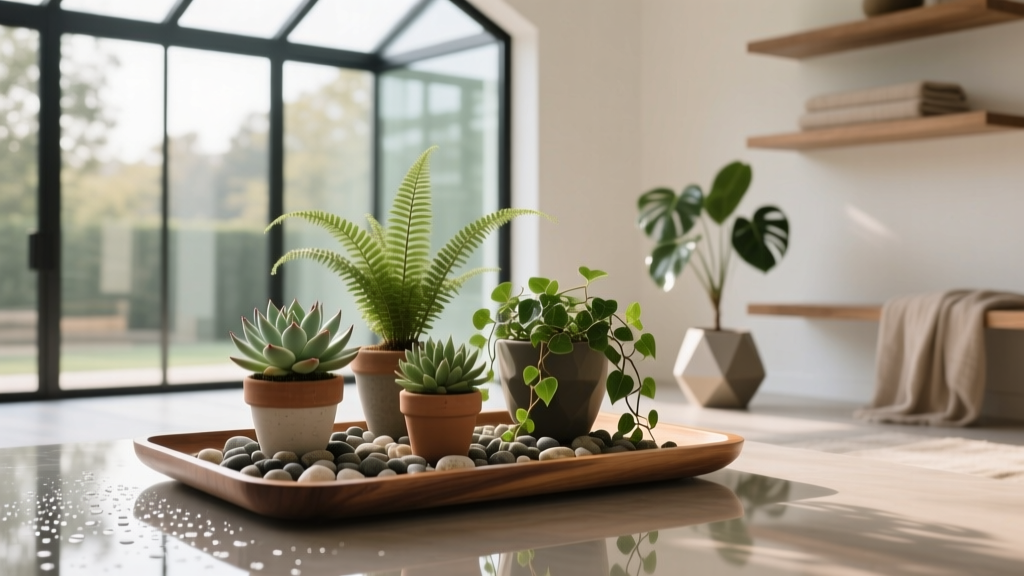
Sunroom Humidity Tray Plant Management
It starts the same way for a lot of sunroom gardeners: you wake up to bright winter sun pouring through glass, your citrus and orchids look almost happy again… and then you notice the crispy leaf edges. The heater ran all night. The air feels desert-dry. A week later, spider mites show up like they own the place. You mist, you fuss, you move plants around, and somehow the sunroom still swings from “too dry” to “condensation on the windows.”
A humidity tray system—done with intention, not as an afterthought—can stabilize that swing. Think of it as a small, controllable microclimate layer that you design into your layout: trays placed where they’ll actually evaporate efficiently, grouped plants that benefit from the same moisture level, and a water strategy that won’t stain your tile or warp your rental’s windowsill. Let’s lay it out like a project, the way a landscape designer would: identify constraints, set performance goals, then design the layout and plant palette to match.
Design goals: what a humidity tray can (and can’t) solve
A humidity tray increases humidity in the immediate zone around plants as water evaporates from a shallow reservoir filled with pebbles or a grate. It’s not a whole-room humidifier, and that’s a good thing: you get targeted relief without fogging every pane of glass.
Most sunrooms run best for people and plants in the 40–60% relative humidity range. The U.S. Environmental Protection Agency notes that keeping indoor humidity between 30% and 50% helps limit mold growth and dust mites (EPA, 2023). Your tropical houseplants may prefer higher, but pushing a glass-heavy space above 60% for long periods can invite condensation and mildew.
“Moisture management is always a balance: you want enough humidity for plant health, but not so much that surfaces stay wet.” — Building Science Corporation, guidance on interior moisture control (Lstiburek, 2009)
Use trays to raise humidity around plant groups while keeping the room itself in a safe, comfortable band.
Layout strategies for humidity tray zones
1) Map the sunroom like a microclimate plan
Before you buy a single tray, take one day to observe. In sunrooms, light and temperature can shift dramatically within a few feet.
- Sunlight hours: Track direct sun on the floor and shelves. Many sunrooms get 4–8 hours of direct light depending on orientation and overhangs.
- Heat sources: Mark vents, radiators, space heaters, and drafty doors. Forced-air heat is a humidity thief.
- Cold glass zones: In winter, the first 12–18 inches from single-pane glass can be significantly cooler, increasing condensation risk if you over-humidify right against the window.
Sketch a quick plan and divide it into three practical zones: bright/dry (near heat vents or strong sun), bright/moderate (good light with less blast), and low-light/moderate (corners or shaded shelves). Your humidity trays will do the most work in bright/dry zones because evaporation is faster there.
2) Choose tray sizes that match your shelf and plant footprint
The biggest mistake I see is a tiny saucer under a large plant collection—too little evaporative surface area, too much wishful thinking. Use tray sizes that match the “plant group module.” Here are reliable, easy-to-source dimensions:
- Standard boot tray: about 30 in x 15 in (76 x 38 cm). Great for 6–10 small pots.
- Restaurant sheet pan (half size): about 18 in x 13 in (46 x 33 cm). Fits many wire shelves.
- Window ledge tray: about 24 in x 6 in (61 x 15 cm). Works for herbs and small tropicals.
Plan on 1 tray per 6–12 sq ft of tightly grouped plants. If plants are scattered, trays become decorative rather than functional.
3) Build “humidity islands” (not a room-wide swamp)
Group plants that want similar humidity and watering frequency. A humidity island is simply: tray + pebble layer + clustered pots + airflow that prevents stale, wet pockets.
Spacing rule: cluster pots so leaves can almost touch, but leave 1–2 inches between pot rims for air movement and easy watering. If foliage stays wet or crowded, pests and fungus get easier wins.
4) Keep trays off finished wood and away from fragile surfaces
If you rent, you need clean edges and no leaks. Place trays on waterproof mats or shallow risers. For wood shelves, use a 3–5 mm thick clear vinyl desk mat cut to size under trays. This one small move prevents the slow, invisible damage that landlords notice at move-out.
5) Use airflow as the “invisible wall” that prevents mold
Humidity without airflow is how you get mildew film on the window track. A small, quiet fan on low speed—aimed across the trays, not directly at foliage—keeps evaporation steady and surfaces dry.
Set the fan 4–6 feet from the humidity island and let it run 6–10 hours/day during the driest months. This is often cheaper than running a humidifier nonstop.
Step-by-step: setting up a humidity tray system that behaves
- Measure your shelf or floor module. Example: a plant bench that’s 48 in long x 18 in deep can comfortably hold two half-sheet pans or one boot tray plus a small side tray.
- Select a tray with a lip. Aim for a rim height of 1–1.5 inches to prevent sloshing during refills.
- Add a pebble or grate layer. Use 1–2 inches of pea gravel, aquarium stones, or an upside-down wire cooling rack so pots sit above water.
- Fill water to just below the pot bases. Keep at least 1/4 inch gap so roots never sit in water. This is humidity management, not bottom-watering (unless you intend it).
- Group plants by need. Put your higher-humidity plants together, and keep succulents away from trays.
- Add a simple hygrometer nearby. Place it at canopy height, not on the floor. Track morning and late afternoon readings for a week.
- Adjust with one variable at a time. Add a second tray, increase water surface area, or improve airflow—don’t do all three at once or you won’t know what worked.
Plant selection: varieties that actually respond well to humidity trays
Humidity trays shine with plants that suffer in dry heated air but don’t require terrarium-level saturation. The key is pairing plants with similar comfort ranges so your tray islands feel coherent and low-drama.
High-reward plants for tray islands (with specific varieties)
Orchids (Phalaenopsis hybrids) — These are classic tray candidates because they like consistent humidity around the leaves and aerial roots, but they hate soggy pots. A tray under a group of orchids can smooth out winter dryness without changing your potting media. Place them in bright indirect light or filtered sun (4–6 hours bright light equivalent).
Maidenhair fern (Adiantum raddianum) — If you’ve ever watched one crisp up in 48 hours, you know why it belongs here. It appreciates higher local humidity and steady moisture. Give it morning sun or bright shade, not harsh afternoon glare. Keep it 18–24 inches back from hot glass in summer.
Prayer plant (Maranta leuconeura ‘Kerchoveana’) — Leaves curl and brown in dry air; trays help maintain pliability. It’s also a good “indicator plant”: when Maranta looks happy, your humidity island is doing its job.
Calathea (Goeppertia) ‘Beauty Star’ — Gorgeous, a little picky, and much easier in a tray cluster with airflow. Calatheas tolerate bright indirect light; avoid direct midday sun in a sunroom unless filtered.
Anthurium andraeanum (common flamingo flower cultivars) — Thick leaves handle indoor conditions better than many tropicals, but they appreciate humidity to keep leaf edges clean and flowers lasting longer.
Plants to keep off humidity trays (or in a separate zone)
Succulents and cacti (Echeveria, Haworthia, Opuntia) — They prefer drier air and strong sun; putting them in a tray island can increase fungal risk in crowded winter conditions.
Mediterranean herbs (rosemary, thyme, lavender) — Most want airflow and lower humidity; treat them as a “dry zone” design feature on the brightest sill.
Comparison table: tray materials and what they mean for renters vs. owners
| Tray option | Typical size | Estimated cost (USD) | Best for | Watch-outs |
|---|---|---|---|---|
| Boot tray (plastic) | 30 in x 15 in | $12–$25 | Floor clusters, plant benches | Can look utilitarian; choose a matte black to disappear visually |
| Half-sheet pan (aluminum) | 18 in x 13 in | $10–$18 | Wire shelving, narrow benches | Mineral deposits show; use a rack to prevent pot contact |
| Ceramic serving tray | Varies (often 16–20 in) | $20–$60 | Visible design moments | Heavy; risk of cracking on tile; needs felt pads |
| Seed-starting tray (no holes) | 10 in x 20 in | $6–$12 | Small plant groups, tight budgets | Shallow rims spill easily—keep fill line low |
Real-world scenarios: three sunrooms, three tray plans
Scenario 1: The renter’s narrow sunroom ledge (minimal mess, maximum effect)
Space: A 60-inch long window ledge, 7 inches deep, with a baseboard heater below.
Problem: Plants desiccate quickly; anything near the heater browns at the tips.
Design move: Use two slim trays (24 in x 6 in) set on a clear waterproof mat. Place plants 12 inches away from the heater line if possible, and add a small clip-on fan aimed parallel to the window to reduce condensation while still allowing evaporation.
Plant palette: One tray holds Phalaenopsis orchids (3–4 plants). The second tray holds a Maranta leuconeura and a small Anthurium with a Peperomia obtusifolia as a buffer (Peperomia tolerates average humidity and visually thickens the grouping).
Budget: Two trays ($30), pea gravel ($8), clear mat ($15), clip fan ($20). Total about $73. DIY alternative: thrifted baking trays and clean river stones.
Scenario 2: The homeowner’s plant bench (showpiece island that’s still practical)
Space: A dedicated bench 48 in x 18 in near south-facing glass, receiving 6–7 hours of strong sun in spring.
Problem: Great light, but huge humidity swings and leaf scorch on sensitive plants.
Design move: Create two humidity islands: one “tropical cluster” and one “bright-tough” cluster. Add a light-filtering shade cloth or sheer curtain to cut peak intensity by roughly a third during the brightest hours (you’ll feel the difference immediately).
Humidity island build: One boot tray (30 x 15 inches) centered on the bench with a wire rack inside; keep the water line 1/2 inch below pot bases. Allow 3–4 inches around the tray perimeter for watering access and for the bench to read as furniture, not storage.
Plant palette: Calathea ‘Beauty Star’, maidenhair fern, anthurium, and a compact Hoya carnosa (Hoyas enjoy humidity but tolerate normal homes, making them good “stabilizers”). Keep sun-lovers like citrus or rosemary in separate pots off-tray, closer to the glass.
Cost planning: Boot tray ($20), rack ($12), shade panel ($25), hygrometer ($12). Total about $69, excluding plants.
Scenario 3: The small sunroom that keeps fogging (too much humidity in the wrong place)
Space: A compact 8 ft x 10 ft sunroom with older windows. The owner already runs a humidifier and gets condensation.
Problem: Wet window tracks, mildew smell, and plants still look stressed because humidity isn’t consistent at leaf level.
Design move: Reduce whole-room humidity and switch to targeted humidity trays placed 24 inches away from the coldest glass. Add airflow across the window base to keep surfaces dry.
Plant palette: Move the most humidity-craving plants (ferns, calatheas) into a single tray island mid-room on a plant cart. Keep tougher plants—snake plant (Dracaena trifasciata) and ZZ plant (Zamioculcas zamiifolia)—near the window edges where conditions fluctuate.
Outcome you’re aiming for: Room humidity held closer to 40–50% (EPA, 2023), but leaf-zone humidity slightly higher around the tray cart. Less condensation, fewer fungal issues, and plants that stop crisping.
Water quality, minerals, and tray hygiene (the unglamorous details that matter)
Humidity trays concentrate minerals as water evaporates and leaves solids behind. If your tap water is hard, you’ll see a white crust on trays and pebbles. The University of Minnesota Extension notes that houseplant problems are often tied to salts and mineral buildup from water and fertilizer (University of Minnesota Extension, 2022). You don’t need perfection, but you do need a routine.
- Weekly: Top up water as needed. In winter heat, a boot tray can need refilling every 3–5 days.
- Monthly: Empty and rinse trays. Wipe the rim and corners where biofilm starts.
- Seasonally: Soak pebbles in a 1:1 vinegar-water solution for 20–30 minutes, rinse thoroughly, and restart.
If you’re already buying distilled water for sensitive plants, reserve it for the pots—not necessarily the trays. For trays, filtered water reduces crust, but tap water is usually fine if you clean regularly.
Maintenance expectations: how much time this really takes
A well-designed tray system should reduce fussing, not add to it. For most sunrooms, plan on:
- 15–25 minutes per week to refill trays, quick-wipe edges, and check for standing water touching pot bases.
- 10 minutes per week to scan for pests (especially spider mites on dry-stressed plants) and rotate plants for even light.
- 30–45 minutes monthly for a full tray rinse and pebble swish.
Seasonal notes: In winter, prioritize airflow and keep tray islands a bit farther from cold glass to avoid condensation. In summer, trays may evaporate faster but your overall room humidity may already be higher—so watch for fungus gnats and let the top layer of potting mix dry appropriately. If you air-condition the sunroom, trays become useful again because AC can dry the air.
Budget choices and DIY alternatives that still look designed
You don’t need expensive “humidity trays.” You need shallow waterproof surfaces with a clean edge and a plan for how they sit in the room.
- DIY tray: thrift-store roasting pans or cafeteria trays. Add adhesive felt pads under corners to protect floors.
- DIY grate: repurpose a stainless cooling rack or plastic light diffuser grid cut to fit (the kind used in ceiling lights).
- Elevate the look: hide utilitarian trays inside a larger decorative frame—like setting a black boot tray into a low wooden planter box lined with pond liner (owners) or into a metal plant stand with a lip (renters).
If you’re choosing between a room humidifier and humidity trays, consider energy and control. A small humidifier might cost $30–$80 plus ongoing filter costs; trays cost less ongoing, but they’re localized. Many sunrooms do best with trays plus a small fan, and a humidifier only during extreme dry spells.
Designing the plant grouping: a simple layout you can copy
If you want a starting layout that behaves predictably, build one “tropical core” and one “dry rim.” Here’s a designer’s go-to arrangement for a medium sunroom shelf:
- Center (on tray): 1 calathea + 1 maidenhair fern + 1 anthurium + 1 maranta, grouped tightly.
- Back row (off tray, bright): 1–2 hoyas on a small trellis; they enjoy the nearby humidity but don’t demand it.
- Outer edges (dry rim): snake plant or peperomia to buffer transitions and visually “cap” the ends.
Keep the tray island where you naturally walk past it—near enough that refilling doesn’t feel like a chore. In design, convenience is sustainability.
Once you dial in your first humidity island, you’ll notice the sunroom feels less like a battle. Leaves stay softer, new growth doesn’t stall, and you stop reacting to problems and start editing your space like a living room that happens to be full of plants. That’s the goal: a sunroom that looks designed, functions smoothly, and lets you enjoy the light instead of constantly trying to fix what the air is doing.
Sources: U.S. Environmental Protection Agency (EPA), “Mold and Moisture” guidance on indoor humidity (2023). Building Science Corporation, Joseph Lstiburek, moisture control guidance (2009). University of Minnesota Extension, houseplant care and mineral/salt considerations (2022).