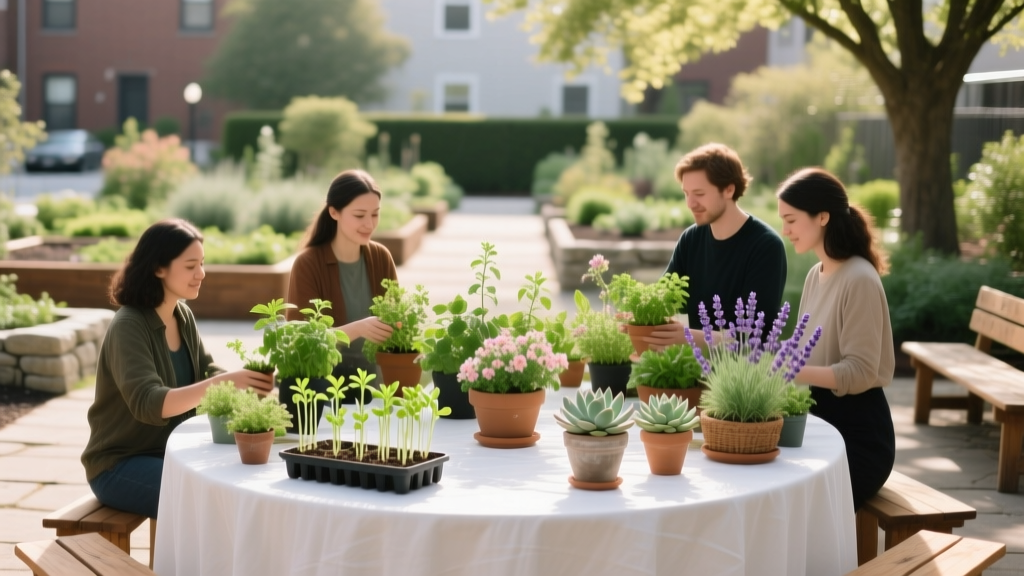
Community Plot Seasonal Plant Swap Ideas
It’s late April and the community garden gate squeaks open like a stage curtain. Half the beds are still bare, a few folks are hovering with trays of seedlings, and someone’s holding a mystery pot labeled “purple… something?” You can feel the same question in the air: how do we fit everyone’s plants, preferences, and limited space into a garden that looks cohesive—and still feeds people?
A seasonal plant swap can be the design tool that turns a patchwork community plot into a flexible, good-looking, high-yield garden. Done well, swapping isn’t just trading plants; it’s a layout strategy: you’re planning “leases” for space—short-term spring tenants, summer workhorses, and fall finishers—while keeping the beds attractive and manageable for busy homeowners and renters.
Design principles that make swaps work (and keep the plot from feeling chaotic)
1) Design for change: build “swap sockets” into the layout
Most community plots fail seasonally because the design assumes plants stay put from May to October. Swaps only shine when the layout anticipates turnover. Create at least two dedicated “swap sockets” in each bed—small zones meant to be planted, harvested, and replanted quickly.
Practical dimensions: In a standard 4 ft × 8 ft bed (32 sq ft), reserve two 18 in × 24 in sockets (each 3 sq ft) near the front corners for short-duration crops and swapped-in ornamentals. That’s 6 sq ft—enough for a flat of basil, six lettuces, or a cluster of marigolds—without sacrificing the main crop plan.
2) Put tall plants north and keep pathways honest
This is the layout rule that keeps peace: tall plants go on the north side so they don’t shade neighbors (in the Northern Hemisphere). In shared plots, that single decision prevents “sunlight disputes” by July.
Plan for a minimum 24 in path width between beds. If gardeners bring carts or mobility aids, bump to 36 in. Your swap events will be smoother because people can browse without stepping into beds.
3) Use “plant guild lanes” instead of random mixing
Swaps tempt people to scatter interesting plants everywhere. Instead, design lanes—simple strips with repeatable logic. In a 4 ft bed, think in four 12 in-wide lanes running the length of the bed:
- Lane 1 (front edge): swap socket + pollinator edging
- Lane 2: salad/greens succession
- Lane 3: fruiting crops (peppers/eggplants) or roots
- Lane 4 (north/back): trellis crops (tomatoes/beans/cucumbers)
When someone brings an extra plant, you immediately know where it belongs. That’s how swaps stay beautiful and practical.
4) Design around sunlight hours, not wishful thinking
Before the swap day, do a quick sunlight audit. Most vegetables need 6–8+ hours of direct sun for best yields; many leafy greens tolerate 4–6 hours. If your community plot has tree shade on one end, treat that area like a “greens-and-herbs zone” and swap accordingly.
For real numbers: aim to place tomatoes, peppers, cucumbers, and basil where they’ll get 8 hours of sun. Put lettuces, cilantro, parsley, chives, and mint (in pots) in 4–6 hours sun pockets.
Layout strategies for a seasonal swap-friendly community plot
Create a swap staging area that doesn’t trample the garden
A swap works best when it feels like a mini market. Reserve a flat area near the entrance—ideally 10 ft × 10 ft—for a temporary table setup. If the garden doesn’t have a plaza, lay down a cheap tarp to protect turf or gravel.
Budget snapshot: Two folding tables can run $40–$80 total (or free if borrowed), and a pack of weatherproof tags is often $8–$12. A shared roll of painter’s tape for labeling is usually under $6.
Build one “quarantine corner” for pest prevention
Swaps can move pests and diseases around fast. Assign a small holding zone: a single 2 ft × 4 ft table or a sunny corner where newcomers sit for a quick inspection before planting. Look for aphids under leaves, stippling that suggests mites, and mushy stems.
“The simplest sanitation steps—starting with clean plants and tools—are among the most effective ways to reduce disease spread in gardens.” — University of Minnesota Extension, 2020
Use modular containers to make renters and small-plot gardeners feel included
If your community plot includes renters who may move mid-season, design the swap around portability. Encourage trades in 1–3 gallon pots for herbs and flowers, and 5 gallon fabric pots for peppers, eggplants, and compact tomatoes. Containers can be swapped like chess pieces without disrupting bed plans.
Cost reality: Fabric grow bags often cost $2–$5 each; a basic 5-gallon bucket is often $3–$6 (sometimes free from food-service sources—just confirm it’s food-safe and clean).
Plant choices that swap well (with specific varieties and spacing)
Spring swap stars (cool-season quick wins)
Spring swaps should favor plants that establish fast and tolerate temperature swings. These are also perfect “socket” occupants.
- Lettuce ‘Buttercrunch’: reliable, tender heads; plant 8–10 in apart. Quick harvest means easy turnover for summer crops.
- Spinach ‘Bloomsdale Long Standing’: slower to bolt than many; plant 4–6 in apart. Great for partial shade beds.
- Pea ‘Sugar Snap’: trellis-friendly; sow 2 in apart along a net trellis. Swaps work if seedlings are young and not rootbound.
- Calendula ‘Pacific Beauty’: edible petals, pollinator draw; space 10–12 in. Makes beds look intentional while you wait for warm-season crops.
Summer swap workhorses (high value per square foot)
Summer swaps should focus on compact varieties and plants that benefit from being started by someone else.
- Tomato ‘Sungold’ (cherry): huge yield, high swap value; space 24 in apart; trellis to 6 ft. Great for the north/back lane.
- Tomato ‘Patio Choice Yellow’ (container-friendly): ideal for renters; one plant per 5 gallon pot.
- Pepper ‘Lunchbox Red’: compact, sweet snacking pepper; space 18 in apart. A strong trade because peppers start slowly from seed.
- Basil ‘Genovese’: pairs with tomatoes; space 10–12 in apart. Easy to propagate for swap extras.
- Zinnia ‘Benary’s Giant’: long-stem cut flower; space 12 in apart. Keeps the plot showy (and encourages pollinators near cucurbits).
Fall swap finishers (plants that love the shoulder season)
Fall swaps are where community plots become truly productive. Pull tired summer plants, refresh soil lightly, and swap in cool-season transplants.
- Kale ‘Lacinato’: cold-hardy, holds quality; space 12–18 in. Great anchor plant when tomatoes come out.
- Broccoli ‘Arcadia’: dependable fall heading in many climates; space 18 in. A prime swap item because timing matters.
- Radish ‘French Breakfast’: quick; sow 2 in apart. Perfect for filling gaps after a swap.
- Cilantro ‘Santo’: slower to bolt than many; sow clusters 6 in apart. Often thrives as temps cool.
A quick comparison: what to swap each season (and what to avoid)
| Season | Best swap items | Why they swap well | Avoid swapping |
|---|---|---|---|
| Spring | Lettuce, spinach, peas, calendula | Fast establishment; short time to harvest; tolerant of cool nights | Root-bound cucumbers; mature brassicas with stressed roots |
| Early Summer | Tomatoes, peppers, basil, zinnias | High value transplants; benefit from early starts; easy to place in lanes | Melons in small beds (they overrun); invasive mints in-ground |
| Late Summer/Fall | Kale, broccoli, cilantro, radishes | Extend the season; quick gap-fillers; reduce “end of summer slump” | Large squash starts (too late); diseased tomato cuttings |
Step-by-step: set up a seasonal plant swap that improves the garden design
- Map the bed lanes. Sketch each bed with four 12-inch lanes and mark two 18 in × 24 in swap sockets.
- Assign sunlight zones. Label areas as 8+ hours, 6–8 hours, or 4–6 hours sun based on observation.
- Set swap rules in one page. Include: no visible pests, label variety/date, and note if it’s container-only (like mint).
- Prep labels and pricing (optional). Even if it’s free, add “suggested trade value” (e.g., one tomato = two basil).
- Create the staging area. Set up a 10 ft × 10 ft zone with tables and a quarantine corner.
- Host a 20-minute “layout walk.” Before trading starts, walk the beds and identify where tall crops, sockets, and containers should go.
- Plant immediately or heel-in. If beds aren’t ready, heel plants into a temporary nursery bed, spaced 6 inches apart, watered well.
- Record what went where. A simple shared spreadsheet or clipboard avoids duplication and helps track results.
Three real-world scenarios (and how swaps solve them)
Scenario 1: The renter with a balcony who still wants to contribute
Leah rents a second-floor apartment and can’t commit to a full bed. She shows up with six herbs in 1-gallon pots: ‘Genovese’ basil, chives, parsley, thyme, oregano, and a mint she promises to keep contained. The design move is to treat her plants as a “mobile border.”
Layout solution: Place pots along the south edge of beds (front lane) where they won’t shade veggies. Keep mint in a pot, set on a paver to discourage rooting into soil. Leah can take her pots if she moves, and the community still benefits from pollinator-friendly blooms and shared herbs.
Maintenance expectation: Containers need more water—plan 10–15 minutes of watering checks 3 times per week in hot spells.
Scenario 2: The tiny 4 ft × 8 ft plot that gets overcrowded by “fun extras”
Sam has one raised bed and tends to over-trade: a tomato here, a squash there, flowers everywhere. By mid-June the bed is a jungle, airflow drops, and disease risk rises.
Layout solution: Use the four-lane system. Commit Lane 4 (north) to a single trellised crop: one indeterminate cherry tomato (‘Sungold’) at 24 in spacing, trained on a 6 ft stake or trellis. Lane 3 gets two peppers (‘Lunchbox Red’) at 18 in spacing. Lane 2 becomes greens that can be pulled anytime. Lane 1 is the “swap socket + edging flowers.”
Swap rule that saves the design: No sprawling vines unless you can point to dedicated trellis space and a 3 ft overflow zone (most small plots can’t). Instead, trade for compact cucumbers (‘Bush Champion’) or pole beans on a vertical net.
Scenario 3: The shaded corner plot that never produces tomatoes
A corner of the community garden only receives about 4–5 hours of sun because of a fence and a maple tree. Every year someone tries tomatoes there, and every year it’s disappointing.
Layout solution: Make it the “cool crop exchange.” Encourage swaps of leafy greens, herbs, and shade-tolerant flowers. Plant kale ‘Lacinato,’ lettuce ‘Buttercrunch,’ parsley, and calendula. Add reflective mulch (even a light straw) to bounce light upward, and keep plants slightly more spaced for airflow.
What it costs: A bale of straw mulch can run around $8–$15 depending on region, and it can cover multiple beds lightly. DIY alternative: shredded leaves (free) if you have access and they’re disease-free.
Spacing, soil, and sanitation: the practical backbone of a swap-friendly plot
Swaps fail when plants are jammed in as afterthoughts. Use spacing as your “design law,” not a suggestion. Tomatoes at 24 inches, peppers at 18 inches, basil at 10–12 inches, lettuces at 8–10 inches: these numbers keep airflow high and reduce powdery mildew and blight pressure.
Support your swaps with light soil refresh instead of full rework. Between seasonal swaps, top-dress beds with 1 inch of compost. For a 4 ft × 8 ft bed, that’s about 10.7 cubic feet (32 sq ft × 1/12 ft). Compost costs vary widely, but bagged compost might be $4–$8 per 1–2 cu ft bag; community gardens often reduce cost by buying bulk or municipal compost.
Sanitation is not glamorous, but it protects the whole plot. The U.S. Environmental Protection Agency notes that cleaning and disinfecting surfaces reduces pathogen spread (EPA, 2024). In garden terms: wipe pruners between plants when disease is suspected, and don’t swap anything with spotted, yellowing, or distorted new growth unless you’re confident it’s nutrient-related.
For crop planning, the USDA’s home gardening guidance emphasizes matching crops to site conditions and seasonal timing (USDA, 2022). Use that mindset when you design swap categories: “sun-lovers,” “shade-tolerant,” “container-only,” and “fast harvest.”
Budget considerations and DIY alternatives that still look designed
A beautiful community plot doesn’t require expensive infrastructure, but it does require consistent visual cues. Repetition is cheap: repeat the same edging flower in multiple beds (calendula or marigold), repeat the same trellis style, repeat the same mulch.
- DIY trellis: A roll of jute twine ($5–$10) + repurposed stakes makes a clean vertical plane for peas or beans.
- Labeling system: Cut-up yogurt lids or mini blinds (often free) + permanent marker. Add variety name and swap date.
- Shared tool rinse station: A bucket with soapy water and a rag near the swap table. Simple, effective, and under $10.
If funds allow, invest where it improves both design and productivity: uniform trellises, a reliable hose splitter, and a shared wheelbarrow. Those are the items that make swapping plants feel effortless rather than chaotic.
Maintenance expectations: what it actually takes each week
Community plots thrive when maintenance is predictable. Plan for 60–90 minutes per week per bed in peak season (late spring through summer). In hot weeks, watering may add another 30 minutes depending on irrigation. If you build swap sockets and lanes, the time stays steady because you’re not constantly untangling overgrown plantings.
Seasonal task rhythm
- Spring (weekly): weed lightly, thin seedlings, install trellises early, swap in cool-season fillers.
- Early summer (weekly): prune and tie tomatoes, mulch bare soil, swap out bolting greens for basil or flowers.
- Late summer (weekly): remove tired plants promptly, top-dress compost, swap in fall brassicas and herbs.
- Fall (biweekly): protect with row cover if needed, harvest steadily, plant cover crops in empty zones.
One underused design trick: schedule swaps as maintenance milestones. A late-May swap coincides with trellis installation. A mid-July swap matches the moment you pull spent spring crops. A late-August swap becomes the official reset for fall.
By the time the first cool evenings arrive, the community plot feels less like a collection of individual experiments and more like a designed landscape—beds with consistent structure, pockets of seasonal color, and a steady flow of plants entering and exiting on purpose. The best part is watching the swap table change over the year: lettuce and calendula in spring, basil and peppers in summer, kale and cilantro in fall—each trade quietly keeping the garden both flexible and finished-looking.
Sources: University of Minnesota Extension (2020); USDA (2022); U.S. Environmental Protection Agency (EPA) (2024).