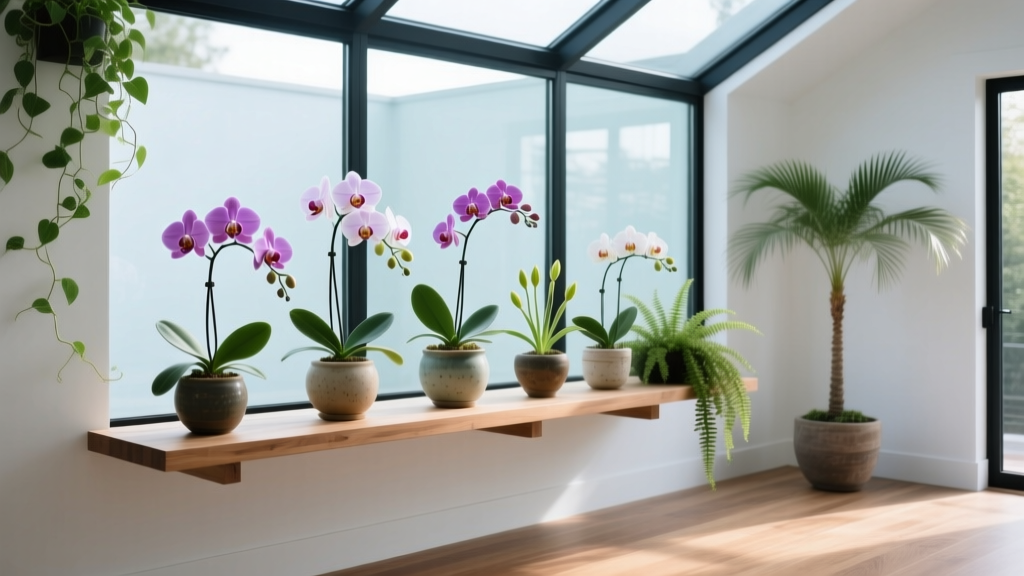
Sunroom Orchid Display Setup
The sun is low and bright, and your sunroom feels like the best room in the house—until you notice the same thing every orchid grower eventually does: half the plants lean toward the glass, the other half sulk in shade, and watering day turns into a drippy obstacle course around chairs and side tables. You wanted a living display. What you’ve got is a scattered collection of pots fighting for light.
Let’s turn that into a designed orchid display—one that looks intentional, fits your daily life, and keeps plants healthy. I’ll walk you through it the way I would on a site visit: we’ll measure the space, map the sun, build a simple layout with good airflow, and choose orchids that actually match the conditions your sunroom can deliver.
Start with the room you have: light, heat, and human traffic
Measure first (it prevents 90% of “why doesn’t this fit?”)
Grab a tape measure and note three numbers: the length of the window wall, the depth of the usable floor area, and the height you can safely use. A common sunroom niche is a 6 ft (1.8 m) window run with about 30 in (76 cm) of depth before you hit a walkway. That 30 inches matters: you’ll want at least 24 in (61 cm) of clear path for comfort, especially in rentals.
If you’re working with a tighter footprint—say a 4 ft x 2 ft (122 cm x 61 cm) corner—plan vertically. If you have a roomy sunroom with 8–10 ft (2.4–3 m) of glazing, you can create a true “orchid gallery” with zones.
Map sunlight hours like a designer, not a guesser
Orchids don’t need “full sun” the way tomatoes do, but they do need consistent, appropriate intensity. Over a clear day, many sunrooms deliver anywhere from 2 to 7 hours of direct sun depending on orientation and nearby trees/buildings.
Stand in the room at three times: morning, midday, late afternoon. Mark where sun lands with painter’s tape on the floor or shelf line. You’re creating three bands:
- Hot band (direct sun hits): closest to glass where leaves can scorch.
- Bright band (bright shade): 12–24 in (30–61 cm) back from the glass—prime orchid real estate.
- Soft band: deeper in the room for lower-light orchids and propagation.
Light targets help you match plants to places. The American Orchid Society notes that many orchids grow well in bright, indirect light and that direct midday sun can burn foliage (American Orchid Society, 2023). That’s your guiding truth for most sunrooms: filter the light, then place plants by need.
Ventilation is part of the design, not an accessory
Orchids love humidity, but they hate stale air. Design for a gentle airflow lane: leave 3–6 in (8–15 cm) between plants and the window and avoid packing pots shoulder-to-shoulder. If your sunroom runs warm, a small oscillating fan on low can prevent fungal issues and help roots dry appropriately after watering.
“Good air movement is as important as humidity for orchid health; humidity without air movement can increase disease pressure.” — American Orchid Society culture guidance (2023)
Layout strategies that make orchids look curated (and grow better)
The “window-to-room gradient” plan (my default for most homes)
Think like a lighting designer: brightest near the glass, softer toward the room. Your display becomes a layered composition rather than a single crowded shelf.
Recommended spacing rules (practical and plant-friendly):
- 6–8 in (15–20 cm) between small pots (3–4 in pots), so leaves don’t overlap and stay wet.
- 10–12 in (25–30 cm) between larger Phalaenopsis in 5–6 in pots.
- 16–18 in (41–46 cm) headroom above tall spikes or mounted plants.
Build the display in three layers:
- Front line (bright band): compact bloomers you want to see daily.
- Middle line: foliage-interest plants and sequential bloomers.
- Back line (soft band): lower-light orchids and young plants.
Choose a staging system: shelves, bench, or hanging rail
Option A: A 48-inch wire rack is the most renter-friendly, easiest-to-adjust solution. A typical rack footprint is 48 in W x 18 in D x 72 in H (122 x 46 x 183 cm). Place it 12 in (30 cm) from the glass if you get strong direct sun; closer if your sun is filtered by trees.
Option B: A greenhouse bench (often 24 in D / 61 cm) gives a cleaner, designer look with one plane. Add a second “step” using upside-down trays to bring some plants closer to light without increasing crowding.
Option C: A ceiling-mounted hanging rail (for sturdy ceilings and owners, or rentals with permission) lets you mount or hang Vandas and mounted miniatures. Keep hanging plants 6–10 in (15–25 cm) away from glass to avoid cold-night leaf chill in winter.
Design the “watering lane” so maintenance stays easy
Here’s the secret of displays that last: they’re easy to water without moving everything. Plan a waterproof zone and a drip strategy from day one.
- Line shelves with 10 x 20 in (25 x 51 cm) nursery trays or boot trays to catch runoff.
- Group plants by watering frequency, not by “prettiest.”
- Keep a 2-gallon (7.6 L) watering can and a small towel basket right under the rack so you don’t wander through the house dripping.
Step-by-step setup: a designer’s build order
- Measure and mark the footprint. Use painter’s tape to outline the rack/bench and a 24–30 in (61–76 cm) walking lane.
- Filter harsh sun first. Install a sheer curtain or 30–50% shade cloth panel on the hottest window section. In many sunrooms, this reduces leaf scorch dramatically without making the room feel dim.
- Install the staging system. Level your rack/bench; wobble is a broken-pot guarantee.
- Add water protection. Place trays on every shelf. If the floor is wood or laminate, put a waterproof mat under the unit (a 36 x 48 in / 91 x 122 cm utility mat works well).
- Set up airflow. Aim a small fan across (not directly at) the plants. Keep it on low for 8–12 hours/day if humidity is high.
- Create three light zones. Front/bright, middle/medium, back/low. This is where plant selection starts making sense.
- Place plants in “families.” Put similar-care orchids together so you can water and fertilize in batches.
- Add a simple monitoring kit. A max-min thermometer and hygrometer help you catch heat spikes and dry air before plants complain.
Orchid selection: varieties that actually match sunroom conditions
Instead of buying “whatever’s blooming,” design a plant palette. You want a mix of reliable bloomers, sequential bloomers, and foliage/structure plants. Also—choose sizes that fit your staging. A 6-foot rack looks elegant with a rhythm of small and medium plants; three oversized specimens can make it feel crowded fast.
Bright, indirect light stars (the front-line showplants)
Phalaenopsis (moth orchids) are the best anchor for most sunrooms: they bloom for weeks, tolerate indoor conditions, and look polished in a display. Choose:
- Phalaenopsis ‘Sogo Yukidian’ (white, classic arching sprays) for a clean, gallery look.
- Phalaenopsis bellina for fragrance and compact habit (likes warm, bright shade).
- Mini Phalaenopsis hybrids for tight shelves; group three minis in matching pots for a designed effect.
Why they work: They prefer bright, filtered light and steady warmth; perfect for the “bright band.” The Royal Horticultural Society notes that many commonly grown orchids prefer bright light out of direct midday sun, aligning with typical indoor placement near a bright window (RHS, 2024).
Medium-bright performers (texture and repeat bloom)
- Oncidium ‘Sharry Baby’ (chocolate fragrance, branching sprays). Great for adding movement and scent.
- Brassia (spider orchids) for dramatic form; they read like living sculpture in a sunroom.
- Miltoniopsis hybrids (pansy orchids) if your sunroom stays cooler and evenly moist—best in the middle band away from hottest glass.
Why they work: These tend to enjoy brighter conditions than Phalaenopsis but still appreciate filtered sun and good airflow—exactly what a sunroom provides if you manage heat.
Lower-light choices (the soft band and deeper shelves)
- Paphiopedilum Maudiae-type hybrids (mottled leaves, long-lasting blooms). A perfect “interior shelf” orchid.
- Jewel orchids (Ludisia discolor) for foliage drama—velvet leaves and pink stems that look intentional in modern interiors.
- Phalaenopsis schilleriana for mottled foliage and graceful spikes; tolerates indoor light well.
Why they work: They can thrive with less intense light, allowing the back of your layout to stay planted instead of becoming a storage zone.
High-light statement pieces (only if your sunroom can support them)
- Cattleya intergenerics (big, showy blooms) for bright sunrooms with filtering. Place them 18–24 in (46–61 cm) back from hot glass.
- Vanda (in baskets) if you have strong light and can commit to frequent watering; these are “high-maintenance art.”
Why they work: They provide the architectural “wow,” but they demand light and routine. If your sunroom is north-facing or shaded, skip these and lean into Phals, Paphs, and jewel orchids.
Comparison table: match orchids to your sunroom reality
| Orchid type | Best placement in sunroom | Light tolerance | Watering rhythm | Design role |
|---|---|---|---|---|
| Phalaenopsis hybrids | Bright band, 12–24 in (30–61 cm) from glass | Bright, indirect; avoid hot midday sun | About every 7–10 days (varies by media) | Reliable bloom “anchors” |
| Paphiopedilum (Maudiae types) | Soft band or middle shelf | Lower to medium light | Keep evenly moist; usually 5–7 days | Foliage texture + long blooms |
| Oncidium ‘Sharry Baby’ | Middle line with airflow | Medium-bright; filtered direct OK | When nearly dry; often 5–7 days | Fragrance + airy movement |
| Cattleya hybrids | Brightest zone with filtering | Higher light; sunroom-friendly with shade | Dry slightly between waterings; 5–10 days | Seasonal “feature blooms” |
| Jewel orchid (Ludisia) | Back line / tabletop away from glass | Low-medium; hates harsh sun | Lightly moist; 5–7 days | Groundcover look + contrast |
Three real-world setups (so you can picture yours)
Scenario 1: The renter’s sunroom corner (4 ft x 2 ft footprint)
You’ve got a bright corner, but no permission to drill, and you need the setup to move when the lease ends. Use a 48 x 18 in (122 x 46 cm) wire rack turned perpendicular to the window so only the front edge gets direct sun. Add a sheer curtain panel to soften the hottest patch.
Plant plan: 4 mini Phals on the top shelf (front), 2 Oncidiums on the second shelf, and 2 Paphs plus a jewel orchid on the lower shelf. Keep 6–8 in spacing between minis; 10–12 in for larger plants.
Budget: Rack $60–$120, trays $20, small fan $20–$35. DIY alternative: thrifted baker’s rack + boot trays can land under $80 total if you’re patient.
Scenario 2: The south-facing sunroom that runs hot (leaf scorch risk)
This is the room that feels like a greenhouse at 2 p.m. in July. Your design job is to control intensity and heat spikes.
Layout move: Pull the bench or rack back 18–24 in (46–61 cm) from the glass and hang a 30–50% shade panel only where sun hits hardest. Use the hottest window section for Cattleyas or a single Vanda basket only if you can water frequently.
Plant plan: Cattleyas on the brightest top tier, Oncidiums mid-tier, Phals and Paphs slightly deeper. Avoid Miltoniopsis unless you can keep conditions cool and evenly moist.
Cost note: Shade cloth and clips are often $25–$60, far cheaper than replacing scorched orchids.
Scenario 3: The north/east-facing “bright but not sunny” sunroom (gentle light, consistent comfort)
This is the easiest sunroom to design for because you’re rarely fighting leaf burn. The risk here is not enough light for bloom.
Layout move: Place plants closer—6–12 in (15–30 cm) from the glass—since heat is usually mild. Use reflective backing (even a white foam board behind the shelf) to bounce light into the lower tiers.
Plant plan: Phals and Paphs will thrive. Add jewel orchids for lushness. Skip Vandas and most high-light Cattleyas unless you supplement with a grow light.
Practical add-on: A simple LED grow bar (often $30–$80) on a timer for 10–12 hours/day can turn “pretty leaves” into reliable blooms.
Budget planning: what to spend on (and what to DIY)
If you spend money anywhere, spend it on the bones: stable staging, water containment, and light management. Plants are the fun part—but the system keeps them alive.
- Staging: $60–$200 depending on rack vs bench. DIY: sealed wood shelves + plastic trays (seal wood carefully).
- Water containment: $15–$50 in trays and mats. DIY: boot trays, cafeteria trays, or repurposed storage lids.
- Air movement: $20–$40 for a small oscillating fan. DIY: none recommended—airflow is hard to fake.
- Light control: $25–$60 for shade cloth/sheers; $30–$80 for LED bars if needed.
- Orchid pots/media refresh: Plan $25–$60 to repot a small collection (bark, sphagnum, clear pots).
One concrete planning tip: design around a 12-plant maximum for a standard 48-inch rack at first. That’s enough for a full look without becoming a chore. You can always add later once you learn the room.
Maintenance expectations: what it really takes to keep it looking sharp
A well-designed sunroom orchid display shouldn’t eat your weekends. With trays, spacing, and plant grouping, most homeowners can maintain a 10–15 plant display in about 30–60 minutes per week.
Weekly rhythm (simple and realistic)
- Watering: 20–40 minutes total (varies by season and media). Water in the morning so foliage dries by night.
- Quick inspection: 5 minutes to check pests, sticky leaves, and mushy roots.
- Wipe shelves/trays: 5–10 minutes to keep algae and mineral buildup from becoming “the look.”
Seasonal tasks (where displays succeed or fail)
- Spring: Repot fast growers; refresh bark. Expect to repot many orchids every 1–2 years depending on media breakdown and root health.
- Summer: Watch heat spikes. Increase airflow; add shade if leaves yellow or redden quickly.
- Fall: Many orchids initiate spikes as nights cool slightly. Keep plants stable—don’t rotate constantly once spikes appear.
- Winter: Protect from cold glass at night; pull plants back 2–6 in if the window chills. Humidity can drop; use a tray-and-pebble approach for micro-humidity (with airflow) rather than fogging the room.
If you want a single “designer trick” for long-term neatness: keep two empty tray spaces on your rack. Those are your quarantine/rehab spots for a struggling plant, and they prevent the entire display from turning into triage mode.
Citations (for light and care guidance you can trust)
Two references I routinely lean on for indoor orchid culture principles:
- American Orchid Society. (2023). Culture guidance on orchid light, humidity, and air movement. aos.org
- Royal Horticultural Society (RHS). (2024). Orchid care advice for indoor growing and light placement. rhs.org.uk
When your sunroom orchid display is set up with a clear light gradient, a watering lane, and plants chosen for the conditions you actually have, the whole space changes. You stop shuffling pots like furniture, and your orchids start reading like a collection—layered, intentional, and easy to live with. The best part is the feeling on a winter morning: you step into the sunroom with a cup of coffee, and the display looks like it belongs there—because now it does.