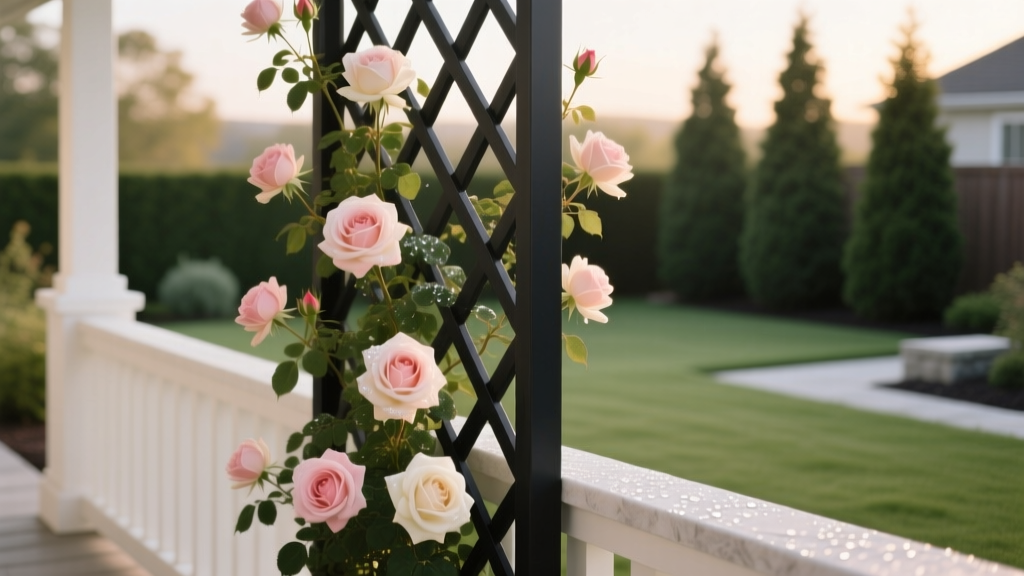
Porch Climbing Rose Trellis Design
The porch looks fine from the street—until you sit down with a coffee and notice the view: a blank post, a glare of afternoon sun on siding, and a railing that feels a little too “builder basic.” You want softness and scent, something that makes the entry feel like a room. But you also want to keep the walkway clear, the door functional, and the maintenance realistic. That’s exactly where a climbing rose trellis earns its keep: it turns vertical space into a living screen, frames your porch like architecture, and gives you flowers at eye level instead of hidden in a back bed.
This project is less about buying a pretty trellis and more about designing a structure that fits your porch dimensions, your sun pattern, and your tolerance for pruning. I’ll walk you through layout strategies, specific rose varieties that behave well in tight quarters, and three real-world porch scenarios—renter-friendly included—so you can build something that looks intentional from day one and gets better every season.
Start With the Porch: Measure What Matters
Before you pick a rose, pick a location. Most porch trellises fail for one of three reasons: they block circulation, they trap moisture against siding, or they’re undersized for the rose’s eventual weight.
Core measurements (take these first)
Use a tape measure and jot these down:
- Clear walkway width: Keep at least 36 inches clear for comfortable entry; 42 inches is better if two people pass often.
- Distance from trellis to siding: Plan 4–6 inches of air gap so leaves dry quickly and paint lasts longer.
- Available height: From soil (or pot rim) to the porch roof/beam. Many porch-friendly climbers are happy at 6–10 feet with training.
- Sun hours: Count direct sun on the trellis face. Most roses bloom best with 6+ hours of sun; some tolerate 4–5 hours with reduced bloom.
Quick reality check: If your porch face only gets 2–3 hours of sun, you can still do a trellis, but you’ll want to shift to a brighter corner, use a lighter-blooming rose (or even mix in shade-tolerant clematis), and prioritize disease resistance.
Design Principles That Make a Rose Trellis Look Built-In
1) Treat the trellis like porch architecture
A rose trellis should echo the lines of your porch—posts, rails, or columns—so it reads as an extension of the house. On most porches, a 24–30 inch-wide panel looks proportional beside a door, while a pair of 18–24 inch-wide panels can flank steps without crowding them.
If your porch has square posts, choose a trellis with a square grid or simple horizontals. If it has arches, you can repeat that curve at the top of the trellis for a “soft entry” effect.
2) Build for training: horizontals beat verticals
Climbing roses bloom more when canes are trained closer to horizontal, because it encourages more flowering laterals. The Royal Horticultural Society notes that “training stems horizontally encourages more flowers” (RHS, 2023).
That means your trellis should offer multiple tie points across the width—wires, slats, or a grid—rather than a ladder with only vertical uprights.
3) Keep the rose off the house
Even if you love that storybook look, letting canes press into siding is a moisture trap and a paint-peeler. Space the trellis out with stand-offs (short blocks or metal spacers) so the plant can breathe. A 4-inch air gap is usually enough; 6 inches is ideal in humid climates.
4) Size the structure for year three, not year one
A healthy climbing rose can produce long canes fast once established. Plan for a trellis that’s at least 7 feet tall if you want a porch column effect, and attach it securely. For most porch applications, aim for a panel around 2 feet wide × 8 feet tall (or two smaller panels), with strong anchoring.
Layout Strategies: Three Porch-Friendly Trellis Configurations
Option A: The “Door Frame” panel (single trellis beside the entry)
Best when you have one open wall section and want a simple vertical accent. Place the trellis so the rose can climb up and slightly over the door casing without interfering with the door swing. Keep the planting point at least 12–18 inches away from the foundation to avoid dry soil under the eaves.
Option B: The “Paired Columns” (two trellises flanking steps)
This is the most balanced look on a traditional front porch: two matching panels create symmetry, soften the railings, and give you twice the bloom without one plant having to do all the work. Use two roses or one rose plus a companion climber for seasonal layering.
Option C: The “Renter Screen” (freestanding trellis in containers)
If you can’t drill into the porch or dig near the foundation, build a freestanding trellis “wall” set into large containers. You get privacy, fragrance, and flowers, and you can take it with you. This approach also lets you rotate the trellis slightly to catch more sun.
Materials and Costs: What You’ll Spend (and Where to Save)
Here are realistic budget numbers for a porch-sized rose trellis project:
- Prefab wood or metal trellis panel: typically $60–$180 for a sturdy 2' × 6' to 2' × 8' panel.
- Cedar or pressure-treated DIY frame lumber: about $40–$90 depending on local pricing and size.
- Stainless or galvanized eye screws + wire: roughly $15–$35 for a wire-trained system.
- Large container for renter version (20–25 gallons): about $35–$120 each.
- Climbing rose (own-root or grafted): usually $35–$75 per plant.
If you’re looking for the sweet spot between durability and cost, a simple framed wire trellis (wood frame + horizontal tension wires) is often the best value. It’s also the easiest to train on, because you can tie canes wherever you want.
Comparing Trellis Styles for Porches
| Trellis style | Best for | Typical size | Pros | Watch-outs |
|---|---|---|---|---|
| Wood lattice panel | Traditional cottage look; quick install | 24" × 72" to 30" × 96" | Lots of tie points; warm look; easy to paint | Needs sealing/paint; can warp if thin |
| Wire-trained frame (horizontal wires) | Maximum bloom + clean, modern lines | 24" × 84" (common) | Encourages horizontal training; customizable spacing | Requires tensioning; needs solid anchors |
| Metal obelisk or tower (in a pot) | Renters; small porches | 72"–96" tall | No drilling; portable; vertical drama | Can tip in wind; may be narrow for true climbers |
Plant Selection: Climbing Roses That Behave Well on a Porch
For a porch trellis, the “best” rose is usually the one that stays healthy with average care and can be trained easily. Disease resistance matters more up close—nobody wants black spot leaves shedding onto porch chairs.
Top climbing rose picks (with practical reasons)
- ‘Zephirine Drouhin’ (Bourbon climber): Nearly thornless canes are kinder near doorways and railings. Strong fragrance. Performs with 4–5 hours of sun better than many climbers, though more sun increases bloom.
- ‘New Dawn’ (climber): A classic for a reason—repeat bloom, good vigor, and forgiving training. Ideal when you want a soft, romantic look and can provide 6+ hours sun.
- ‘Climbing Iceberg’ (climber): Bright white blooms show up at dusk and against darker siding. Great for a crisp, clean porch palette; looks especially sharp on black metal trellis.
- ‘Don Juan’ (climber): Deep red, fragrant flowers and strong vertical performance. Works well when you want bold contrast against light trim.
- ‘Lady Banks’ (Rosa banksiae, warm climates): Nearly thornless, with cascades of spring bloom. Best for mild winters; plan space and a substantial trellis.
Container-friendly options (for renters and tight footprints)
In containers, you want a rose that’s vigorous but not monstrous. Look for climbers described as “moderate” vigor, or consider a large shrub rose trained onto a small trellis.
- ‘Climbing Pinkie’ (small climber): Good for smaller trellises and containers; repeat bloom and manageable canes.
- ‘Bathsheba’ (David Austin climber in many regions): Apricot tones, strong fragrance, and a lush look that pairs beautifully with a porch seating area.
For disease management, remember the practical rule: more airflow, less leaf wetness. That’s not just a gardener’s saying—plant pathology research consistently links leaf wetness duration with disease development in many ornamentals. Keep your trellis off the wall and avoid overhead watering.
“Training climbing roses with main stems as close to horizontal as possible increases the number of flowering shoots.” — Royal Horticultural Society (RHS), 2023
Step-by-Step: Installing a Porch Trellis That Can Handle a Real Rose
This setup assumes a wall-mounted trellis panel beside a porch (the most common scenario). Adjust as needed for your configuration.
- Find your studs or solid structure. Use a stud finder on wood framing, or locate masonry anchors points on brick. A mature rose can get heavy; avoid fastening only into thin trim.
- Mark the air gap. Plan stand-offs for a 4–6 inch gap between trellis and siding.
- Mount the trellis securely. Use exterior-rated screws and appropriate anchors. For a 2' × 8' trellis, aim for at least 4 strong attachment points (top and bottom corners).
- Prepare the planting area. If planting in-ground, loosen a zone roughly 18–24 inches wide. Mix in compost. If planting in a pot, use a container at least 20 gallons with drainage.
- Plant with spacing in mind. Set the rose so the base is about 12–18 inches from the trellis plane (or centered in the pot), giving room to angle canes toward the structure.
- Water deeply and mulch. Apply 2–3 inches of mulch, keeping it off the crown. Water at the soil line.
- Begin training immediately. As new canes grow, loosely tie them to the trellis every 12–18 inches using soft ties. Don’t wait for the canes to stiffen.
Real-World Scenarios: Three Porches, Three Solutions
Scenario 1: Narrow townhouse porch with a straight shot walkway
The problem: The porch is only 48 inches deep from door to railing, so anything that protrudes becomes a shoulder-check hazard.
The design move: Use a wall-mounted wire trellis that stays nearly flush, with a 4-inch stand-off. Choose one climber—‘Climbing Iceberg’ if the area is bright—to visually widen the porch with light-colored bloom.
Spacing: Keep the trellis width to 18–24 inches and start it 8–12 inches above the porch floor so sweeping is easy.
Budget approach: DIY a simple frame with horizontal wires for around $70–$140 (wood + wire + fasteners), plus the rose.
Scenario 2: Covered porch with morning sun only (4–5 hours)
The problem: The roof cuts afternoon light; roses can sulk, and black spot pressure can rise if foliage stays damp.
The design move: Pick a variety known to cope with less sun—‘Zephirine Drouhin’ is often used in brighter shade conditions—then prioritize airflow: 6-inch stand-offs, no overhead watering, and keep the base out from under the deepest eave line if possible.
Layout tip: Angle the trellis slightly toward the brighter side of the porch (even a small rotation helps), and keep companion plants low so breezes move through.
Maintenance expectation: You may do more selective thinning to keep leaves dry—plan 20–30 minutes/week during peak growth.
Scenario 3: Renter-friendly porch with no drilling and no digging
The problem: Lease rules forbid mounting hardware; you need portable beauty.
The design move: Use two 25-gallon containers with a sturdy metal trellis or obelisk in each, set just inside the railing line so you maintain a 36-inch clear path. Train canes upward and then fan them outward to create a living privacy panel.
Plant choice: A moderate climber like ‘Climbing Pinkie’, or a vigorous shrub rose trained up, depending on your sun. Avoid the most massive climbers—they’ll outgrow the pot fast.
Hidden trick: Add weight for wind stability: a layer of gravel in the bottom 2 inches (without blocking drainage holes), and use heavy pot feet to keep airflow under the container.
Companion Planting on a Porch: Keep It Neat, Not Crowded
On porches, companions should do three things: cover the soil, echo the rose color, and stay tidy near foot traffic.
- Lavender (‘Hidcote’ or ‘Munstead’): Drought-tolerant, neat mounds, and visually “ties in” with rose fragrance. Best with 6+ hours sun.
- Catmint (Nepeta ‘Walker’s Low’): Softens the base with a long bloom season and doesn’t mind heat reflecting off porch steps.
- Sweet alyssum: Annual living mulch that spills gently without becoming a tripping mess.
- Evergreen structure (small boxwood alternative in pots): If boxwood blight is a concern in your area, consider a compact holly or dwarf conifer in a container to anchor the look in winter.
Keep companion plants at least 12 inches away from the rose crown so you can water and inspect canes without wrestling foliage.
Maintenance: What It Really Takes (Week by Week, Season by Season)
A porch trellis rose isn’t difficult, but it is interactive—you’ll be tying, guiding, and trimming like you would with a well-tailored hedge.
Weekly time estimate
- First year: about 15–25 minutes/week (watering checks, a few ties, quick inspection).
- Established plants: about 20–40 minutes/week in the growing season (deadheading, training, pest check). In winter, it drops to near zero except pruning day.
Seasonal task list
- Early spring: Prune out dead or crossing wood; refresh mulch; check trellis fasteners and wire tension.
- Late spring to midsummer: Train new canes every couple of weeks; deadhead repeat bloomers; water deeply during heat.
- Late summer: Ease up on high-nitrogen feeding so growth can harden; keep training long canes to prevent wind breakage.
- Fall: Remove fallen leaves (important near porches); do a final tie-down before storms.
- Winter (cold climates): Secure canes; avoid heavy pruning until late winter/early spring.
For fertilizing, follow label directions for a rose fertilizer, and avoid overfeeding in containers. If you’re watering by hand, a deep soak is more effective than frequent sips—especially under an eave where rain doesn’t reach.
Sunlight, Training, and Bloom: Setting Expectations With Real Data
Roses want sun. Many extension services recommend at least 6 hours of direct sunlight for best flowering and plant health; fewer hours typically means fewer blooms and more disease pressure. The University of Minnesota Extension notes that roses generally perform best in full sun (University of Minnesota Extension, 2020).
That said, porches are rarely perfect full-sun sites. Your design can compensate: reflect light with a pale trellis color, open up airflow, and prioritize varieties known for vigor and resilience.
DIY Alternatives That Still Look High-End
If you want the “designed” look without custom fabrication, here are practical shortcuts that hold up:
- Cattle panel trellis: Cut a section to fit a wooden frame. It’s strong, gives excellent tie points, and reads surprisingly modern once painted black.
- Wire-and-eye-screw system: For a minimalist porch, run 4–6 horizontal wire lines across a framed area. This is one of the best training systems for bloom.
- Repurposed bed headboard (metal): Works especially well for renter container setups; just ensure it’s stable and rust-safe.
Spend your money where it shows: a sturdier trellis and a healthier plant. Save money on things that don’t: you can mix your own compost blend, and you don’t need fancy ties—soft Velcro plant tape works beautifully and is inexpensive.
The best porch climbing rose trellis designs don’t shout for attention on day one. They start as clean structure, a well-placed plant, and a little patience. By the second summer, you’ll notice the porch feeling quieter and cooler—filtered light, a bit of privacy, and that moment when you open the door and catch the rose fragrance before you even step outside.
Sources: Royal Horticultural Society (RHS), 2023. University of Minnesota Extension, 2020.