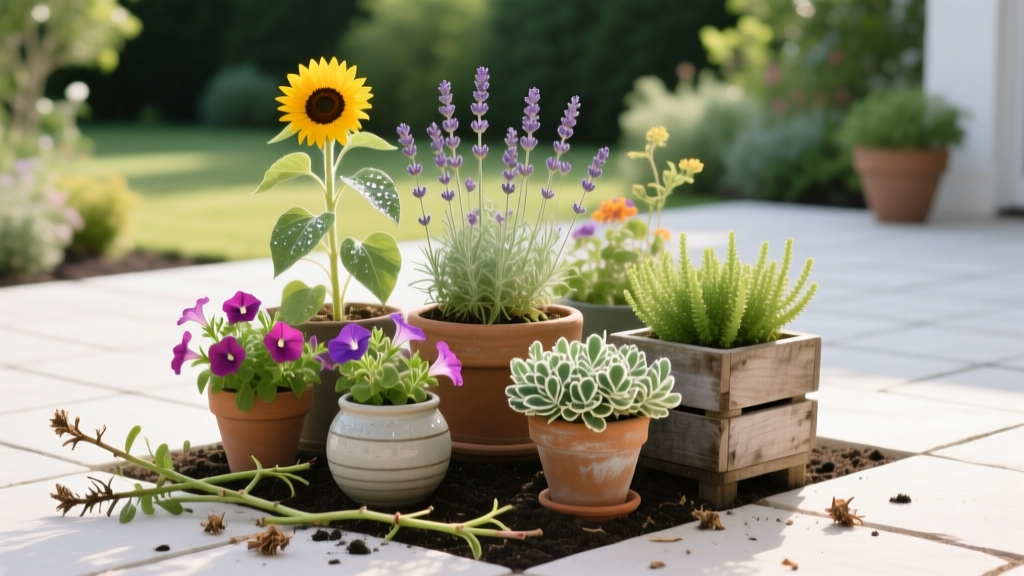
Summer Container Garden Refresh and Deadheading
Mid-summer containers can go from “thriving” to “tired” in a single hot week. If you’re seeing faded blooms, stretched stems, crusty potting mix, and plants that wilt by noon, you’re right on time: this is the window when quick, targeted work pays off fast. A 30–60 minute refresh now can buy you another 6–10 weeks of color—often right up to your first frost date.
Use this guide like an almanac: start with the highest-impact tasks (watering, deadheading, light pruning), then move to planting replacements and protecting containers from heat, pests, and storm stress. Keep your local forecast handy—especially when daytime highs hit 90°F, nights stay above 70°F, or you’re within 8–10 weeks of your average first fall frost.
Priority 1 (Do This First): Restore Water, Roots, and Nutrition
1) Rehydrate intelligently (and check if your potting mix is repelling water)
Summer potting mix can become hydrophobic—water runs down the side of the pot and out the drain holes while roots stay dry. This shows up as “I watered and it still wilted.” Fix it before you fertilize or prune.
- Morning is best (roughly 6–10 a.m.). If your plant wilts daily, it needs moisture before heat builds.
- Soak test: Water until it runs out the bottom, wait 10 minutes, then water again. If the second watering soaks in slowly, you’ve re-wet the root zone.
- Emergency dunk: For small pots (up to ~12 inches), submerge the container in a tub for 10–20 minutes until bubbles stop, then drain.
- Temperature trigger: At sustained highs above 85–90°F, expect daily watering for many annuals in small pots; twice daily is possible for black containers in full sun.
Extension guidance consistently emphasizes that containers dry faster than in-ground beds and need closer monitoring in heat. NC State Extension notes container plants may require watering daily in summer, sometimes more in hot, windy weather (NC State Extension, 2020).
2) Top-dress and patch the potting mix (without repotting everything)
If your container has sunk 1–2 inches since planting, roots are exposed and water moves too quickly. Refresh the surface:
- Scrape off and discard the top 1 inch of crusty mix if it’s salty or compacted.
- Add fresh potting mix plus compost (up to 20–30% by volume) to bring soil level back to 1 inch below the rim.
- Finish with a thin mulch layer (1/2 inch) of fine bark or compost to reduce evaporation.
3) Reset fertility (containers run out of food quickly)
By mid-summer, most containers have depleted slow-release fertilizer and leached nutrients from frequent watering. Nutrient stress often looks like pale leaves, fewer flowers, and weak growth.
- If you used slow-release granules in spring: Many formulations last ~8–12 weeks. If you’re past that window, scratch in a light re-application per label.
- Weekly feed option: Use a water-soluble fertilizer at 1/2 strength every 7–10 days for flowering annuals.
- Heat rule: If daytime highs are above 90°F and plants are wilt-prone, feed after a deep watering and avoid fertilizing drought-stressed plants.
Research-based recommendations for annual bedding plants emphasize that consistent moisture and regular, moderate fertilization are key to sustained bloom in containers; over-fertilization can drive leafy growth at the expense of flowers and increase stress in heat (University of Minnesota Extension, 2019).
Priority 2: Deadheading and Mid-Summer Pruning (The Fastest Way to Restore Bloom)
Deadheading isn’t cosmetic—it redirects energy from seed production to new flowers. In containers, it also prevents rot and fungal issues from spent petals accumulating on damp soil.
Deadheading: what to cut, and how far back
- Petunias, calibrachoa: Pinch or snip just above a leaf node; if leggy, shear back by 1/3 and feed after watering.
- Geraniums (Pelargonium): Remove the entire flower stalk at the base (don’t just pluck petals).
- Marigolds, zinnias: Cut spent blooms back to the next set of leaves to encourage branching.
- Salvia, snapdragons: Cut flower spikes back by 1/3 or to a side shoot; many rebloom within 10–14 days.
- Begonias, impatiens: Often self-cleaning; focus on removing brown leaves and any mushy stems.
The “mid-summer haircut” (when plants are stretched and tired)
If your container looks sparse in the middle with long stems hanging over the rim, do a controlled reset:
- Shear flowering annuals back by 25–40% (not all at once for mixed planters—stagger over 7 days).
- Remove weak, crossing, or shaded stems at the base to improve airflow.
- Water deeply, then fertilize lightly. Expect a flush of growth within 2–3 weeks.
Quick checklist: Deadheading session (15–20 minutes per large pot)
- Bring clean snips and a bucket.
- Remove spent blooms and seed heads first.
- Cut back leggy stems to a node.
- Pull yellow leaves and any petals stuck to soil.
- Check undersides of leaves for pests before you put tools away.
What to Plant Right Now (Smart Replacements and Fill-Ins)
Summer is not too late to plant in containers—if you match plants to heat and your frost timeline. Use your average first frost date as the anchor. Many gardeners in USDA Zones 3–5 may have first frost around Sept 20–Oct 10; Zones 6–7 often fall around Oct 15–Nov 10; Zones 8–10 may not see frost until Dec or later (or not at all).
Heat-proof bloomers for the next 6–10 weeks
- Lantana (best in full sun; thrives above 85°F)
- Angelonia (excellent for hot patios; steady bloom)
- Vinca (Catharanthus; heat tolerant; avoid overwatering)
- Celosia (color holds in heat; good for bold accents)
- Sweet potato vine (foliage filler; fast recovery after pruning)
Fast edible refreshers (short timeline crops)
If you’re within 8–10 weeks of first frost, focus on quick crops:
- Leaf lettuce, arugula: often harvestable in 30–45 days (best with afternoon shade in hot zones).
- Basil: thrives when nights are above 55–60°F; pinch weekly to prevent flowering.
- Green onions: quick and forgiving in containers.
Three regional “right now” scenarios
Scenario A: Hot and humid (Southeast, Gulf Coast; USDA Zones 7b–10)
If nights stay above 70°F and afternoon thunderstorms are frequent, prioritize airflow and disease prevention. Choose heat lovers (vinca, lantana, pentas). Avoid crowding—fungal leaf spots explode when foliage stays wet overnight.
Scenario B: Hot days, cool nights (High elevation West; USDA Zones 4–7)
You can get strong rebloom from a mid-summer haircut because cooler nights (50–60°F) reduce stress. Watch wind: containers can dehydrate in a single afternoon. Add windbreaks and water deeply.
Scenario C: Coastal/marine influence (Pacific Northwest; USDA Zones 7–9)
If summer is mild (70–80°F) and nights are cool, petunias and calibrachoa may keep going with weekly feeding and consistent deadheading. Slugs can be a container issue—especially under dense foliage—so elevate pots and remove hiding spots.
What to Protect (Heat, Sunscald, Storms, and Container-Specific Stress)
Heat management: move pots before you move plants
In a heat wave, relocation beats constant rescue watering.
- Shift sun-loving containers from 10+ hours of sun to 6–8 hours temporarily during 95°F spikes.
- Protect roots: slip a nursery pot into a larger decorative pot to create an insulating air gap.
- Light-colored containers run cooler than black plastic. If you can’t swap, wrap the pot with burlap or shade cloth during extreme heat.
Sunscald and leaf scorch: recognize it quickly
Sunscald often shows as bleached patches on leaves facing the sun; scorch shows brown, crispy edges. It’s common after moving a container from shade to full sun or after aggressive pruning in hot weather. Provide 30–40% shade for 7 days and keep moisture steady.
Storm-proofing: keep tall containers upright
- Group pots together to reduce tipping.
- Remove saucers during heavy rain to prevent waterlogging.
- Stake tall “thrillers” (canna, ornamental grass) before storms arrive.
Pest and Disease Prevention That Matters in Summer Containers
Containers concentrate plant stress—and stressed plants attract pests. The goal is early detection and simple controls before you reach for stronger measures.
Weekly scouting (5 minutes per container)
- Check new growth for aphids (sticky leaves, clustered insects).
- Inspect undersides for spider mites (fine webbing, stippled leaves), especially in hot, dry weather above 85°F.
- Look for whiteflies (cloud of tiny white insects when disturbed).
- Scan for thrips (distorted flowers, streaked petals), common on petunias and daisies.
Container-appropriate controls (practical and repeatable)
- Blast with water: A strong spray dislodges aphids and mites; repeat every 2–3 days for 1–2 weeks.
- Insecticidal soap or horticultural oil: Useful for soft-bodied pests; apply early morning/evening and avoid spraying when temps exceed 85–90°F to reduce plant injury risk. Follow label directions precisely.
- Sanitation: Remove spent blooms and fallen leaves—this reduces botrytis and keeps fungus gnats down.
Disease watch: botrytis, powdery mildew, and root rot
- Botrytis (gray mold): common when faded petals stick to damp foliage. Deadhead aggressively and increase airflow.
- Powdery mildew: shows as white, dusty coating in humid nights and crowded pots. Thin stems and avoid overhead watering late in day.
- Root rot: if the pot stays wet and plants wilt anyway, suspect root issues. Remove the plant and check roots: healthy roots are white/tan; rotten roots are brown/black and slimy. Improve drainage and replace mix.
Integrated pest management recommendations from extension services emphasize monitoring and using the least-toxic effective options first, escalating only if thresholds are exceeded (UC IPM, 2021).
What to Prepare (Late-Summer Transition, Succession, and Fall Color)
As soon as you’re within 6–8 weeks of your average first frost, begin transitioning at least one container toward late-season performance. This prevents the “everything collapses at once” look in early fall.
Plan the handoff: summer to fall containers
- Keep one or two heat lovers as anchors (lantana, ornamental pepper, sweet potato vine).
- Prepare space for cool-season inserts once nights fall below 55°F: pansies, violas, ornamental kale, and mums perform better in cooler weather.
- Stock fresh potting mix and slow-release fertilizer now—fall refresh is easier when supplies are on hand.
Timeline checklist: a 4-week refresh cycle
- Week 1: Rehydrate, top-dress, start deadheading every 3–4 days.
- Week 2: Light shear (up to 1/3) on leggy annuals; feed after deep watering.
- Week 3: Replace one failing plant per container (the “weak link”); refresh mulch layer.
- Week 4: Scout pests; adjust light exposure; prepare a fall container plan if within 6–8 weeks of frost.
Monthly Schedule: Summer Container Refresh at a Glance
| Month/Window | What to do this week | Trigger numbers to watch | Best targets |
|---|---|---|---|
| Late June–Early July | Deep water routine; begin regular deadheading; light feeding | Highs 85°F+; mix sinking 1 inch | Petunias, geraniums, calibrachoa, herbs |
| Mid-July | Top-dress potting mix; mid-summer haircut (staggered); pest scouting | Leggy growth; daily wilt; slow-release past 8–12 weeks | Petunias, verbena, salvia, sweet potato vine |
| Late July–Mid August | Replace failing plants; heat protection; disease sanitation | Heat waves 95°F+; nights 70°F+ (humid zones) | Swap in lantana, vinca, angelonia, celosia |
| Late August–September | Begin fall transition; reduce nitrogen; keep deadheading | Within 6–8 weeks of first frost; nights <55°F | Add pansies/violas/kale where suitable |
Deadheading and Pruning by Plant Type (Quick Comparison)
| Plant | Deadhead method | Mid-summer pruning? | Expected rebound |
|---|---|---|---|
| Petunia | Pinch above node; remove seed pods | Yes, shear back 1/3 | 2–3 weeks |
| Geranium (Pelargonium) | Remove whole flower stalk at base | Light thinning only | 10–21 days |
| Calibrachoa | Snip tips; remove stuck blooms | Yes, selective cutback | 2 weeks |
| Marigold | Cut back to leaf set | Optional, light shaping | 7–14 days |
| Salvia | Cut spent spikes to side shoot | Yes, cut back 1/3 | 10–14 days |
Three Common Mid-Summer Problems (and the Fix That Works)
Problem 1: “My container looks green but barely blooms.”
Cause is often excess nitrogen, low light, or missed deadheading. Fix: stop high-nitrogen feeds, move to brighter light (add 1–2 hours of sun if possible), deadhead thoroughly, then use a bloom-leaning fertilizer at half strength weekly for 2–3 weeks.
Problem 2: “It wilts every day even after watering.”
Check for hydrophobic mix, rootbound pots, or root rot. Fix: soak twice, then evaluate drainage. If roots are circling densely, you may need to lift the plant, tease roots lightly, and add fresh mix around it. If roots are rotten, replace the plant and the potting mix (don’t reuse compromised soil).
Problem 3: “Leaves are speckled and dull; webbing appears.”
Likely spider mites, especially during hot, dry stretches. Fix: rinse undersides with water every 2–3 days, increase humidity around plants (grouping helps), and apply labeled miticide/insecticidal soap if pressure persists.
Right-Now Checklist (Print This Mental List Before You Go Outside)
- Water deeply, wait 10 minutes, water again.
- Remove spent blooms and seed heads; clear petals from soil.
- Cut back leggy annuals by 25–40% (stagger mixed planters).
- Top-dress potting mix to within 1 inch of rim; add a thin mulch layer.
- Feed lightly after watering (especially if past 8–12 weeks since slow-release application).
- Scout undersides of leaves for mites/aphids/whiteflies.
- Move stressed containers to 6–8 hours sun during extreme heat.
- Note your first frost date; if within 6–8 weeks, plan a fall handoff container.
When you stay ahead of spent blooms and moisture stress, containers stop acting like emergencies and start behaving like steady performers. Make one pass today (water + deadhead), one pass in a week (top-dress + prune), and you’ll be set up for a second peak—right when many gardens start fading.
Citations: NC State Extension (2020), container watering and summer care guidance; University of Minnesota Extension (2019), research-based annual care emphasizing consistent moisture and appropriate fertilization; UC IPM (2021), integrated pest management monitoring and least-toxic control principles.