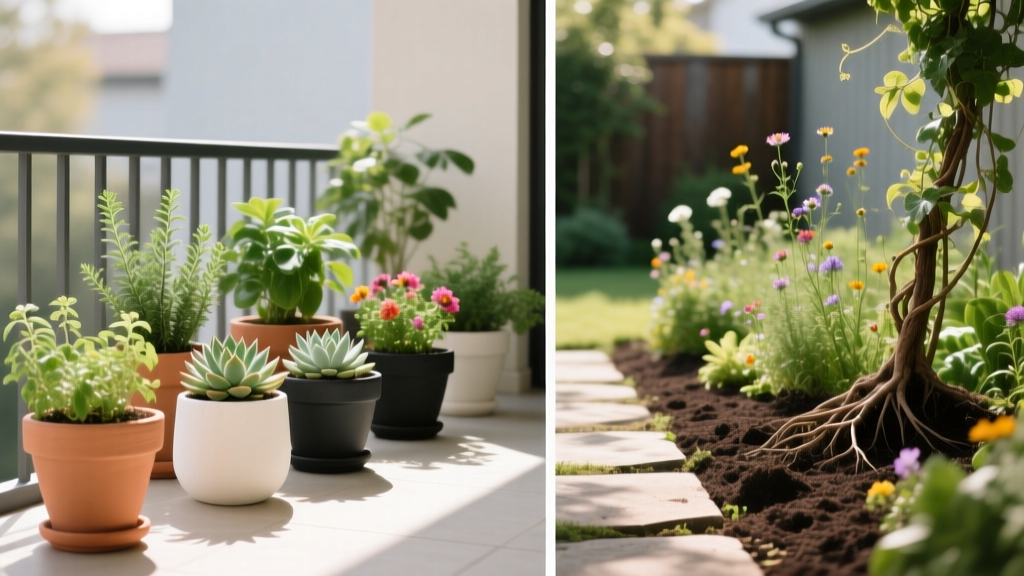
Container Gardening vs Ground Planting Comparison
The most common mistake I see isn’t “choosing the wrong plant”—it’s assuming a container is just a tiny version of garden soil. It’s not. A pot is basically a controlled ecosystem where roots hit walls, water behaves differently, and nutrients wash out faster, which is why the same tomato that thrives in-ground can sputter in a 5-gallon bucket.
If you’ve ever wondered why your patio peppers look “stuck” while your neighbor’s in-ground plants are exploding, it usually comes down to a handful of fixable details: container volume, potting mix physics, and a watering/fertilizing rhythm that matches how containers actually work.
Quick comparison: the stuff that changes everything
| Category | Container Gardening | Ground Planting |
|---|---|---|
| Root space | Limited by pot size; roots circle if cramped | Expands outward/downward; more buffering |
| Watering rhythm | Often daily in heat; dries faster | Less frequent; deeper watering holds longer |
| Soil medium | Soilless/potting mix; drains fast; nutrients leach | Mineral soil; holds nutrients; biology more stable |
| Fertilizer needs | Small doses more often (weekly/biweekly) | Can be seasonal; slower nutrient swings |
| Weeds & pests | Fewer weeds; easier to isolate problems | More weed pressure; broader pest access |
| Cost to start | Higher upfront (pots, mix); scalable | Lower if you already have soil; bed prep tools may add cost |
| Mobility | Can move for sun, storms, frost | Fixed location; microclimate is what it is |
One research-backed reality check: container substrates behave differently than field soil because they’re engineered for porosity and drainage. Penn State Extension (2019) notes that potting mixes are typically soilless and designed to hold air and water in a narrow root zone—great for roots, but it also means you manage moisture and fertility more actively than in-ground.
“Container media are designed to drain quickly and hold adequate air, which means they dry out faster than garden soil and require more frequent irrigation.” — Penn State Extension, 2019
Group 1: Root space hacks (where most “mystery problems” start)
Tip: Match pot size to the crop—don’t guess
A “big enough” container is usually bigger than people think. For full-size tomatoes, aim for 10–15 gallons; peppers do well in 3–5 gallons; salad greens can be happy in 6–8 inches of soil depth. A real-world example: if your tomato is in a 5-gallon pot and wilts by noon despite watering, it’s often root-bound and overheating—moving it to a 15-gallon container can fix that in a week.
Tip: Stop root circling before it starts
When roots hit smooth plastic, they circle, which creates a “strangled” root ball that can’t forage efficiently. Use fabric pots, air-pruning pots, or do a DIY fix: drill extra side holes (not just bottom holes) every 2–3 inches around the container to encourage branching. Example: gardeners growing citrus in tubs often see better growth after switching from slick nursery pots to fabric grow bags.
Tip: In-ground plants still need “root rules” (spacing is fertilizer)
In the ground, your biggest root mistake is crowding—plants compete underground long before you see it above ground. Use spacing that matches mature size, not seedling size: tomatoes at 24–36 inches, peppers at 18–24 inches, bush zucchini at 3–4 feet. Example: two tomato plants jammed into one raised bed corner often yield less than one properly spaced plant because roots and airflow both suffer.
Group 2: Soil and mix shortcuts (the hidden engine of growth)
Tip: Don’t fill containers with garden soil—use a mix that stays airy
Garden soil compacts in pots and collapses air spaces, leading to soggy roots and slow growth. Use a quality potting mix or make a simple DIY blend: 2 parts screened compost + 2 parts coco coir (or peat) + 1 part perlite/pumice. Example: basil in straight garden soil often turns yellow from root stress; in an airy mix, it rebounds with darker leaves and faster regrowth after harvest.
Tip: For in-ground beds, steal the “container mindset”: build structure with organic matter
Ground planting wins on buffering—but only if the soil is workable. Add 1–2 inches of compost on top each spring and let worms do the mixing, rather than rototilling everything into dust. North Carolina State Extension (2020) recommends organic matter additions to improve soil structure and water-holding—especially in sandy or heavily compacted soils.
Tip: Use mulch differently in pots vs beds
In containers, a 1-inch layer of fine mulch (pine bark mini-nuggets or shredded leaves) slows evaporation without smothering the surface. In-ground, go thicker—2–4 inches of straw, shredded leaves, or wood chips—because it also blocks weeds and moderates soil temperature. Example: a mulched raised bed can cut weeding time drastically, while a lightly mulched pot can buy you an extra day between waterings in mild weather.
Group 3: Watering strategies that actually work (no “water regularly” nonsense)
Tip: Use the “lift test” for containers—your hands are a moisture meter
Instead of guessing, pick up the pot: if it feels dramatically lighter than yesterday, it’s time. Water until you get 10–20% runoff, which flushes salts and ensures the whole root ball gets wet (especially important in peat/coir mixes that can dry unevenly). Example: patio cucumbers often fail because water only wets the top inch; deep watering with visible runoff prevents that “dry core” problem.
Tip: Add a $3 watering hack: a DIY reservoir or wicking setup
If daily watering is ruining your summer, build a self-watering system. DIY version: set a pot on a shallow tray and run a strip of cotton rope (or old T-shirt fabric) from the tray up into the potting mix as a wick; keep the tray topped up. Example: balcony gardeners often keep lettuce going longer using a simple wick system because moisture stays more even during hot spells.
Tip: In-ground watering should be deep and timed—aim for morning, not evening
Most vegetables prefer about 1 inch of water per week from rain/irrigation, but delivered deeply so roots chase moisture downward. Water early to reduce disease pressure; damp leaves overnight are a fungal party. Example: ground-planted squash with morning drip irrigation often shows less powdery mildew than overhead evening watering.
Group 4: Fertility and feeding (containers need a different cadence)
Tip: In containers, feed lighter but more often
Because nutrients leach out with runoff, containers do best with “small sips.” Use a balanced liquid fertilizer at 1/2 strength every 7–14 days, or top-dress with worm castings monthly. Example: container cherry tomatoes often stop setting fruit when they’re underfed; a biweekly feed schedule brings blossoms back within a couple of weeks.
Tip: For in-ground beds, front-load nutrients and let biology handle the rest
Ground soil holds nutrients better, so you can do a seasonal approach: compost + a slow-release organic fertilizer at planting, then one midseason boost for heavy feeders. A practical timing: side-dress corn and tomatoes around 4–6 weeks after transplanting when growth is accelerating. Example: gardeners who only fertilize once at planting often see tomatoes stall in midsummer; one side-dress can prevent the slump.
Tip: Watch for salt buildup in pots (the sneaky container killer)
If you fertilize and never flush, salts accumulate and roots struggle to take up water. Once a month, water heavily so at least 20% drains out the bottom, or repot with fresh mix each season for annuals. Example: container strawberries that look “dry” even in moist soil often perk up after a thorough flush and a lighter feeding routine.
Group 5: Temperature and microclimate tricks (the advantage containers can steal)
Tip: Use mobility to your advantage—chase the best light
Containers let you move plants to match the season: spring sun near a south wall, midsummer shade protection during 100°F heat, and fall warmth by a brick patio. A simple rule: fruiting crops want 6–8 hours of direct sun, but in extreme heat, afternoon shade can prevent blossom drop. Example: peppers in black pots can stop flowering during heat waves—sliding them to get morning sun and afternoon shade often saves the crop.
Tip: Prevent “hot pot syndrome” with a cheap wrap
Dark containers can overheat roots, especially on concrete. Wrap pots in burlap, slide them into a larger light-colored outer pot, or cluster pots so they shade each other’s sides; even a 1–2 inch air gap between a pot and an outer sleeve helps. Example: gardeners growing herbs on balconies often notice oregano and thyme are fine, but basil sulks—cooler root temps usually fix it.
Tip: In-ground beds benefit from windbreaks and row cover timing
Ground planting can’t move, so you manage the microclimate with tools. Use a lightweight row cover in spring to bump temperatures a few degrees and keep pests off, then remove when flowering starts to allow pollination. Example: early carrots and brassicas often grow faster under row cover in the first 3–4 weeks after sowing.
Group 6: Pest and disease tactics (containers can be cleaner, ground can be tougher)
Tip: Containers are perfect for “quarantine gardening”
If one plant gets aphids, spider mites, or mildew, you can isolate it immediately—something you can’t do in a packed bed. Keep one empty “hospital spot” where infected pots go, then treat with a strong water spray or insecticidal soap every 4–5 days for a couple of cycles. Example: isolating one mite-infested cucumber pot can prevent an entire patio crop from getting webbed.
Tip: In-ground wins with rotation and mulch barriers
Rotate plant families each year (tomatoes/peppers/eggplant in a new spot, cucurbits elsewhere) to reduce disease carryover. Add mulch to reduce soil splash, which spreads pathogens onto leaves during rain. Example: tomatoes mulched with straw often show fewer soil-borne leaf spots because rain can’t bounce spores upward.
Tip: Choose varieties based on method—some are container champs
Look for compact or patio types in containers: ‘Patio’ tomato, ‘Bush’ cucumbers, compact peppers, and dwarf blueberries. In ground, go for vigorous indeterminate tomatoes and sprawling squash that can roam. Example: a dwarf tomato in a 10-gallon pot can outperform a full-size beefsteak in the same pot simply because its genetics match the root space.
Real-world scenarios: which method wins (and how to make it work)
Scenario 1: Apartment balcony with 4 hours of sun
Containers are the move here, but pick crops that tolerate partial sun: leafy greens, mint (in its own pot), chives, parsley, and some strawberries. Use a reflective trick: place a light-colored panel behind pots to bounce extra light, and keep containers on risers so drainage is clean (no angry downstairs neighbors). Budget snapshot: 3 fabric pots ($6–$10 each) + one bag of potting mix ($12–$20) can get you a serious salad setup for under $50.
Scenario 2: New house with compacted clay and patchy lawn
Ground planting is absolutely doable, but start with a “compost-on-top” strategy and a broadfork if you can borrow one. Build a simple bed: cardboard sheet mulch, then 3–4 inches of compost and topsoil blend, then plant into it—no heroic digging required. Cost comparison: a DIY sheet-mulched bed using free cardboard and bulk compost is often cheaper than filling multiple large containers with bagged mix.
Scenario 3: Busy schedule—can’t water every day in summer
In-ground usually wins because it buffers drought better, but you can make containers behave with self-watering setups and mulch. Prioritize larger containers (think 15–20 gallons for tomatoes) because bigger volume dries slower; add a simple drip system on a timer (many basic kits run about $25–$40). Example: a timed drip line feeding 6 containers for 10 minutes at dawn can outperform hand watering because it’s consistent.
Scenario 4: Deer and rabbits treat your yard like a salad bar
Containers can be a stealth win if you can place them on a deck, behind a railing, or inside a simple mesh enclosure. In-ground can still work, but you’ll likely need fencing; a deer fence is commonly 7–8 feet tall to be reliable, which is a bigger commitment. Example: gardeners often keep herbs and greens in elevated containers near the house while fencing a smaller in-ground area for sturdier crops.
Money-saving moves (because soil and pots add up fast)
Tip: Buy fewer, bigger containers instead of many small ones
Small pots are tempting, but they punish you with constant watering and limited yields. One 15-gallon container can outperform three 5-gallon pots for a heavy feeder because root conditions stay more stable. Example: a single big pot with one tomato and basil around the edges is easier to manage than a cluster of tiny pots drying out at different rates.
Tip: Cut potting mix costs with “core fill” (done correctly)
If you’re filling very large containers, you can reduce mix use by placing clean, inert filler in the bottom third—like upside-down nursery pots or chunks of foam—then fill the root zone with real potting mix. Don’t use gravel as a “drainage layer”; it can create a perched water table effect in containers, keeping roots wetter than you expect (this is a well-documented container physics issue discussed widely in horticulture education). Example: for a tall patio planter, core fill can save $10–$25 in mix while keeping the top 10–12 inches premium for roots.
Tip: DIY trellises beat store-bought every time
For containers, a tomato cage often tips in wind; use a sturdy bamboo tripod or a single 6–7 foot stake zip-tied to the pot handle/frame. In-ground, cattle panels make a high-yield arch trellis for cucumbers and beans; split the cost with a neighbor. Example: a $20 cattle panel can trellis multiple plants for years, while flimsy $6 cages get crushed by August.
Fast decision rules (pick your method in 60 seconds)
Tip: Choose containers when control and flexibility matter most
If your soil is awful, your space is rented, or you need mobility for sun and frost, containers are your friend. Just commit to the container realities: right pot size, airy mix, and a tighter feeding schedule. Example: gardeners with contaminated or salty soil often grow food safely in containers using fresh mix and controlled inputs.
Tip: Choose ground planting when you want maximum yield with less daily maintenance
If you have decent soil (or can improve it), the ground’s buffering makes life easier—especially for sprawling, thirsty crops like squash, melons, corn, and big indeterminate tomatoes. Pair it with thick mulch and timed deep watering and you’ll spend less time “babying” plants. Example: a mulched in-ground tomato row often needs fewer interventions than the same number of tomatoes split across small pots.
If you take only one shortcut from all this, make it this one: match the plant to the root zone you can actually provide. Containers are amazing when you treat them like a high-performance system (bigger pots, airy mix, frequent light feeding), and ground beds shine when you build soil structure and mulch like you mean it.
Sources: Penn State Extension (2019), container media and watering behavior; North Carolina State Extension (2020), compost/organic matter impacts on soil structure and performance.