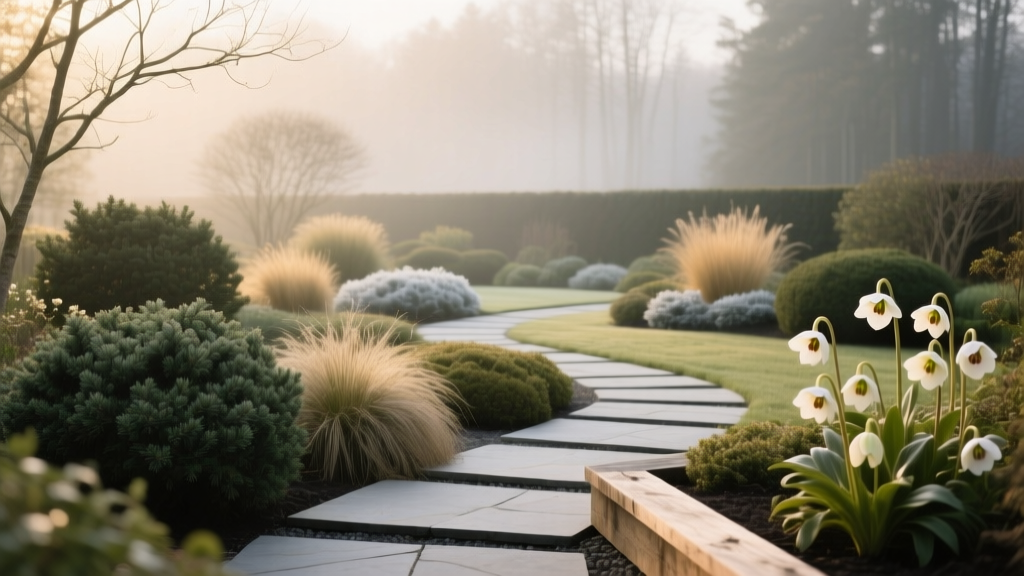
Advanced Techniques for Year-Round Garden Interest
Most “boring winter gardens” aren’t short on plants—they’re short on structure. A common mistake is treating flowers as the whole show and ignoring what’s left when blooms fade: stems, seedheads, bark, evergreen backbone, and lighting. The fix isn’t buying more plants; it’s designing for the 9–10 months when petals aren’t doing the heavy lifting.
Below are the insider techniques I use (and see pros use) to keep gardens looking intentional in every season—without turning your weekends into a second job.
Build a four-season backbone (so flowers become a bonus)
Tip: Use the “40–40–20” planting ratio for year-round structure
A practical shortcut: aim for roughly 40% evergreen structure (shrubs, conifers, broadleaf evergreens), 40% long-season perennials/ornamental grasses, and 20% seasonal pop (bulbs, annuals, tender perennials). This keeps the garden from collapsing visually in winter and early spring. If you’re replacing plants gradually, shift just one bed per season until the ratio evens out.
Example: In a 10 ft × 20 ft bed, you might anchor with 3–5 evergreen shrubs, fill mid-layer with 7–12 perennials/grasses that hold form, then reserve pockets for tulips and summer annuals.
Tip: Design with “winter lines” first—then add color
Before you shop, stand where you view the garden most (kitchen window, patio chair) and sketch the silhouettes you want in January: mounds, spires, and horizontal layers. A good trick is to take a photo in late winter and draw over it—add 2–3 evergreen shapes and 1–2 upright accents per view. Once the lines look good in grayscale, flowers will look great automatically.
Example: A single upright conifer or narrow evergreen (think 8–12 ft mature height) can “hold” a border visually when herbaceous plants are cut down.
Tip: Pick at least one “bark plant” per major bed
Winter interest is often bark and stems, not flowers. Plant one standout with exfoliating, colorful, or patterned bark (paperbark maple, river birch, red-twig dogwood) where low winter sun hits it. Place it within 15–25 ft of your main viewing spot so you actually notice it in January.
Example: Red-twig dogwood looks best when you coppice (see below), keeping stem color vivid instead of dulling on older wood.
Extend “peak season” with succession planning that actually sticks
Tip: Stagger bloom times using a simple 3-wave bulb system
Instead of one big bulb splash, plant three waves: early (crocus/snowdrops), mid (daffodils), late (tulips/alliums). For each square yard, a reliable spacing hack is 25–35 small bulbs (crocus) or 10–12 medium bulbs (daffodils). Plant when soil temps drop to about 55°F (13°C)—often 4–6 weeks before the ground freezes.
Example: In one 4 ft × 8 ft strip, plant daffodils in drifts and tuck crocus into the front edge; add alliums behind for late spring fireworks that also read well as dried seedheads.
Tip: Use the “overplant + underplant” combo for long-lasting containers
For pots that look good longer than two weeks, combine a structural “overplant” (dwarf conifer, rosemary, small grass) with an “underplant” that changes by season. Keep the structure and swap the underplant 3–4 times per year; it’s cheaper than redoing the whole pot. Budget-wise, keeping one $25–$45 structural plant and swapping $6–$12 fillers is a win.
Example: A small juniper stays year-round; spring pansies switch to summer calibrachoa, then fall mums, then winter greens and berries.
Tip: Force branches for indoor “spring” 6–8 weeks early
When your outdoor garden is dull, force flowering branches indoors: forsythia, pussy willow, redbud, quince. Cut stems on a mild day, recut under water, and place them in a bucket in a cool room for 24–48 hours before moving to a brighter spot. Many species bloom indoors in 7–21 days.
Example: A few quince branches in February can carry your “garden interest” to the dining table before anything outside wakes up.
Pruning and training tricks that create off-season interest
Tip: Coppice colorful-stem shrubs on a 1–3 year schedule
Red-twig dogwood and some willows look best on young growth. Cut back 1/3 of the oldest stems to near ground level each spring, or coppice the whole plant to 6–12 inches every 2–3 years if it’s vigorous. This keeps stem color bright and prevents that tired, gray look.
Case example: A front-yard bed with a tired red-twig dogwood can look “new” in one season after a hard coppice, especially when backlit by winter sun.
Tip: Leave the right perennials standing—selectively
Cutting everything down in fall is the fastest way to erase winter texture. Leave sturdy stems and seedheads (coneflower, sedum, ornamental grasses) until late winter, then cut back when you see new basal growth. For tidiness, use a targeted approach: cut floppy plants now, leave architectural ones, and tie grasses into neat sheaves with jute twine (one loop at mid-height).
Research-backed note: Standing stems and leaf litter can support beneficial insects overwintering; many extension sources recommend delaying full cleanup until temperatures are consistently warmer in spring (e.g., University of Minnesota Extension, 2019).
Tip: Create “cloud pruning” on one shrub for instant year-round form
You don’t need a Japanese garden budget to borrow the trick: pick one evergreen shrub (yew, boxwood, holly in mild climates) and prune into 3–5 rounded pads over time. Do it gradually—remove no more than 20–25% of green growth per pruning session. The result is structure that reads even under snow.
Example: One cloud-pruned yew at the corner of a bed can visually “finish” the planting when everything else is dormant.
Soil and microclimate hacks that keep plants attractive longer
Tip: Use a measured mulch depth—too much can backfire
Mulch is a four-season tool, but depth matters. Apply 2–3 inches of shredded bark or leaf mold, keeping it 2–3 inches away from trunks and crowns to reduce rot. This stabilizes soil moisture and temperature, helping perennials stay presentable longer into summer and reducing winter heaving in freeze-thaw cycles.
Source: Proper mulch depth and trunk clearance are widely recommended by extension services (e.g., Washington State University Extension, 2020).
Tip: Build a “warm wall” microclimate for shoulder-season flowers
A south- or west-facing wall stores heat and can shift bloom time and survival for borderline plants. Place containers or a narrow bed within 1–3 ft of the wall, and use dark mulch or stone to capture warmth. This is a sneaky way to get earlier spring growth and longer fall color without changing your whole yard.
Case example: A townhouse patio with a sunny brick wall can keep snapdragons or calendula going weeks longer than the open yard.
Tip: Use leaf mold as a DIY soil “interest extender”
Leaf mold is basically free, and it improves soil structure so plants handle stress better (which means they look good longer). Collect fall leaves in a wire bin, keep them damp, and wait 6–12 months for dark, crumbly material. Use it as a 1–2 inch topdress around perennials in spring.
Cost comparison: Two cubic feet of bagged compost might run $8–$12; homemade leaf mold costs you a $20–$40 bin once, then pennies.
Hardscape and lighting: the “cheat codes” for winter interest
Tip: Add one non-plant focal point per view (and keep it big enough)
In winter, small decor disappears visually. Choose one focal element per main viewing angle: a boulder, bench, obelisk, or water bowl, sized so it reads from indoors—often 24–36 inches tall for vertical pieces. It gives the eye something to land on when plants are resting.
Example: A simple cedar obelisk becomes a sculpture in winter and a vine support in summer—double-duty value.
Tip: Uplight bark and grasses with low-voltage LEDs (cheap drama)
Winter nights are long; use that. A 3–5 watt LED uplight aimed at a birch trunk or ornamental grass clump makes your garden feel alive after dark. Many starter kits run $80–$150, but you can also start with one transformer and add fixtures slowly.
“Outdoor lighting is most effective when it highlights form and texture—not when it floods everything evenly.” — Lighting guidance commonly emphasized in landscape design education (see e.g., Colorado State University Extension materials, 2018).
Tip: Use gravel “negative space” to make winter shapes pop
Plants look better when they’re not crowded by visual noise. A 18–24 inch strip of gravel or a small gravel pad around a focal shrub creates contrast, drains well, and stays neat in winter. It’s also a practical mud-reducer where you step off paths.
DIY option: Use a layer of cardboard, then 2–3 inches of gravel; edge it with steel or stone to keep it crisp.
Plant choices that perform even when nothing is blooming
Tip: Choose perennials for seedheads and winter stance, not just flowers
Some plants are basically winter sculptures if you let them be. Prioritize sturdy, upright types like sedum (‘Autumn Joy’ types), echinacea, globe thistle, and ornamental grasses that hold their shape. The trick is to site them where they won’t flop—full sun and not over-fertilized.
Example: A drift of upright grasses looks intentional under frost; a floppy, overfed perennial reads messy fast.
Tip: Mix evergreen leaf textures to avoid the “green blob” problem
Evergreens are essential, but variety matters: pair needle (dwarf spruce), scale (juniper), and broadleaf (inkberry/holly where hardy). Use at least 3 different textures in a medium-sized bed so winter doesn’t look flat. Keep repeats for cohesion—think “same plant, different spots” rather than a collector’s chaos.
Case example: A foundation planting often looks dated because it’s one-note; swapping just two shrubs for contrasting textures can modernize it instantly.
Tip: Pick plants with off-season color that doesn’t depend on flowers
Look for foliage that shifts (heuchera), winter stems (dogwoods), berries (winterberry holly), or persistent cones (some conifers). For berry plants, remember you often need a pollinator partner; for winterberry, plan for 1 male shrub per 3–5 females (check cultivar compatibility). This is the kind of detail that separates “pretty in theory” from “works every year.”
Example: One male winterberry tucked out of sight can fuel berries on several females placed where you see them daily.
Fast redesigns for real-life gardens (three scenarios)
Scenario: Small suburban front yard that looks dead from November to March
Start with two anchors: one narrow evergreen (vertical) and one mounded evergreen (horizontal) so the bed has shape. Then add a colorful-stem shrub you can coppice, plus a drift of bulbs at the front edge. You’ll notice the difference immediately because the view from the street is all about silhouette.
Example plan: One 6–10 ft upright evergreen near the corner, one 3–4 ft mounded shrub near the walkway, and a 5–7 ft dogwood set back slightly—then 50–80 crocus bulbs sprinkled along the front.
Scenario: Shady backyard that looks flat year-round
Shade interest is texture and contrast, not big blooms. Use evergreen groundcover in defined shapes, add one variegated broadleaf evergreen where hardy, and introduce winter stems (like certain dogwoods if they get enough light). In deep shade, rely more on hardscape: a dark gravel path and a simple bench can create “presence” even when plants are subtle.
Money-saver: Divide and spread hardy shade perennials (hosta, ferns) every 3–4 years instead of buying new—spend the budget on one standout structural plant.
Scenario: Rental garden or “I might move” situation—portable interest
Go heavy on containers and modular elements you can take with you: trough planters, lightweight resin pots, and a few obelisks. Use the overplant/underplant method so your core plants travel, and seasonal swaps are cheap. Keep a consistent pot color (all matte black, for example) to make the collection look designed.
Example cost math: Three quality pots at $30 each plus one LED spotlight at $25–$40 can give you more winter “wow” than $150 of random annuals that vanish after frost.
Method comparison: quick wins vs deeper investments
| Upgrade | Method A: Quick Win | Method B: Longer-Term Fix | Typical Cost | Best Season Impact |
|---|---|---|---|---|
| Winter color | Buy winter greens + berries for pots | Plant winterberry + coppiced dogwood | $15–$60 vs $40–$150+ | Winter |
| Structure | Add one obelisk or bench | Shift beds toward 40% evergreens | $30–$200 vs $100–$600+ | All seasons |
| Spring punch | Force branches indoors | 3-wave bulb system in beds | Free–$15 vs $30–$120 | Late winter–spring |
| Plant longevity | Topdress 1 inch compost/leaf mold | Fix drainage + rebuild soil over time | $0–$40 vs $200–$1,000+ | Summer + winter survival |
Two “pro habits” that keep your garden interesting without extra work
Tip: Keep a 10-minute monthly photo log (it beats guessing)
Take photos from the same 2–3 spots on the first weekend of each month. After one year, you’ll see exactly where interest drops out—usually one bed or one sightline. Then you only fix what’s actually failing, instead of impulse-buying plants that don’t solve the real gap.
Example: If February photos show nothing but fence, you’ll know to add one bark plant, one evergreen, or lighting—rather than more summer bloomers.
Tip: Use a “one-in, one-out” rule to prevent clutter (and boost impact)
Year-round interest depends on plants having room to show their form. When you add a new perennial or shrub, remove or divide something else so spacing stays realistic—think 12–18 inches between many perennials, more for big grasses. This keeps winter silhouettes clean and makes summer look more intentional too.
Example: Instead of squeezing in three new plants, add one great grass and give it space; you’ll get movement, seedheads, and winter texture from a single decision.
If you want the quickest payoff, start with one bed you see every day: add an evergreen anchor, commit to leaving the right stems standing, and install a single uplight. Do those three things and your garden won’t “turn off” after the last flower—people will assume you planned it that way (because now you did).
Sources referenced: University of Minnesota Extension (2019) guidance on pollinators/beneficials and delaying full cleanup; Washington State University Extension (2020) recommendations on mulch depth and keeping mulch away from trunks/crowns; Colorado State University Extension (2018) educational materials emphasizing lighting for form and texture.