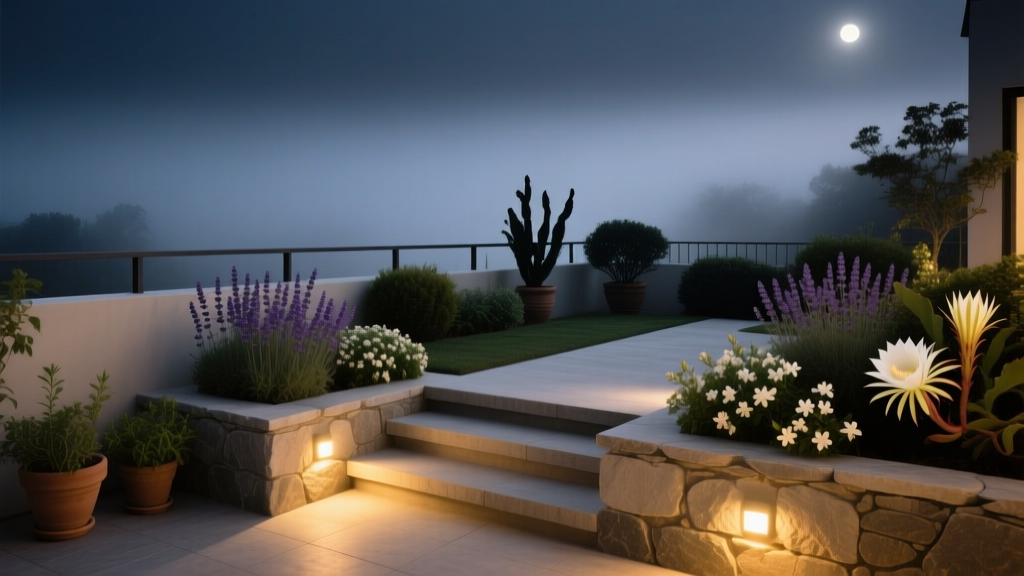
Terrace Aromatic Night Garden
The terrace looks perfect at 2:00 p.m.—sun on the railings, chairs neatly stacked, the city humming below. Then evening arrives and the space turns flat: too dark to linger, too hot from stored concrete heat, and strangely scentless. If you’ve ever stepped outside at night and thought, “Why doesn’t this feel like a garden?”, you’re exactly where this design begins. We’re going to build a terrace that wakes up after sunset—fragrant, softly lit, and laid out so you can move through it with a drink in hand without bumping elbows or pots.
The goal is simple: an aromatic night garden that’s practical for renters and homeowners, thrives in containers, and feels intentional from the door threshold to the far railing. Think layers of scent (leaf, flower, resin), a comfortable circulation loop, and lighting that flatters plants instead of blasting them.
Start with the night: what your terrace needs after sunset
Design target: a “3-sense loop”
Night gardens work when they engage at least three senses: scent, touch (textured foliage), and sight (light catching pale petals and silvery leaves). Sound is a bonus if your building allows a small fountain. The loop is how you experience it: you should be able to step out, make one easy circuit, and catch a new scent every few steps.
Rule of thumb for layout: keep a clear walking lane of 90 cm (36 in) wherever you’ll pass with a tray or watering can. If your terrace is narrow, 60 cm (24 in) can work for a single-person path, but it will feel tight when plants spill outward.
Light reality check: measure your terrace before you buy plants
Before selecting jasmine or nicotiana, figure out how many direct sun hours you actually get. On many terraces, “full sun” is really “3 hours of sun plus bright shade” because of buildings. Track sun for one day, or use a sun calculator app, but make a simple note: 2–4 hours, 4–6 hours, or 6+ hours.
Also note night conditions: wind tunnels and reflected heat. If your terrace is windy, fragrance can dissipate fast—so place the most aromatic plants in pockets near seating, not only at the railing.
Layout strategies that make scent feel intentional
Anchor points: door, seating, and the “scent stop”
Aromatic gardens benefit from choreography. You want at least two “scent stops”—places you naturally pause. The first is usually within 1–1.5 m of the door, so you smell it as you step out. The second should be beside your seating, where fragrance gathers at head height.
Designer move: put taller, night-scented plants behind or beside the chair (not in front), so scent drifts over your shoulder rather than blocking views.
Container zoning: tall at the back, touchable at the edge
On terraces, containers become your planting beds. Use three height zones:
- Back/rail zone (70–120 cm tall plants): screening, vertical scent (star jasmine, scented pelargoniums trained up a trellis).
- Mid zone (30–70 cm): flowering scent (nicotiana, dianthus, heliotrope), and silvery reflectors (lavender, artemisia).
- Edge zone (0–30 cm, spillers): touch-and-release herbs like creeping thyme and Corsican mint (in contained pots), plus trailing rosemary.
Keep the most “handleable” plants (herbs, soft foliage) where hands naturally land: at the terrace edge near seating, and along the route to the grill or door.
Spacing that prevents the “overstuffed pot aisle”
Container gardens fail at night when they’re hard to navigate. Use these spacing baselines:
- Leave 10–15 cm between pot rims so you can water without knocking things over.
- In long planters, space medium plants (like nicotiana or dianthus) at 25–35 cm centers; compact herbs at 15–20 cm.
- If you’re using a trellis, place it 10 cm off the wall to improve airflow and reduce mildew.
Three real-world terrace scenarios (and how the design shifts)
Scenario 1: A renter’s 1.2 m x 3 m balcony with 3–4 sun hours
Constraints: limited sun, weight concerns, and “no drilling” rules. Here we focus on fragrance close to seating and plants that tolerate bright shade.
Layout: one narrow bench (about 35–40 cm deep) against the wall, two tall planters at the railing corners, and a slim line of herbs in window-box style planters clipped to the railing. Add battery or solar micro-lights so you don’t need electrical work.
Winning plants: Nicotiana ‘Perfume Deep Purple’ (handles part sun), Dianthus ‘Sweet Black Cherry’ (clove scent), and scented pelargoniums like ‘Attar of Roses’ (leaf fragrance even when not flowering).
Scenario 2: A 2.5 m x 5 m terrace with 6+ sun hours and a hot microclimate
Constraints: heat buildup and fast drying. The advantage is you can grow classic sun-lovers that smell strongest after warmth.
Layout: a U-shaped container arrangement that creates an inner “cool pocket.” Use larger pots (30–45 cm diameter) so roots stay stable. Introduce one small water bowl or tabletop fountain (if allowed) to soften heat and add sound.
Winning plants: Lavender ‘Hidcote’ for structure, rosemary ‘Arp’ or ‘Tuscan Blue’ for evergreen aroma, and night-blooming nicotiana for evening fragrance. Add silver-leaf plants (Artemisia ‘Powis Castle’) to reflect low light.
Scenario 3: A shared rooftop corner with wind and neighbor sightlines
Constraints: gusts and privacy. Scent needs shelter, and plants must be stable.
Layout: create a windbreak with heavy rectangular planters (or filled “false bottom” planters—more on that below). Place the seating 60–90 cm inside the windbreak to form a calm zone. Use a trellis panel lashed to planters (no drilling) for vertical scent.
Winning plants: Star jasmine (Trachelospermum jasminoides) trained on a trellis for scent and screening; scented geraniums; and tougher herbs like thyme and rosemary that don’t mind breezes.
Plant palette for a terrace aromatic night garden
Night fragrance tends to come from plants that release scent in cooler evening air or are pollinated by moths. A classic example is nicotiana, which is widely noted for evening fragrance. The Royal Horticultural Society notes that Nicotiana is “strongly scented in the evening” (RHS, 2024).
“White and pale flowers are more visible at dusk, and many night-scented plants intensify fragrance in the evening to attract pollinators.” — Royal Horticultural Society guidance on night-scented planting (RHS, 2024)
Core “night scent” flowers (containers-friendly)
- Nicotiana ‘Perfume Deep Purple’ or ‘Perfume White’: evening fragrance, vertical habit; space 30 cm apart in planters. Works best with 4–6 sun hours.
- Dianthus ‘Sweet Black Cherry’: compact, clove scent; excellent near seating where you’ll brush past it; space 20–25 cm.
- Heliotrope ‘Marine’: vanilla/cherry-like fragrance; loves sun and consistent moisture; space 25–30 cm.
- Night-scented stock (Matthiola longipetala): old-fashioned evening perfume; treat as a seasonal fill plant; space 20 cm.
Vines and vertical scent (privacy + perfume)
- Star jasmine (Trachelospermum jasminoides): evergreen in mild climates, intensely scented when in bloom; ideal on a trellis. Use a pot at least 40 cm wide and a trellis 120–180 cm tall.
- Honeysuckle (Lonicera periclymenum ‘Serotina’): strong evening scent, but needs more root room and regular watering; best for larger terraces.
Herbs that release fragrance when touched (the “brush-by” layer)
- Lavender ‘Hidcote’: classic, drought-tolerant once established; also reflects moonlight with gray foliage.
- Rosemary ‘Arp’ (hardier) or ‘Tuscan Blue’: evergreen structure; place by the grill or kitchen door for practical snipping.
- Thyme ‘Doone Valley’ or creeping thyme: low, resilient, and releases scent when brushed; use as planter edge.
- Mint (choose spearmint or chocolate mint): keep in its own pot to prevent spreading; place near seating for evening drinks.
Moonlight plants: visibility matters at night
At night you “read” the garden by contrast. Pale blooms and silver foliage glow in low light.
- Dusty miller (Senecio cineraria): silver foliage, strong contrast in dusk; easy in containers.
- Artemisia ‘Powis Castle’: soft, silver mound; aromatic foliage; excellent for hot terraces.
- White petunias or calibrachoa: not the most refined scent, but they brighten a dark terrace and spill well.
For plant safety around pets, check toxicity before planting. The ASPCA provides a searchable toxic and non-toxic plant list (ASPCA, 2025), which is especially useful for renters with indoor-outdoor pets.
Comparison table: top fragrance performers for terrace night gardens
| Plant | Best light | Fragrance timing | Container size | Notes for terraces |
|---|---|---|---|---|
| Nicotiana ‘Perfume White’ | 4–6+ sun hours | Evening/night | 30 cm+ pot or long planter | Great “night garden” signal plant; pinch early for bushiness |
| Star jasmine | 4–6 sun hours (tolerates bright shade) | Bloom season evenings | 40 cm+ pot with trellis | Also provides privacy; protect from harsh wind to keep scent nearby |
| Lavender ‘Hidcote’ | 6+ sun hours | Day into evening | 30–40 cm pot | Needs sharp drainage; silver foliage reads well at night |
| Dianthus ‘Sweet Black Cherry’ | 4–6+ sun hours | Day/evening | 20–30 cm pot | Place near chairs; deadhead for repeat bloom |
| Scented geranium ‘Attar of Roses’ | 3–6 sun hours | On touch | 25–35 cm pot | Fragrance even without flowers; easy renter-friendly star |
Step-by-step setup: build the terrace aromatic night garden in a weekend
1) Sketch the circulation first (15 minutes)
- Measure your terrace length and width. Mark door swing and any obstructions.
- Draw a clear path at least 90 cm wide from the door to the seating zone.
- Choose two “scent stops”: one near the door, one at seating.
2) Choose container sizes that match your watering reality
- For structural plants (jasmine, rosemary), choose pots 40–45 cm wide for stability and moisture buffering.
- For seasonal fragrance (nicotiana, stock), use 25–35 cm pots or long planters.
- If weight is a concern, use lightweight fiberglass or resin and add a “false bottom” (empty upside-down nursery pots) to reduce soil volume.
3) Build the “night layers” in this order
- Vertical layer: place trellis planters at corners or behind seating.
- Mid layer: add flowering scent plants in clusters of 3 for impact (one plant reads like a sample; three reads like a design).
- Edge layer: tuck herbs and spillers at the path edge where you’ll brush them.
- Moonlight accents: insert silver foliage or white flowers in every sightline from your chair.
4) Add lighting that supports fragrance (not stadium glare)
- Use warm LEDs (2700K) to keep the mood soft and flattering to foliage.
- Place 2 small uplights aimed at silver foliage or a trellis to create depth.
- Use a string of micro-lights only where you need orientation (door and railing), not across the entire ceiling line.
Budget and DIY alternatives (with real numbers)
You can build this garden in phases. Here are three cost bands, assuming a terrace with roughly 6–10 containers.
Budget plan: $120–$250
Use nursery pots dropped into thrifted baskets (lined with a plastic tray), DIY trellis with bamboo canes, and focus on herbs plus one or two “night scent” annuals.
- Herb starts: $4–$7 each (thyme, rosemary, mint in its own pot)
- Annuals (nicotiana/stock): $5–$8 each
- Warm white solar lights: $20–$40
Mid-range plan: $300–$650
Invest in a couple of large statement planters and one trellis panel, then fill with a mix of perennials and seasonal color.
- 2 large planters (40–45 cm): $60–$120 each
- Trellis panel (120–180 cm): $30–$90
- Star jasmine: $35–$70 (size dependent)
Higher-investment plan: $700–$1,500
This is where you buy matching planters, upgrade soil, and add low-voltage lighting. The garden will look designed in daylight and feel like an outdoor room at night.
- Low-voltage lighting kit: $150–$400
- Quality potting mix and drainage materials: $80–$200
- Statement containers: $100–$250 each
DIY soil upgrade that pays off: don’t cheap out on mix for aromatic plants—fragrance and bloom rely on steady growth. For large containers, blend potting mix with 10–20% pumice or perlite for drainage (especially for lavender and rosemary), and top-dress with bark fines to slow evaporation.
Maintenance expectations: keep it fragrant without making it a chore
Plan on 30–60 minutes per week in peak season for watering, deadheading, and light pruning on an average container terrace. In heat waves, watering can jump to 10 minutes per day if pots are small or sun exposure is high.
Weekly rhythm (growing season)
- Watering: check moisture 3–5 times/week. Hot, windy terraces dry fast. Water early evening so you’re not losing it to midday evaporation, but avoid soaking foliage late at night if mildew is an issue.
- Deadheading: 10 minutes to keep dianthus and nicotiana blooming.
- Herb harvesting: pinch tips weekly; it keeps plants bushy and releases scent.
Seasonal tasks
- Spring (setup and refresh): refresh top 5 cm of soil, add slow-release fertilizer to heavy bloomers, and check trellis ties.
- Summer (manage heat): mulch pots, group containers to shade each other’s sides, and move the most delicate plants a step back from reflective walls.
- Autumn (extend fragrance): bring scented geraniums indoors near a bright window; cut rosemary lightly and dry sprigs for kitchen use.
- Winter (protect structure): in cold climates, wrap pots or move tender plants inside; reduce watering dramatically.
Small design details that make the terrace feel finished
Use scent at head height: Place nicotiana or jasmine where blooms sit around 80–140 cm high near seating. Low herbs smell wonderful, but the air at night moves above them; head-height fragrance is what makes you pause.
Create one dark “resting” corner: Not every inch needs lighting. A slightly darker corner makes the illuminated foliage feel richer and keeps the terrace from looking like a patio showroom.
Choose one material to repeat: Terraces can look chaotic fast. Repeat one finish (all terracotta, all matte black, or all natural baskets) for at least 60% of containers, then add a few accents.
Plan for water management: Use saucers or hidden trays where required by building rules. If drainage is a concern, lift pots on feet by 1–2 cm so roots don’t sit in water.
Citations
Royal Horticultural Society (RHS). 2024. Guidance noting evening fragrance in Nicotiana and night-scented planting principles. (See RHS plant profiles and night-scented garden resources.)
ASPCA. 2025. Toxic and Non-Toxic Plants database for checking pet safety before planting on balconies and terraces.
When you step out tomorrow night, you should smell the garden before you see it: a soft wave of jasmine near the trellis, a spicy clove note where dianthus sits beside the chair, and that unmistakable evening sweetness from nicotiana hovering in the still air. The terrace won’t just be “outdoor space” anymore—it will be a place that opens up after dark, designed to be lived in, one scented lap at a time.