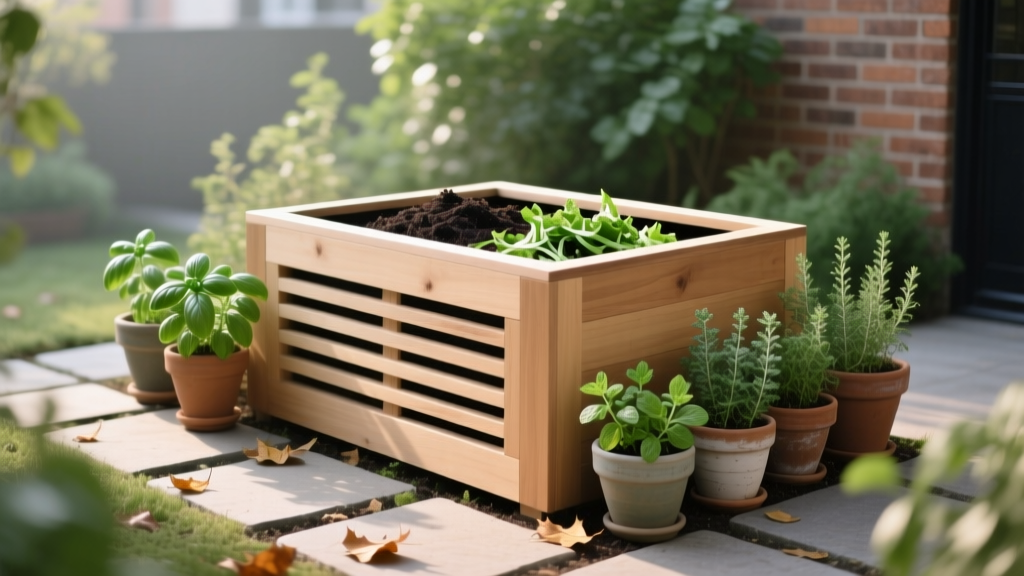
Compost Corner Setup in a Small Garden
The bin arrived on a Tuesday—the kind of day when the trash can is already full and the kitchen scrap bowl is mysteriously overflowing. You step outside, look at your small garden, and realize the truth: there isn’t an obvious place to put compost that won’t be an eyesore, steal precious planting space, or turn into a soggy, smelly mess. And yet, you want the payoff—richer soil, fewer trash bags, and plants that look like you actually have time to pamper them.
Let’s design a compost corner that feels intentional, fits into tight quarters, and works for real life. I’ll walk you through the layout choices I make as a landscape designer: where the bin goes, what sits around it, how to hide it (without making it harder to use), and what to plant nearby so the whole corner looks like part of the garden—not the “utility area you apologize for.”
Start with the three rules: access, air, and “no regrets” placement
A small garden doesn’t forgive awkward placement. If the compost is inconvenient, you won’t use it. If it’s too hidden, it may stay too wet. If it’s too close to the patio, you’ll resent it. So we design around three rules.
Rule 1: Make the path feel effortless
Plan for the way you actually move: kitchen door to bin, bin to beds. In most small yards, a 30–36 inch wide path is comfortable for a bucket in one hand and a tool in the other. If you’re squeezing between planters, 24 inches can work, but you’ll feel it.
Keep the bin opening facing the path. If you have to step into mulch or pivot around a pot, composting becomes a chore. Design goal: 10 steps or fewer from the door you use most.
Rule 2: Give compost oxygen (and yourself room to work)
Compost needs air to stay aerobic. A quick placement trick: leave 6–12 inches of clearance behind and to at least one side of the bin for airflow and to slide a fork in if you ever turn the pile. If you’re using a closed plastic bin, airflow matters even more—avoid wedging it tight against a fence with no gap.
Rule 3: Place it where you can live with it year-round
Think beyond summer. In winter, will snow, rain, or mud make the compost inaccessible? In peak heat, will full sun bake it bone-dry? Many compost systems do best with 4–6 hours of sun or bright dappled light: warm enough to keep biology active, shaded enough to avoid constant drying.
Also consider neighbor sightlines. If the bin is visible from a shared walkway, plan a screen that looks like a garden feature, not a barricade.
Layout strategies that work in tight spaces
Here are designer-tested layouts that fit common small garden shapes. Pick one and tailor the dimensions to your site.
The “Back Corner Triangle” (best for tiny yards)
This layout uses a corner and turns it into a compact workstation: compost bin, tool hook, and a small curing area.
- Minimum footprint: 4 ft x 4 ft (bin plus working space)
- Ideal footprint: 5 ft x 6 ft (bin + small leaf stash + kneeling room)
- Screening: one tall element (trellis or slatted panel) + one planting strip
Angle the front edge of the area (even slightly) so it feels designed, not leftover. A simple diagonal line of pavers can do the job.
The “Side-Yard Runway” (best for narrow side passages)
If your garden is more of a side passage than a backyard, go linear: keep everything flat to the fence and maintain a clean walking lane.
- Minimum width needed: 36 inches total passage
- Compost zone depth: 18–24 inches (bin tucked against fence)
- Walking lane: 18 inches minimum, 24 inches preferred
Use wall-mounted solutions: a small shelf for carbon material (shredded leaves in a lidded tote), and hooks for a hand rake and compost aerator.
The “Patio-Adjacent Disguise” (best for renters or courtyard gardens)
In courtyards and rentals, you may only have one workable corner near the patio. The trick is to treat the compost like patio storage: tidy, enclosed, and paired with planters that soften it.
- Footprint: 3 ft x 5 ft can work with a compact tumbler or worm bin
- Screen: two tall planters or a freestanding lattice panel
Choose a system that looks intentional: a black tumbler, a sleek worm tower, or a wooden bin with a hinged lid.
Choose the right compost system (and match it to your space)
In small gardens, the “best” compost is the one you’ll keep using. Here’s a comparison you can use to decide based on footprint, speed, and cost.
| System | Typical footprint | Good for | Approx. cost (USD) | Notes |
|---|---|---|---|---|
| Compact plastic bin | 2 ft x 2 ft | Back corner, simple setup | $60–$150 | Low-profile, can go anaerobic if too wet; add bulky browns |
| Tumbler | 2.5 ft x 2.5 ft | Patio-adjacent, fast turning | $120–$250 | Neat and contained; capacity is limited |
| DIY pallet bin | 3 ft x 3 ft | Bigger volume, quick breakdown | $0–$60 | Best performance when you can build to 3 ft dimensions |
| Worm bin (vermicompost) | 1.5 ft x 2 ft | Apartments, shaded patios | $50–$200 | Great for kitchen scraps; keep 55–77°F comfort range |
Performance tip: compost piles often heat best when they’re big enough to insulate themselves. Many extension services recommend a minimum pile size around 3 ft x 3 ft x 3 ft for hot composting performance (Cornell Waste Management Institute, 2023). If you can’t fit that, don’t fight physics—go tumbler, worm bin, or cold compost and focus on tidy management.
“The most successful compost setup is the one that’s easiest to use every day—distance and convenience matter as much as the biology.” — Washington State University Extension, 2020
Step-by-step: build a compost corner that feels like part of the garden
This sequence keeps the project clean and avoids the common mistake of putting the bin down first and trying to ‘decorate’ around it later.
- Mark the footprint. Use a hose or string to outline a 5 ft x 6 ft rectangle (or your available size). Stand at the kitchen door and confirm it feels natural to walk to.
- Set the surface. For low-mess access, install 2 inches of compacted gravel or decomposed granite. If you want a softer look, lay 18 x 18 inch pavers as stepping squares over mulch.
- Place the bin with clearance. Leave 6–12 inches behind it for air movement. Ensure the lid can open fully without hitting a fence or branch.
- Add a carbon station. Put a lidded tote (even a 12–18 gallon storage bin) beside the compost to hold shredded leaves or straw. This one move prevents odors because you’ll always have browns within arm’s reach.
- Design the screen. Install a trellis panel or slatted screen 48–72 inches tall. For renters, use a freestanding screen or two tall planters with a lattice between them.
- Plant the edges. Add a narrow planting strip—12–18 inches deep is enough—to soften the compost corner and cue “this is intentional.”
- Set a tool hook and a bucket spot. One hook for a hand fork, one for a small rake, and a dedicated landing spot for your kitchen scrap pail. Remove friction, and the habit sticks.
Planting around a compost corner: hide it, soften it, and keep it functional
The best compost-corner plants do three jobs: screen views, tolerate nutrient swings, and handle the slightly warmer/more humid microclimate near decomposing material. Avoid plants that demand perfect dry feet right next to the bin.
Evergreen structure for screening (choose one backbone)
For partial sun (4–6 hours):
- Podocarpus macrophyllus ‘Maki’ (upright yew plum pine): Narrow, tidy, and takes clipping well. Space 24–30 inches apart for a tight screen in a small bed.
- Ilex crenata ‘Sky Pencil’ (Japanese holly): A vertical accent that reads “designed.” Great when you only have a 12–18 inch strip. Space 18–24 inches apart.
For sunnier spots (6+ hours):
- Myrtus communis ‘Compacta’ (compact myrtle): Dense, fragrant foliage; handles clipping. Space 24 inches apart.
Softening perennials and grasses (the “make it pretty” layer)
- Nepeta ‘Walker’s Low’ (catmint): Spills over edges, drought-tolerant once established, and makes utility corners feel romantic. Space 18–24 inches apart.
- Salvia nemorosa ‘Caradonna’: Vertical purple spikes bring order and pollinators; stands up well near paths. Space 12–18 inches apart.
- Hakonechloa macra ‘Aureola’ (Japanese forest grass): Perfect for dappled shade; brightens a tucked-away corner. Space 18 inches apart.
Edible planting near compost (yes—with smart boundaries)
You can plant edibles near a compost corner, but keep them in defined beds or containers and avoid direct contact between unfinished compost and edible parts. A tidy approach is to place a small herb trough 24 inches away from the bin edge.
- Rosemary ‘Arp’: Tough, upright, and aromatic—helps the corner smell like herbs, not chores.
- Chives: Reliable, compact, and happy in a sunny strip.
- Strawberries ‘Seascape’ in a raised pot: Productive, pretty, and keeps fruit off the ground.
Compost safety note: use finished compost on edible gardens and follow safe handling practices. The U.S. EPA emphasizes composting as a key strategy to reduce food waste and notes its role in creating a useful soil amendment (U.S. EPA, 2024).
Three real-world compost corner scenarios (and how the layout changes)
These are the situations I see most often when working with homeowners and renters.
Scenario 1: The 10' x 12' townhouse patio garden
You’ve got containers, a grill, and a narrow strip of planting. A traditional bin feels too bulky. Here, a 1.5 ft x 2 ft worm bin tucked behind a bench is the quiet hero. Pair it with two tall containers—say 18-inch diameter pots—with Podocarpus ‘Maki’ or a trellised vine like star jasmine (if your climate allows). You get screening without giving up floor space.
Budget snapshot: worm bin $80, coconut coir bedding $10, red wigglers $35, two large pots (DIY with galvanized tubs) $40 total.
Scenario 2: The narrow side yard with a gate (3'–4' wide)
This is a “runway” design. Put a compact bin against the fence, keep a clean walking lane, and use vertical storage. I like a 2 ft x 2 ft closed bin plus a lidded tote for browns.
Planting should be slim: Ilex ‘Sky Pencil’ or espaliered citrus (in warm climates) along the opposite side, keeping at least 24 inches of clear passage. Underplant with Salvia ‘Caradonna’ for tidy vertical rhythm.
Time reality: because you’ll walk past it daily, you’ll actually use it. This is one of the highest success layouts for habit-building.
Scenario 3: The family backyard corner that turns into a dumping ground
You know the one: a corner where spare pots, broken stakes, and “I’ll deal with it later” items migrate. Compost can either become part of the mess, or it can be the anchor that organizes the corner.
Go bigger if you can: a DIY pallet bin at 3 ft x 3 ft gives you enough volume to heat. Add a second bay for curing if space allows (even 3 ft x 2 ft helps). Screen with a 6 ft slatted panel and plant Nepeta ‘Walker’s Low’ at the base to soften the structure.
Cost control: pallets are often free; spend on screws, hinges, and hardware cloth—typically $35–$75 depending on what you already own.
Odor, pests, and neighbor-proofing: design details that prevent problems
Most compost issues are design issues in disguise: the bin is too far away (so you skip adding browns), too hard to access (so you dump scraps and run), or too wet (so it turns anaerobic).
- Keep browns closer than greens. If your carbon tote is within arm’s reach, you’ll naturally cover food scraps. Aim for a simple habit: add 1–2 handfuls of browns each time you add kitchen scraps.
- Use a critter-resistant base. If rodents are a concern, line the bottom with 1/2-inch hardware cloth before setting the bin down.
- Don’t compost meat/dairy in open systems. In tight gardens, the risk-to-reward ratio isn’t worth it.
- Plan a rinsing spot. Even a small watering can rinse the scrap bucket weekly. A clean bucket means fewer flies.
If your corner is visible from a neighbor’s window, treat the screen like a design feature: paint the panel a deep charcoal, train a climber, and add a single accent pot. A compost corner that looks composed gets far less scrutiny.
Budget options and DIY alternatives (without sacrificing aesthetics)
You can build a compost corner that looks tailored on a modest budget. Here are practical swaps I recommend often.
- Instead of new pavers: use reclaimed bricks or concrete squares. Budget $0–$2 per piece if you source locally.
- Instead of a cedar bin: build with pallets and line with hardware cloth. Budget $0–$75.
- Instead of a custom screen: use a freestanding lattice panel. Many big-box options run $30–$70.
- Instead of buying “compost browns”: store fall leaves in a lidded can. Shred with a mower for faster breakdown.
If you’re renting, keep everything reversible: a tumbler or worm bin, freestanding screen, and container plants. You can take the whole setup with you.
Maintenance expectations: what it actually takes to keep it pleasant
A well-designed compost corner shouldn’t feel like another project. For most small gardens, plan on 10–20 minutes per week.
- Weekly (10–20 minutes): add scraps + browns, do a quick stir or tumbler spin, check moisture (it should feel like a wrung-out sponge), and tidy any spills.
- Monthly (20–30 minutes): deeper mix/turn if you’re hot composting, break up clumps, and top up your browns supply.
- Seasonal:
- Spring: harvest finished compost, screen if you want finer texture for pots.
- Summer: watch moisture—small bins dry out fast; add water lightly if needed.
- Fall: stockpile leaves (your future browns). This is compost “insurance.”
- Winter: slowdowns are normal; keep adding browns and avoid waterlogging.
One realistic note: if you produce lots of kitchen scraps but have very little yard waste, you’ll need a consistent carbon source. That can be shredded leaves, straw, cardboard (plain, non-glossy), or purchased wood shavings. Plan storage for it from day one.
Small design upgrades that make compost corners feel intentional
This is where the corner stops feeling like “the compost area” and starts reading as a cohesive part of your garden.
- Repeat a material. If your garden has black metal edging, choose a black tumbler or paint the screen black. Repetition creates calm.
- Use one focal plant. A single upright evergreen or a bold container—kept trimmed—signals care.
- Light it softly. A small solar stake light along the path makes evening compost drops easy and reduces the “mystery corner” vibe. Even a $10–$20 light changes how the space feels.
Once your compost corner is easy to reach, easy to use, and easy to look at, it stops being a compromise. It becomes one of the smartest “small garden” moves you can make: a working utility zone that feeds the rest of the space—quietly, steadily, and with the kind of elegance that comes from good layout.
Sources: Cornell Waste Management Institute (2023); Washington State University Extension (2020); U.S. Environmental Protection Agency (2024).