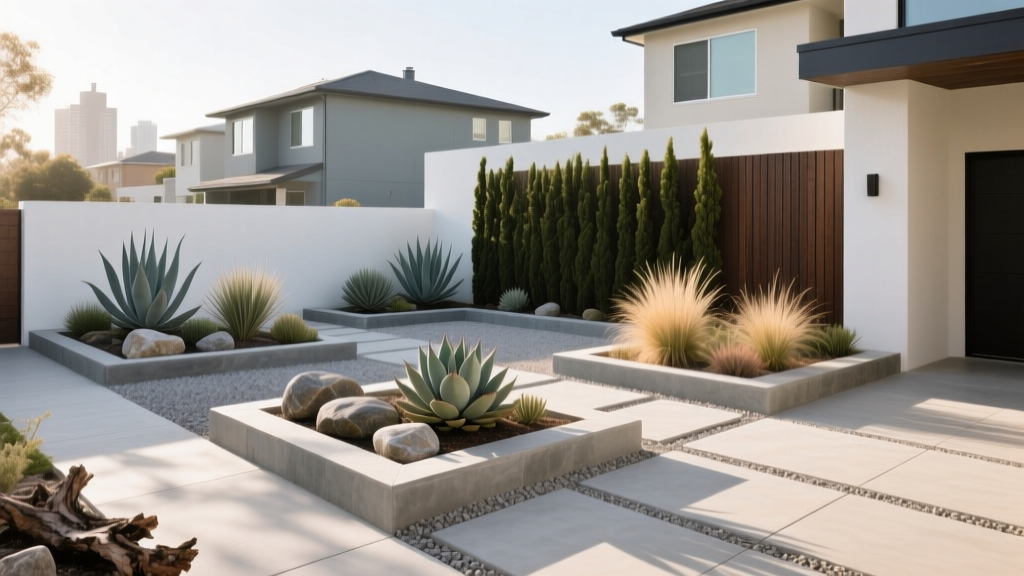
Corner Lot Landscaping That Stands Out
You pull into the driveway and there it is again: that wide-open corner lot, fully visible from two streets, with a sad strip of lawn trying (and failing) to look intentional. The house feels like it’s sitting on a stage—great for curb appeal when it’s designed, brutal when it’s not. Cars cut the corner, dog walkers shortcut across the grass, and the wind seems to hit from every direction. A corner lot can feel like too much yard and not enough plan.
Let’s treat it like a designer would: define the edges, choreograph what people see from each approach, and use plants and hardscape to solve real problems—privacy, traffic splash, salt, heat, and the awkward “double-front-yard” effect. You don’t need a mansion budget. You need a layout that controls sightlines and a plant palette that looks good from two angles, all year.
Start With the Two-Approach View: Your Lot Has Two “Front Doors”
On a corner lot, people experience your landscape from at least two directions—often at different speeds. Pedestrians notice detail and fragrance; drivers notice big shapes and clean lines. Before picking plants, stand at the two main viewing points: (1) the approach down your primary street, and (2) the approach down the side street. Sketch what you want them to notice first: a tree canopy, a bold entry walk, or a layered planting bed.
Rule of thumb: design in layers (low, medium, tall)
Layering creates depth without blocking safety sightlines. Keep the lowest layer near sidewalks and corners, use mid-height shrubs to frame, and reserve taller trees as punctuation behind.
- Low layer (0–24 in.): grasses, perennials, groundcovers for clean edges
- Mid layer (24–48 in.): rounded shrubs and upright perennials for structure
- Tall layer (8–25 ft.): small trees or large shrubs to anchor the corner
Corner Lot Layout Strategies That Solve Real Problems
1) Respect the sight triangle (and still create privacy)
Most municipalities require visibility at intersections. A common standard is a “sight triangle” where plantings must stay low (often under 30 inches) for a set distance (frequently 20–30 feet) from the corner. Check your city code, then treat that zone as your “low garden.” You can still get privacy by placing taller screening behind the sight triangle—closer to the house, not the curb.
“Home landscape safety is often about visibility—keeping plantings low near driveways and intersections so drivers and pedestrians can see one another.” — UF/IFAS Extension, Landscaping for Safety (publication guidance widely used in home landscape planning; see UF/IFAS resources, 2019)
Design move: create a low, tidy foreground (18–24 in. max) and then a taller “green wall” farther back using shrubs or a slatted fence with vines.
2) Use a “corner anchor” to keep the yard from feeling like leftover lawn
The most effective corner lots have a deliberate anchor at the corner—usually a small tree with underplanting. This stops the eye from sliding off the property and makes the whole lot feel composed.
Spacing guidance: place a small tree 10–15 feet from the curb (or as setbacks require) and 8–12 feet from the sidewalk, giving it room for canopy while keeping it out of the splash zone from plows and cars.
3) Build a perimeter “frame” with a deep bed, not a skinny strip
Skinny foundation beds look especially underwhelming on corner lots. Go deeper. A bed that’s 6–8 feet deep along the side-street frontage reads intentional and allows layering. You can reduce mowing, cut water use, and make maintenance easier because edges are clearer.
For renters or anyone avoiding permanent changes, use a curving line of heavy planters (or stock tanks) to define a bed without digging up turf.
4) Choose paths that control movement (yours and everyone else’s)
Corner lots get accidental foot traffic. If people are cutting across, give them a “preferred route” with a stepping-stone path, then protect your planting zones with low hedges or dense groundcover.
Practical dimension: a comfortable garden path is 36 inches wide for one person, 48 inches if you want two people to walk side-by-side.
5) Plan for wind and reflected heat
With two open exposures, corner lots can be windy, and sidewalks reflect heat. Put tougher, drought-tolerant plants near pavement. Save thirstier, delicate plants for areas closer to the house or within fenced space.
The U.S. Environmental Protection Agency notes that trees and vegetation can reduce surface and air temperatures through shading and evapotranspiration—one of the key strategies in reducing heat island impacts (EPA, Using Trees and Vegetation to Reduce Heat Islands, 2023).
A Simple Designer’s Layout You Can Scale
Here’s a layout that works on many suburban corner lots (adjust to your site):
- Map your sight triangle: mark the corner zone where plants must stay under 30 inches.
- Choose your corner anchor: one small tree, planted 10–15 feet back from the curb.
- Draw a deep perimeter bed: aim for 6–8 feet depth along the side street for visual weight.
- Place your privacy element: a hedge or fence line 6–12 feet behind the sidewalk (or per setback), starting after the sight triangle.
- Connect entry points: a 36–48 inch path from driveway to front door, and optionally to the side yard gate.
- Fill with layers: groundcover at 12-inch spacing, perennials at 18-inch spacing, shrubs at 3–5 feet spacing, depending on mature size.
Plant Selection: Varieties That Look Good From Two Streets
The goal is plants that hold their shape, don’t flop into sidewalks, and offer multi-season interest. The specific varieties below are widely available and perform well in many regions—adjust for your USDA zone and local water restrictions.
Corner anchor trees (small, street-smart, ornamental)
- Serviceberry (Amelanchier x grandiflora ‘Autumn Brilliance’): spring flowers, edible berries, orange-red fall color; typically 15–20 ft. tall. Works as a corner punctuation without overpowering the lot.
- Japanese tree lilac (Syringa reticulata ‘Ivory Silk’): creamy summer blooms, tidy form, handles urban conditions; about 20–25 ft. at maturity.
- Crabapple (Malus ‘Sugar Tyme’): strong bloom, good fruit persistence for winter interest; choose disease-resistant cultivars to avoid messy leaf drop.
Mid-layer shrubs (structure, privacy, and curb discipline)
- Panicle hydrangea (Hydrangea paniculata ‘Little Lime’): upright, hardy, doesn’t mind sun; great for repeating rhythm along a side street. Space 3–4 ft. apart.
- Boxwood (Buxus ‘Green Velvet’): evergreen structure for winter; use where you want consistent shape. Space 2.5–3 ft. apart for a low hedge.
- Ninebark (Physocarpus opulifolius ‘Diabolo’): dark foliage for contrast; tough in wind and heat. Give it room—space 5–6 ft. apart.
Low layer plants (sightline-safe and tidy at the sidewalk)
- Catmint (Nepeta ‘Walker’s Low’): long bloom, softens edges without blocking views; space 18–24 in..
- Feather reed grass (Calamagrostis x acutiflora ‘Karl Foerster’): vertical form that reads clean from the street; space 24–30 in..
- Creeping juniper (Juniperus horizontalis ‘Blue Rug’): evergreen groundcover for hot, dry corners; space 3–4 ft. depending on expected spread.
- Daylily (Hemerocallis ‘Stella de Oro’): durable, repeat bloom; great for renters because it forgives missed watering.
Pollinator and seasonal punch (for the slower pedestrian view)
- Purple coneflower (Echinacea purpurea ‘Magnus’): upright, reliable; seedheads feed birds.
- Black-eyed Susan (Rudbeckia ‘Goldsturm’): strong summer color; handles heat.
- Allium (Allium ‘Millenium’): tidy clumps, late-summer blooms, low maintenance.
Comparison Table: Three Corner Lot Styles and When They Work
| Style | Best for | Key elements | Upfront cost range | Weekly upkeep (growing season) |
|---|---|---|---|---|
| Clean & Modern | Minimalists, small crews, tidy neighborhoods | Evergreen structure, grasses, crisp edging, limited palette | $800–$3,500 | 30–60 minutes |
| Cottage-Pollinator | Flower lovers, wildlife-friendly goals | Long-bloom perennials, soft curves, layered color | $400–$2,500 | 60–120 minutes |
| Privacy-First | High foot traffic, close neighbors, corner exposure | Hedge or fence + vines, small trees, controlled openings | $1,200–$6,000 | 45–90 minutes |
Three Real-World Corner Lot Scenarios (and How I’d Design Them)
Scenario 1: The windy, sunny corner with lots of sidewalk glare
Site notes: Full sun (7–9 hours), strong wind channeling down the side street, soil dries fast near pavement.
Design approach: Use drought-tough plants at the perimeter, keep the corner low for visibility, and build a deeper bed to reduce scorching turf.
Plant recipe:
- Corner anchor: Japanese tree lilac ‘Ivory Silk’
- Mid layer: Ninebark ‘Diabolo’ set back from the sidewalk
- Low layer: ‘Karl Foerster’ grass + catmint repeating in drifts
- Groundcover in hottest spots: creeping juniper ‘Blue Rug’
DIY win: Swap expensive stone edging for a clean shovel-cut edge refreshed twice a year. Materials cost: $0, just time.
Scenario 2: The corner lot where everyone cuts across (and the lawn is losing)
Site notes: Mixed sun (4–6 hours), foot traffic creates worn diagonals, and you want it to look friendly—not fenced off.
Design approach: Install a welcoming path where people already walk, then use plant massing to guide them. Add a focal point (like a bench or birdbath) to “explain” why the bed exists.
Layout move: A 36-inch stepping-stone path placed on the natural desire line, with stones spaced 18–24 inches apart (center to center) for comfortable walking.
Plant recipe:
- Low hedge near path: boxwood ‘Green Velvet’ (kept around 24–30 in.)
- Perennial drifts: allium ‘Millenium’ + coneflower ‘Magnus’
- Spring interest: tuck in daffodils (naturalize in clusters of 12–25 bulbs)
Budget note: Concrete stepping stones are often $3–$8 each. A simple run of 12 stones typically lands around $36–$96 before base material.
Scenario 3: The renter-friendly corner lot with rules about digging
Site notes: You can’t remove turf or install permanent fences, but you want privacy and personality.
Design approach: Use large containers to create a “soft boundary,” focus on repeatable shapes, and pick plants that thrive in pots.
Container plan: Line the side-street edge with 5–7 large planters (minimum 18–24 inches diameter) staggered, leaving visibility at the intersection.
Plant recipe (containers):
- Vertical: feather reed grass or dwarf arborvitae ‘Mr. Bowling Ball’ (where hardy)
- Spiller: sweet potato vine or creeping Jenny (seasonal)
- Bloomer: salvia or lantana for long color in sun
Cost reality: A sturdy resin planter can run $35–$90, while ceramic often starts around $60 and climbs quickly. If you need seven containers, you can cap costs by mixing in two galvanized stock tanks.
Budget Planning: Where to Spend, Where to Save
If you want the corner lot to “stand out,” invest in the elements that read from the street: one tree, repeated shrubs, and clean edging. Save on filler plants and swap them in over time.
- Spend: a quality corner anchor tree (often $150–$450 for a 5–7 gallon to small balled-and-burlapped size), plus mulch and edging clarity.
- Save: buy perennials in 4-inch pots and space them properly; they fill in within 1–2 seasons.
- DIY alternative to fencing: a line of shrubs + a simple wire trellis between posts for vines can mimic a privacy screen at lower cost.
Mulch math: A bed that’s 6 ft deep and 30 ft long is 180 sq ft. At a 3-inch mulch depth, you need about 1.7 cubic yards. Bulk mulch often costs $35–$60 per yard plus delivery.
Step-by-Step Setup: A Practical Weekend-to-Weekend Plan
- Week 1: Measure and mark. Use marking paint or a hose to outline bed curves. Keep the corner’s visibility zone clearly marked.
- Week 2: Edge and prep. Cut a clean edge; remove sod only where beds will be (or sheet-mulch with cardboard if allowed). Add compost if your soil is thin.
- Week 3: Install the corner anchor tree. Plant at proper depth (root flare visible). Stake only if wind demands it, and remove stakes after the first season.
- Week 4: Place shrubs for structure. Start with repeating shrubs at consistent spacing (often 3–5 ft depending on mature width).
- Week 5: Fill with perennials and groundcovers. Plant in drifts of 3, 5, or 7 for a designed look. Keep groundcovers around 12 inches apart for faster knit-in.
- Week 6: Mulch and water-in. Apply 2–3 inches of mulch, keeping it off stems and trunks. Deep water every few days in the first couple weeks (more in heat).
Maintenance Expectations (So It Keeps Looking Intentional)
A corner lot landscape succeeds when it stays crisp at the edges. Plan on 45–90 minutes per week during the main growing season for weeding, deadheading, and quick shaping—less once plants fill in. If you choose a modern, limited palette, you can often keep it closer to 30–60 minutes.
Seasonal task list
- Spring (1–2 sessions): cut back grasses and perennials, top up mulch where thin, prune winter damage.
- Summer (weekly light touch): deadhead where needed, check irrigation, keep sidewalk edges from flopping (a quick shear on catmint after first bloom works wonders).
- Fall (1–2 sessions): leaf cleanup (especially under serviceberry/crabapple), plant bulbs, water trees deeply before freeze in cold climates.
- Winter (as needed): brush heavy snow off shrubs, keep salt spray in mind—rinse evergreens near streets during thaws if your area uses de-icing salts.
If you’re planting near the roadway, remember that de-icing salts can damage many plants. Salt-tolerant choices (like certain junipers and hardy grasses) are safer near curbs, while more sensitive shrubs belong deeper in the yard.
Details That Make a Corner Lot Feel Designed (Not Just Planted)
Repeat, then repeat again. The easiest designer trick is repetition: three clumps of ‘Karl Foerster’ along the side street, five hydrangeas spaced evenly, a continuous ribbon of catmint. This reads as a plan from a moving car.
Keep the corner low and clean. A tight, low planting at the intersection signals care. Think 18–24-inch mounded forms and groundcovers, not tall, floppy perennials that block views.
Light the anchor. One low-voltage uplight on the corner tree can transform the lot at night. Basic LED landscape lights often start around $30–$60 per fixture, plus transformer if you don’t have one.
The payoff is immediate: instead of feeling exposed on two streets, your home gains a confident “front” from every angle—defined edges, a clear focal point, and plantings that look deliberate even in the off-season. Once the structure is in, you can tweak color and add favorite perennials over time, but the layout will keep carrying the design every time you pull into the driveway.
Citations: U.S. EPA, Using Trees and Vegetation to Reduce Heat Islands (2023). UF/IFAS Extension resources on landscape safety and sightline visibility (2019).