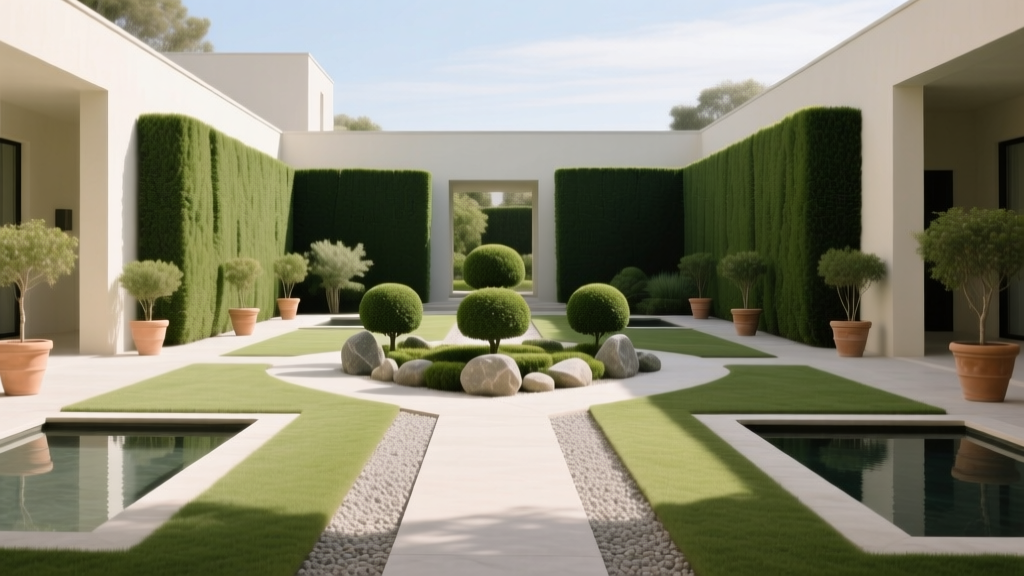
Courtyard Formal Garden Symmetry Design
You step into the courtyard with a cup of coffee and instantly see the problem: the space is tidy but restless. The fence lines feel a little too close, the paving pulls your eye in three directions at once, and the one lonely pot in the corner looks like it’s apologizing. You want calm. You want order. You want the kind of courtyard that makes people slow down without you having to explain why.
Formal symmetry is the fastest way to get there. It doesn’t mean stiff or expensive—it means deliberate balance: repeated shapes, mirrored planting, and a clear axis that tells your brain, “This place makes sense.” Let’s walk through a practical courtyard plan the way a landscape designer would: starting with the axis, then building outward, then choosing plants that behave.
Start with the axis: the backbone of symmetry
In a courtyard, you don’t have the luxury of “wandering paths.” Your layout needs one strong line to organize everything else. That line is the axis—usually from the door you use most to a focal point (a pot, bench, fountain, or sculpture).
Pick a focal point that earns its place
A focal point should be readable from your most common viewing spot—typically the back door or kitchen window. In small courtyards, strong focal points are often vertical or reflective.
- Best small-space focal points: a 90–120 cm tall pedestal planter, a wall fountain, a 150 cm tall obelisk with climber, or a round bistro table centered in the plan.
- Practical tip: if you rent, choose a freestanding focal point (large pot, movable fountain) instead of anything that requires drilling masonry.
Work with real courtyard dimensions (example layout)
Here’s a dimension set I use often because it fits many urban courtyards: 6 m long × 4 m wide (24 m²). The symmetry reads clearly, and you still have room for seating.
Baseline layout: create a central axis running along the 6 m length. Then split the 4 m width into mirrored “rooms.”
- Center path: 1.0 m wide (comfortable two-person pass)
- Planting beds left & right: each 1.5 m wide
- Edge allowance: ~0.25 m on each side for edging/maintenance buffer (adjust based on existing walls)
This gives you symmetry you can feel underfoot: path in the middle, matching beds on both sides, and a destination feature at the far end.
Geometry that calms: simple shapes, repeated twice
The most successful formal courtyards use two core shapes, repeated. Three shapes starts to look busy in tight quarters.
Choose one primary shape
Pick one of these and commit to it:
- Rectangle: clean, modern-formal, easiest to build with pavers.
- Circle: classic formal, great for a central pot or small fountain.
- Square grid: contemporary formal, strong rhythm, great with repeated planters.
Add one secondary shape (used sparingly)
Example: if your primary shape is rectangular beds, your secondary shape can be a single circle at the center (table, pot, or gravel circle). This creates a “pause” in the axis without chaos.
“Repetition and simplicity of form are fundamental to making a small space legible and restful.” — John Brookes, Garden Design Workbook (2017 edition)
Layout strategies that make symmetry feel intentional (not rigid)
Use a centerline you can physically mark
Before you buy anything, snap a chalk line or stretch a string from the main entry view to the focal point. Symmetry fails when the axis is guessed rather than measured.
Borrow height from walls, not floor space
Formal courtyards get their richness from vertical accents. Use walls for:
- Espalier fruit (apples/pears) in matching patterns
- Climbers on trellis panels (one on each side of the axis)
- Wall-mounted lanterns or matching sconces (renters: solar or adhesive-rated mounts)
Create “green architecture” with hedging substitutes
Traditional formal gardens rely on clipped hedges. In courtyards, you can scale that down with dwarf hedging plants or even repeated containers.
Recommended hedge height for courtyards: 45–75 cm. That’s tall enough to read as structure but low enough to keep light and sightlines.
Step-by-step: set up a symmetrical courtyard plan you can actually build
- Measure everything (length, width, door swing, drain locations). Note sunlight: aim to observe 6+ hours for sun-loving plants or 3–5 hours for part-shade palettes.
- Mark the axis with string from your primary viewpoint to the far end.
- Decide your hardscape footprint: central path or central patio pad. In a 6 m × 4 m courtyard, keep hardscape at 40–60% if you want a planted, calm feel.
- Set edges first: steel edging, brick soldier course, or timber (timber is fastest DIY but shortest lifespan in wet climates).
- Place focal point at the terminus (end) of the axis: a 60–70 cm diameter pot, a bench centered on the far wall, or a slim fountain.
- Mirror your layout: anything you place on the left needs an equal visual weight on the right (not necessarily identical—same height/volume works).
- Plant in layers: structure (evergreen), seasonal bloom, then groundcover to hide soil and unify the pattern.
Plant selection: formal structure that behaves in a courtyard
Courtyard plants need three qualities: they must tolerate reflective heat (walls and paving amplify it), they must look neat with minimal intervention, and they must repeat well. Below are designer-favorite varieties that hold their shape and read clearly in symmetry.
Evergreen structure (the “bones”)
- Boxwood alternative: Ilex crenata ‘Sky Pencil’ (Japanese holly): narrow, upright form for matching pairs. Space at 45–60 cm for a slim column effect. Good for formal rhythm without boxwood blight worries.
- Buxus sempervirens ‘Suffruticosa’ (dwarf boxwood): classic edging, clips cleanly. Space plants at 20–25 cm for a continuous low hedge.
- Lavandula angustifolia ‘Hidcote’: reads formal when repeated. Space at 30–40 cm; keep as a low “hedge” in sunny courtyards.
- Taxus baccata (yew), for shaded courtyards: slow, elegant, very formal. Best in-ground if you own; in containers it needs consistent moisture.
Flowering accents (kept disciplined)
- Rosa ‘Olivia Rose Austin’: rounded shrub rose with repeat bloom; looks “designed” without fussy staking. Plant at 90–110 cm spacing in mirrored groups.
- Hydrangea paniculata ‘Little Lime’: strong structure, reliable bloom; good in part sun. Space at 1–1.2 m.
- Salvia nemorosa ‘Caradonna’: upright purple spikes that reinforce vertical lines; space at 30–40 cm.
- Nepeta ‘Walker’s Low’: softens edges without looking messy if you keep it repeated; space at 45–60 cm.
Groundcovers that look intentional (not “leftover”)
- Thymus serpyllum (creeping thyme): for sunny joints or gravel edges; fragrant, tidy. Space plugs at 20–30 cm.
- Geranium macrorrhizum: excellent for part shade, suppresses weeds, forms a clean sheet. Space at 35–45 cm.
- Heuchera ‘Caramel’ or ‘Obsidian’: strong leaf color for shaded symmetry; space at 30–40 cm.
Container “topiary” for renters or small beds
If you can’t plant in-ground, use matching containers as your symmetry anchors:
- Laurus nobilis (bay) as twin standards in 40–50 cm pots
- Myrtus communis (myrtle) for a softer evergreen ball
- Olea europaea (olive) for hot courtyards with a Mediterranean vibe (best with 6+ hours sun)
Comparison table: three formal courtyard planting styles
| Style | Best for sunlight | Key plants | Look & feel | Weekly upkeep |
|---|---|---|---|---|
| Evergreen Minimal | 3–6 hours | Ilex crenata, yew, heuchera | Quiet, architectural, modern-formal | 30–45 min |
| Classic Box & Roses | 6+ hours | Buxus, English roses, lavender | Traditional, fragrant, romantic-formal | 60–90 min |
| Mediterranean Courtyard Formal | 6–8 hours | Olive, rosemary, thyme, santolina | Sun-washed, crisp, drought-aware | 30–60 min |
Hardscape choices that reinforce symmetry (and stay buildable)
Hardscape is where symmetry becomes obvious. If the paving lines don’t match, the planting can’t save it. Keep materials limited: one paving type, one edging type, one gravel (if used).
Paving patterns that look formal fast
- Large-format slabs (60 × 60 cm): fewer lines, calmer look, modern formal.
- Brick herringbone: classic formal texture; hides slight inconsistencies.
- Gravel with crisp edging: the most DIY-friendly formal look—if your edging is sharp and your gravel depth is right.
Gravel spec that works: install gravel at 5–7 cm depth over a compacted base. Use a stabilizing grid if you want high heels or easy chair movement.
Budget and DIY alternatives (with real numbers)
Costs vary by region, but courtyard projects become manageable when you decide what must be perfect (alignment, edges) and what can be flexible (plant maturity, accessories).
- Steel edging: often $6–$12 per linear foot installed; DIY kits can be less.
- Gravel courtyard surface: commonly $3–$8 per sq ft depending on base work and grid systems.
- 60 × 60 cm concrete pavers: often $4–$10 per sq ft for materials (installation adds more).
- Large feature pot: a good frost-proof container typically $80–$250.
- Evergreen structural plants: expect $25–$60 each for 2–5 gallon shrubs in many markets.
DIY swap that still looks formal: instead of built-in raised beds, use two identical 120 cm long trough planters placed symmetrically along the axis. You get instant structure, renter-friendly flexibility, and cleaner lines than a patchwork of small pots.
Three real-world courtyard scenarios (and how symmetry solves each)
Scenario 1: The renter’s paved courtyard with no dig rights
Problem: solid paving, nowhere to plant, and you can’t attach trellis to the wall.
Solution: use mirrored container groups to create “beds” without soil.
- Place a narrow central outdoor rug or gravel runner (removable) to establish the axis.
- On each side, place matching trough planters: bay standards at the back (height), lavender in front (low hedge effect).
- Focal point: a single large pot with an olive or a slim water bowl on a stand at the far end.
Numbers that matter: choose containers at least 40 cm wide for shrubs; water 1–2 times weekly in summer; feed monthly during active growth.
Scenario 2: A narrow townhouse courtyard (2.2 m × 8 m) that feels like a hallway
Problem: too narrow for a centered path and beds; anything down the middle blocks movement.
Solution: shift symmetry to the walls and vertical elements while keeping the floor simple.
- Keep a single clear walking lane at least 90 cm wide.
- Install paired wall trellises opposite each other (same size, same height), planted with matching climbers in pots.
- Create symmetry through pairs of tall, narrow planters (e.g., Ilex ‘Sky Pencil’) spaced evenly along the length.
This reads formal because your eye catches repeated intervals—like columns in architecture—even if the floor plan can’t be perfectly mirrored.
Scenario 3: A sunny courtyard (6+ hours) that bakes in summer
Problem: reflected heat, pots drying fast, scorched foliage.
Solution: lean into a Mediterranean formal palette and design for drought behavior.
- Choose silver and evergreen structure: olive, rosemary, santolina, thyme.
- Use gravel mulch in beds to reduce evaporation and visually unify the plan.
- Add a small water feature (even a recirculating bowl) to cool the feel without needing a pond.
Water planning: drip irrigation on a timer is often worth it; even a simple kit can reduce summer maintenance to 15 minutes of checks per week instead of constant hand-watering.
Sunlight, microclimate, and spacing: the details that keep symmetry crisp
Formal gardens look best when plants hold their intended size. That means spacing them for their mature width, not the size in the pot. Crowding creates uneven growth and ruins mirrored shapes.
- Lavender ‘Hidcote’: space 30–40 cm, full sun (6+ hours).
- Salvia ‘Caradonna’: space 30–40 cm, sun to part sun.
- Dwarf boxwood edging: 20–25 cm for a continuous line.
- Roses: 90–110 cm for shrub types to avoid congestion.
Also watch wind tunnels: courtyards can accelerate gusts. If leaves shred on one side and not the other, symmetry starts to look “off.” In that case, use tougher mirrored anchors (bay, yew, holly) and keep softer perennials closer to the ground.
Maintenance expectations: what it takes to keep formal symmetry looking sharp
Formal doesn’t have to mean high-maintenance, but it does mean you can’t ignore it for months. The trick is short, regular sessions.
- Weekly time: plan on 30–90 minutes per week depending on how many clipped plants and roses you use.
- Spring (2–3 hours total over the season): refresh mulch/gravel, feed shrubs, replace any winter losses to preserve mirrored pairs.
- Summer (15–30 minutes weekly): deadhead repeat bloomers, check irrigation, trim lavender lightly after flowering.
- Autumn (1–2 hours): tidy perennials, clean paving joints, check edging alignment.
- Winter (30–60 minutes): clean pots, protect tender containers, prune structure plants only if needed (avoid heavy winter pruning in very cold areas).
For clipped hedges, two light trims per year is usually enough in courtyards: late spring and late summer. That schedule keeps lines crisp without stressing plants.
Notes grounded in research (citations)
Good courtyard design is also good building science: shade and evapotranspiration can improve comfort. The U.S. Environmental Protection Agency notes that vegetation and shade trees can reduce heat impacts in built environments (EPA, 2023). And if you’re choosing plants and water strategies, the Royal Horticultural Society provides practical guidance on drought-tolerant planting and efficient watering approaches for gardens (RHS, 2022).
Sources: U.S. EPA Heat Island Effect (2023); Royal Horticultural Society guidance on drought and watering (2022).
When you’re done, the courtyard won’t just look “symmetrical.” It will feel settled: a clear line to follow, matched shapes that make the space readable, and plants that hold their boundaries instead of arguing with them. The last step is the simplest—stand at your doorway again, look down the axis, and adjust anything that pulls the eye off-center. In formal design, small shifts (even 5 cm) can be the difference between “almost” and effortless.