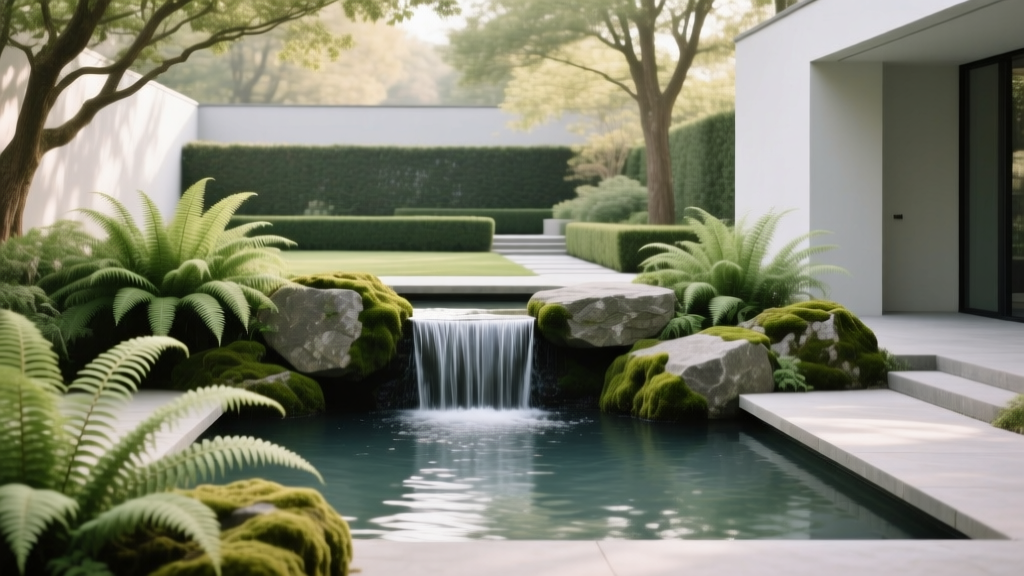
Courtyard Waterfall and Fern Garden
The afternoon you decide your courtyard needs “something,” it’s usually because the space feels louder than it should. The neighbor’s AC kicks on. Footsteps echo off brick. A single pot plant looks a little stranded against hard surfaces. You want calm—but you also need the courtyard to function: a clear walking route, a place to sit, and a design that doesn’t turn into a weekly burden. That’s where a small waterfall and a fern-forward planting scheme shine: water softens the acoustics, and ferns turn shaded corners into lush, intentional rooms.
I’m going to walk you through a layout that works for many real courtyards—rental-friendly versions included—using practical dimensions, plant spacing, and a few budget options. Picture a narrow, enclosed rectangle: walls on three sides, maybe a fence on the fourth, with light that shifts from bright at the top to shade down low. That’s not a limitation; it’s exactly the setting ferns and moving water are designed for.
Design principles: make the courtyard feel bigger, quieter, and greener
1) Use sound as a layout tool (not an afterthought)
A waterfall is more than decoration; it’s an acoustic buffer. Place it closer to the noise source (street side or neighbor wall) so the water masks what you don’t want to hear. For most courtyards, that means positioning the waterfall within 3–6 feet of the wall facing the unwanted sound, angled toward your seating area so you hear the water first.
“Natural sounds, such as water, can support restoration and reduce perceived stress in built environments.” — Alvarsson, Wiens & Nilsson (2010), International Journal of Environmental Research and Public Health
This isn’t about blasting noise; a small sheet or runnel of water can be enough. You want a steady, mid-frequency trickle rather than a splashy, irregular gurgle (which can read as “leak” to the brain).
2) Keep circulation generous—then plant the edges hard
Courtyards fail when the path pinches. I like a minimum clear walkway of 36 inches (comfortable for two people passing sideways) and will squeeze to 30 inches only in very tight rentals. Once that path is set, you can “plant the edges hard” with layered ferns and shade companions to hide walls and soften corners.
A reliable layout for a small courtyard is: path along one long side, seating at the far end, waterfall opposite the seating, and planting beds (or planters) wrapping the base of the walls. If you can only do one bed, do it on the side you see most from indoors.
3) Design for shade gradients, not “shade” as a single condition
Most courtyards are brighter up high and darker at ground level. Track sunlight for one day: note how many hours of direct sun the floor gets. Fern gardens thrive at 2–4 hours of morning sun or bright all-day shade. If your courtyard gets 6+ hours of direct sun, you can still do ferns, but you’ll need more moisture buffering (mulch, drip irrigation, and heat-tolerant species like autumn fern).
Also think about reflected heat: a white wall can bounce light and warmth, while dark brick can hold heat into the evening. Put the most delicate ferns (maidenhair) in the coolest pocket you have—often the north or east corner, or behind the waterfall where evaporative cooling helps.
Layout strategies that work in real courtyards
A practical “12 x 18” courtyard plan you can adapt
Let’s use a common footprint: 12 feet wide x 18 feet long (216 sq ft). Here’s a designer-friendly zoning approach:
- Circulation strip: 3 feet wide along one side (54 sq ft).
- Seating pad: 6 feet x 6 feet (36 sq ft) at the back, centered or slightly offset.
- Waterfall zone: 2.5 feet wide x 2 feet deep footprint for a wall fountain or spillway basin (5 sq ft) on the side opposite the seating, ideally near a wall.
- Planting/planter band: 18–30 inches deep along two walls (roughly 50–80 sq ft depending on how continuous it is).
This gives you a courtyard that reads as “garden” rather than “patio with pots,” without sacrificing usability.
Option 1: Wall-mounted waterfall (best for tiny footprints)
If your floor space is precious, a wall fountain is the cleanest move. A typical unit is 24–36 inches wide, with a reservoir basin around 10–18 gallons. Look for models with an accessible pump compartment and a lip that directs water tightly back into the basin (less splash = less mineral mess on pavers).
Place the wall waterfall at eye level when seated: the water should be visible above plantings. In practice, that means the spillway around 36–42 inches from the ground, depending on your chair height.
Option 2: Bubbling urn (renter-friendly and easy to winterize)
A bubbling urn gives you sound and movement without construction. It can sit in a large glazed pot or a hidden reservoir. The footprint can be as small as 20 inches in diameter, and the setup is typically plug-in. This is the easiest “move-out” feature: unplug, drain, and roll it away.
Option 3: Slim rill along the wall (for modern courtyards)
If you want a linear, architectural feel, consider a narrow rill: 6–8 inches wide and 2–3 inches deep, recirculating to a concealed basin at one end. This is a higher-skill DIY, but it’s stunning in a long courtyard because it stretches the eye and makes the space feel longer.
Step-by-step setup: building the waterfall zone
Below is a straightforward approach for a courtyard waterfall that doesn’t require permanent plumbing. Always check your lease and local electrical codes; for outdoor outlets, GFCI protection is standard practice.
- Choose the location: Pick a wall near power. Keep the reservoir within 6–10 feet of the outlet to avoid long cord runs.
- Set the base: Level the pad with pavers or a concrete stepping stone. Aim for less than 1/4 inch tilt across the basin so the water returns cleanly.
- Install a reservoir: Use a manufactured basin or a heavy-duty tub hidden under a grate and river stones. Target 10–20 gallons for stability and fewer top-offs.
- Add the pump: A common courtyard pump range is 200–400 GPH (gallons per hour). Use a valve to fine-tune the sound.
- Run tubing discreetly: Conceal with a vertical trellis panel or behind the fountain body. Leave access for cleaning.
- Test splash: Run it for 10 minutes. Adjust flow until you get a steady sheet or trickle that stays inside the basin.
- Plan for topping up: In warm weather, expect to add water every 2–4 days in drier climates. In humid, shaded courtyards, it may be weekly.
Water quality matters more than people think. If your tap water is hard, mineral buildup will show on dark stone. A simple mitigation is to wipe the spillway weekly and occasionally use distilled water for top-offs.
Plant selection: ferns that thrive near water and walls
A fern garden looks best when it has structure: one or two taller ferns for height, a mid-layer for fullness, and low plants that cover soil and edges. Ferns also appreciate consistent moisture, which pairs naturally with a waterfall zone (higher humidity, occasional splash, and a visual theme that matches “woodland”).
Core fern palette (with spacing and “why it works”)
Japanese painted fern (Athyrium niponicum var. pictum ‘Pictum’)
Silvery foliage lights up shade and echoes the shimmer of moving water. Space at 18 inches. Great for bright shade and morning sun.
Autumn fern (Dryopteris erythrosora)
Coppery new growth gives seasonal color without flowers. Tolerates a bit more sun and courtyard heat. Space at 24 inches.
Western sword fern (Polystichum munitum) (or a similar tough Polystichum in your region)
Architectural, upright fronds anchor the design. Use as a “backbone” along walls. Space at 30–36 inches.
Maidenhair fern (Adiantum aleuticum or Adiantum raddianum)
The fine texture is perfect near the waterfall where humidity is higher. Space at 12–18 inches, and protect from hot afternoon sun.
Hart’s tongue fern (Asplenium scolopendrium)
Glossy strap leaves contrast with feathery fronds, making the planting look designed, not accidental. Space at 18–24 inches.
Companion plants that make ferns look intentional
Hellebore (Helleborus x hybridus)
Evergreen presence in many climates, winter-to-early-spring flowers, and bold leaves that frame ferns. Space at 18–24 inches.
Hosta (Hosta ‘Halcyon’ or ‘June’)
Big leaves read well from indoors and help hide fountain hardware. Space at 24–30 inches. (If slugs are intense, skip or grow in pots.)
Heuchera (Heuchera ‘Obsidian’ or ‘Caramel’)
Color contrast; forms neat mounds that edge a path. Space at 16–18 inches.
Carex (Carex oshimensis ‘Evergold’)
Grass-like texture that moves in breeze and bridges water-to-plant transitions. Space at 18 inches.
Mossy accents (sheet moss where viable, or moss-like groundcovers)
Moss can be tricky in dry courtyards, but you can simulate the look with low groundcovers. If you attempt true moss, keep it shaded and evenly moist.
Comparison table: three waterfall styles for courtyard gardens
| Water feature type | Typical footprint | Sound character | Best for | Approx. cost (USD) |
|---|---|---|---|---|
| Wall fountain (self-contained) | 2–3 ft wide; 1.5–2 ft deep basin | Steady sheet/trickle; good masking | Tight courtyards, strong focal point | $300–$1,200 |
| Bubbling urn (recirculating) | 18–24 in diameter | Gentle burble; intimate | Renters, easy seasonal storage | $150–$600 |
| Linear rill (custom) | 6–8 in wide; length varies (6–12 ft common) | Light runnel; modern | Long narrow courtyards, contemporary design | $600–$2,500+ |
Soils, containers, and irrigation: keep ferns lush in a hardscape world
Ferns don’t want soggy soil; they want consistent moisture and oxygen at the roots. In courtyards, you’re often planting in raised beds or containers, which dry faster. Use a moisture-retentive but airy mix: fine bark, compost, and coir or peat, plus perlite/pumice for drainage.
Mulch matters. A 2-inch layer of fine bark helps reduce evaporation and keeps roots cooler. For containers, choose larger pots than you think you need: a minimum of 16–20 inches diameter for medium ferns so they don’t dry out daily in summer.
Irrigation can be simple: a drip line tucked under mulch with 0.5 GPH emitters near each plant is discreet and efficient. If you’re hand-watering, plan on 10–20 minutes every other day during hot spells in sunny courtyards.
For water use and efficiency, drip irrigation and targeted watering are widely recommended in water-wise landscaping guidance. The U.S. Environmental Protection Agency notes that irrigation can account for a significant share of residential water use and encourages efficient irrigation practices like drip where appropriate (EPA WaterSense, 2023).
Three real-world scenarios (and how the design adapts)
Scenario 1: A rental courtyard (8 x 12) with strict rules—no digging, no wall mounting
In an 8 ft x 12 ft rental courtyard, floor space is precious and modifications are limited. Go with a bubbling urn in a large pot and build the garden with grouped containers.
Layout move: Keep a 30-inch path from door to seating. Cluster three large planters (20–24 inches wide) at the far corner to create a fern “thicket.” Place the bubbling urn near the seating side so the sound is close and personal.
Plant picks: Autumn fern (heat tolerant), Japanese painted fern (brightness), Carex ‘Evergold’ (movement). Add one hellebore for structure. Use saucers carefully—standing water can stain pavers.
Cost reality: A renter-friendly setup can land around $250–$700 total if you source secondhand pots and choose a midrange pump.
Scenario 2: A shaded brick courtyard (12 x 18) that feels damp and dark
This courtyard already has the right microclimate for ferns, but it can look gloomy. Your job is to brighten it without turning it into a high-glare white box.
Layout move: Install a wall fountain with a lighter stone face (or a simple stainless spillway) to catch ambient light. Use a pale gravel strip (just 8–12 inches wide) behind the fern bed to lift the whole scene visually.
Plant picks: Japanese painted fern (silver), hart’s tongue fern (gloss), and a ribbon of heuchera ‘Caramel’ to warm the palette. Maidenhair near the water for fine texture.
Maintenance note: Shadier courtyards may grow algae on wet stone. Plan a quick scrub every 2 weeks in warm seasons.
Scenario 3: A sun-baked courtyard (10 x 20) with reflected heat and wind tunnels
Ferns can still work here, but you’ll design like a microclimate engineer.
Layout move: Put the water feature on the hottest wall to cool the immediate area and draw you toward that end. Create a wind break with a trellis panel and evergreen screening in pots.
Plant picks: Autumn fern and tougher Dryopteris types, plus Carex and heuchera. Use hosta only if you can keep consistent moisture. Skip maidenhair unless you can guarantee shade and humidity.
Specific strategy: Add 2 inches of mulch, use larger containers (20+ inches), and run drip irrigation on a timer. Without that, you’ll be hand-watering constantly.
Budget planning and DIY alternatives (without sacrificing the look)
A courtyard waterfall and fern garden can be done in phases. The trick is to invest first in the bones: circulation, water placement, and a few strong plants. Then you fill in over time.
Typical cost bands (very general):
- DIY bubbling urn: $150–$350 (urn/pot, pump, tubing, basin or reservoir, stones)
- Midrange wall fountain: $400–$1,200 (unit plus setup materials)
- Planting: $15–$45 per fern in 1–2 gallon sizes; a small courtyard often uses 10–18 plants depending on spacing and layering
- Drip kit: $40–$120 for a basic courtyard run
DIY alternative that still looks designed: If a full fountain is out of reach, start with a glazed bowl feature: a wide bowl (18–24 inches) with a small recirculating pump and a single stone that bubbles. The sound is subtler, but it gives you movement and a focal point for under $120 if you thrift the container.
Another smart savings move: buy fewer, larger ferns instead of many small ones. Three structural ferns at 3-gallon size can anchor the design immediately, and you can underplant with smaller starts as budget allows.
Maintenance expectations: what it takes to keep it lush
Plan on 30–60 minutes per week in the growing season for a typical courtyard fern garden with a small waterfall. That includes checking water level, tidying fronds, and quick weeding.
Weekly (10–20 minutes)
- Top off the reservoir (more often in heat): expect every 2–4 days in dry weather.
- Remove fallen leaves from the basin and pump intake.
- Quick scan for crispy fern tips—usually a sign of inconsistent watering or too much sun.
Monthly (20–40 minutes)
- Wipe the spillway and splash zone to prevent mineral scale.
- Trim battered or browned fronds at the base for a clean look.
- Check emitters if you use drip irrigation.
Seasonal tasks
- Spring: Cut back old fern fronds before new growth unfurls (timing varies by climate). Refresh mulch to 2 inches.
- Summer: Watch for heat stress and increase watering frequency during heat waves.
- Autumn: Net or skim falling leaves so the pump doesn’t clog. This is the #1 cause of “my fountain stopped.”
- Winter: In freeze-prone climates, drain and store pumps; a bubbling urn is easiest to winterize. If you keep it running, you risk ice damage.
If you want a benchmark for plant health: your ferns should hold firm, hydrated fronds through the week. If they collapse by day two after watering, the root zone is drying too quickly—go up a pot size, add mulch, or add drip.
Small design details that make it feel like a finished courtyard
Lighting: A single low-voltage uplight aimed at the waterfall and a second grazing across fern fronds makes the courtyard usable at night. Even two fixtures can transform the space. Keep lighting warm (around 2700K) so foliage looks natural.
Edges: Fern gardens look best with a crisp boundary: steel edging, a narrow gravel strip, or a line of flat stones. In tiny spaces, this “line” reads as intentional design.
Seating placement: Put your chair where you can see both the water and at least one layered planting pocket. If you can’t see the water while seated, it won’t feel like part of daily life.
Finally, remember the goal: a courtyard that feels quieter the moment you step outside. The water gives your ears something pleasant to hold onto, and the ferns give your eyes somewhere to rest. Start with the path width and water location, choose a tight fern palette with clear spacing, and you’ll end up with a courtyard that looks established—without needing constant fussing to keep it that way.
Sources: Alvarsson, J.J., Wiens, S., & Nilsson, M.E. (2010). Stress recovery during exposure to nature sound and environmental noise. International Journal of Environmental Research and Public Health. U.S. Environmental Protection Agency, WaterSense program guidance on water-efficient irrigation and outdoor water use (2023).