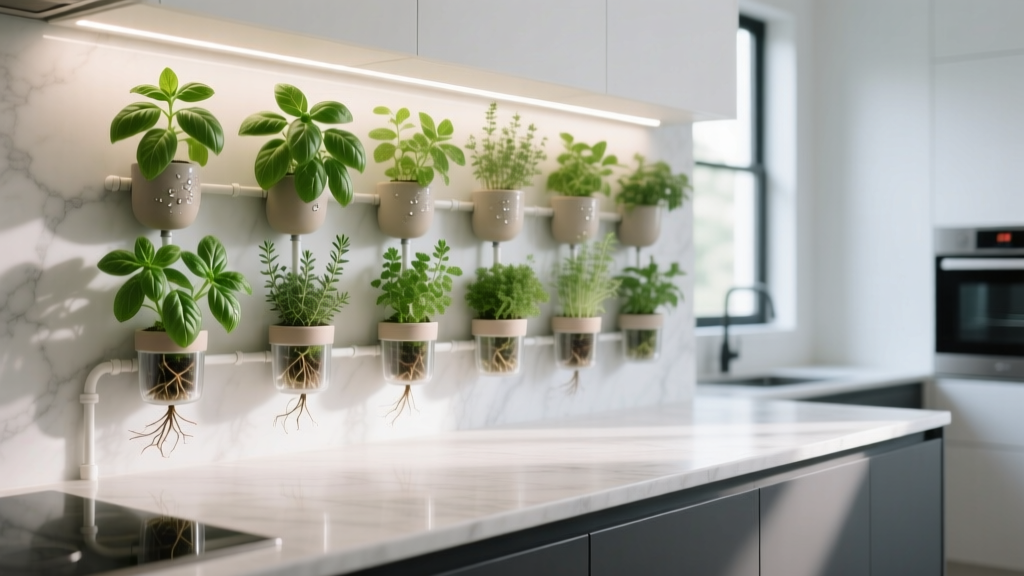
Kitchen Countertop Living Herb Wall
You’re halfway through cooking when you realize the basil is limp, the cilantro is already slimy in the crisper drawer, and the little clamshell of “living herbs” from the grocery store has turned into a root-bound straw hat. The recipe doesn’t need much—just a handful of fresh leaves—but you’re stuck with dried herbs or a last-minute dash to the store. This is the exact moment a countertop living herb wall earns its keep: it turns that narrow strip of unused vertical space between your counter and upper cabinets into a small, bright, productive garden you can harvest in seconds.
Think of this project as a designer’s trick for adding usable “garden square footage” without adding floor clutter. We’ll build upward, keep the footprint tidy, and design for real kitchen conditions—steam, heat, variable light, and your very human habit of forgetting to water for a day or two.
Design principles for a countertop herb wall that actually works
Start with the “counter runway”: measure the real, usable zone
Most herb wall failures come from ignoring clearances. Before you buy anything, measure three dimensions:
- Width: the span you can dedicate—often 24–36 inches between appliances or a corner and a sink.
- Height: from countertop to the underside of upper cabinets—commonly 18 inches. If you have open shelving, you may have 24–30 inches.
- Depth: how far you can come forward without interfering with work—aim to keep the system within 4–6 inches from the backsplash so you still have elbow room.
As a working target, design a wall that’s 30 inches wide and 18 inches tall, holding 6–9 plants in compact pots. This fits many kitchens and keeps the herbs within arm’s reach while chopping.
Light is the layout: decide between window-driven and lamp-driven design
Herbs want brightness. Many kitchens don’t provide it consistently, especially in winter. A sunny window can work if you’re getting 4–6 hours of direct sun or 8–12 hours of strong indirect light. If you don’t have that, plan for a grow light from day one.
One practical benchmark: for indoor edible plants, a dedicated LED grow bar run 12–14 hours/day produces steadier growth than relying on kitchen daylight that changes by season. Purdue University Extension notes that many herbs do best with bright light, often around 6–8 hours of sun or equivalent indoor lighting (Purdue Extension, 2020).
“Light is the limiting factor for most indoor herb gardens; if growth is thin or pale, increase light intensity or duration before changing fertilizer or watering.” — Purdue Extension, Indoor Herbs guidance (2020)
Use vertical layers, not a single crowded row
A living herb wall performs best when it’s arranged in tiers. This reduces shading and keeps air moving. The simplest approach is a two-row grid:
- Top row: slower-growing woody herbs (thyme, rosemary) and compact basil cultivars.
- Bottom row: cut-and-come-again herbs (chives, parsley, cilantro) you harvest frequently.
Plan for 6–8 inches between pot centers. If you cram pots shoulder-to-shoulder, leaves overlap, airflow drops, and fungus gnats move in like they pay rent.
Protect the kitchen: water management is non-negotiable
Countertop gardens fail when water leaks behind the backsplash or drips into outlets. Your design should include:
- A continuous drip tray (at least 2 inches wider than the pot array).
- Waterproof backing (thin poly sheet, removable acrylic panel, or even a baking sheet mounted vertically).
- Bottom-watering capability (pots sit in a tray for 10–15 minutes to soak, then drain).
If you prefer a cleaner look, use self-watering planters—but still keep a tray beneath. Kitchens are too valuable to gamble on “probably won’t leak.”
Layout strategies: three formats that fit real kitchens
Format A: The rail-and-pot “backsplash band” (best for renters)
This is the most rental-friendly layout: a freestanding frame or tension-rod rail system that supports small pots with hooks. It sits on the counter and leans lightly against the wall—no holes, minimal commitment.
Recommended dimensions: 30 in W × 18 in H × 5 in D. Use 3-inch to 4-inch pots (roughly 0.5–1 pint). Keep weight low to avoid tipping.
Format B: The pegboard herb wall (best for flexibility and tools)
A sealed pegboard panel gives you a modular grid: pots, scissors, labels, even a small watering bottle can hang together. If you can anchor into studs, it’s rock-solid. If you can’t, build it into a framed stand that sits on the counter.
Spacing rule: place hooks so pot rims sit 6–7 inches apart. Leave 4 inches of vertical space above each pot for airflow and harvesting.
Format C: The slim shelf wall (best for heavier pots and woody herbs)
If you want rosemary that lasts, a little more root room helps. A narrow two-tier shelf system holds 4–5 inch pots securely.
Shelf depth: 5.5–6 inches. Shelf vertical spacing: 9–10 inches so parsley doesn’t press against the underside.
Plant selection: varieties that thrive indoors and behave on a wall
Indoor herbs succeed when you choose compact cultivars, match them to your light level, and avoid pairing “thirsty” herbs with those that prefer drying slightly between waterings. For most kitchens, I design around a core set of 6–9 plants, then rotate seasonal favorites.
Best all-around picks for a countertop living herb wall
- Basil ‘Prospera’: Downy mildew resistance and vigorous regrowth make it forgiving indoors. Keep it under strong light and pinch weekly.
- Basil ‘Spicy Globe’: Naturally compact—great for tight vertical systems where classic Genovese basil gets lanky.
- Parsley ‘Darki’ (Italian flat-leaf): Sturdy stems and good flavor; handles frequent cutting. Give it consistent moisture.
- Chives: Almost indestructible indoors if light is decent. Harvest by snipping near the base; it rebounds fast.
- Thyme ‘German Winter’: Compact, woody, and happier with slightly drier soil—ideal for top rows where heat collects.
- Mint ‘Spearmint’ (in its own pot): Excellent indoor performance, but isolate it—mint spreads and can overwhelm neighbors.
Seasonal or “use fast” herbs (rotate these in)
- Cilantro ‘Calypso’: Slower to bolt than many, but still best grown as a succession crop. Sow a new pot every 3–4 weeks.
- Dill ‘Bouquet’ (or ‘Fernleaf’ for compactness): Needs bright light; best as a short-term crop on the wall’s brightest section.
- Oregano ‘Greek’: Strong flavor and compact growth; prefers to dry slightly between waterings.
Herbs that are tricky on a countertop wall (but possible)
- Rosemary (‘Arp’ or ‘Tuscan Blue’): It wants intense light and excellent drainage. Use a larger pot (5–6 inches) and keep it on the top shelf with a fan nearby if your kitchen is humid.
- Lavender (‘Hidcote’): Needs very bright light and dry air; many kitchens are too humid. Attempt only with a strong grow light and gritty mix.
For food safety and plant health, avoid using garden soil indoors. Use a sterile potting mix and a saucer or tray to control runoff. The University of Illinois Extension recommends well-drained media and bright light for indoor herbs (University of Illinois Extension, 2021).
A practical comparison: choose your system by constraints
| System | Best for | Typical capacity | Approx. cost (USD) | Install complexity | Water risk |
|---|---|---|---|---|---|
| Rail-and-pot freestanding frame | Renters, minimal tools | 6–8 pots (3–4") | $45–$120 | Low | Low–Medium (tray needed) |
| Pegboard panel (sealed) | Modular layouts, tools + herbs | 6–10 pots | $60–$160 | Medium | Medium (drips from hanging pots) |
| Two-tier slim shelf | Heavier pots, woody herbs | 6–9 pots (4–5") | $70–$220 | Medium | Low (stable bases) |
| Hydroponic wall pods | Fast growth, low soil mess | 8–20 pods | $120–$350 | Low–Medium | Low (but pump maintenance) |
Step-by-step setup: a designer’s build sequence
This sequence assumes a 30-inch wide living herb wall with a grow light. Adjust to your kitchen, but keep the order—each step prevents a common mistake later.
- Map the counter zone. Tape off a rectangle 30 in W × 6 in D on the counter. Open cabinets, check appliance doors, and confirm you still have a comfortable prep area.
- Choose a backer and tray. Set a waterproof tray at least 32 inches wide. Add a wipeable backer panel behind the pots if your wall is painted drywall.
- Install the structure. Place your freestanding frame/pegboard/shelf so the top is 2–3 inches below the cabinet underside (or below the lowest shelf). Confirm it won’t wobble when you pull a pot.
- Add lighting. Mount an LED grow bar so it sits 8–12 inches above the herb canopy. Put it on a timer set to 12–14 hours/day.
- Pot the herbs correctly. Use pots with drainage. For 4-inch pots, fill with indoor potting mix and leave 1/2 inch headspace for watering.
- Place by water needs. Group thyme/oregano/rosemary together (drier), and parsley/cilantro/basil together (more consistent moisture). Keep mint alone.
- Label and date. Add small labels with planting date—especially for cilantro and dill so you remember when to resow.
- Water in and observe for 7 days. For the first week, check daily: leaf posture, soil moisture, and any dripping. Fine-tune light height and timer.
Budget planning and smart DIY alternatives
A good-looking herb wall doesn’t have to read as “gadget.” Here are realistic cost ranges with a few swaps that keep it polished.
- Grow light bar: $25–$80. DIY option: a simple under-cabinet LED grow strip on a timer ($8–$15 timer).
- Frame/pegboard/shelf: $30–$150. DIY option: seal a small pegboard panel with water-based polyurethane ($12–$20), then mount to a simple wood stand.
- Pots + saucers: $3–$8 each. For 8 pots, plan $24–$64. DIY option: reuse nursery pots but hide them inside matching cachepots (still keep drainage).
- Potting mix: $8–$18 per bag (enough for several small pots).
- Plants or seeds: starts at $3–$6 per herb; seeds $2–$4 per packet. A starter set of 8 plants typically totals $24–$48.
For many kitchens, a realistic all-in budget is $90–$220 for a soil-based wall with good lighting. If you already have a bright window and skip the grow light, you can land closer to $50–$120, but growth will be more seasonal.
Three real-world layout scenarios (and what I’d design for each)
Scenario 1: The renter with a north-facing window and zero drilling allowed
North light is gentle and often insufficient in winter. I’d build a 24-inch wide rail-and-pot frame that sits on the counter, then add a 2-foot LED grow bar tucked under the cabinet lip. Keep the palette compact and shade-tolerant: chives, parsley, thyme, mint (solo), and basil ‘Spicy Globe’ right under the brightest section.
Layout tip: Put the timer outlet inside a cabinet to reduce visual clutter, and route the cord along the backsplash edge with removable clips.
Scenario 2: The homeowner with a bright south window but limited counter depth
If your counter is tight, depth is the enemy. I’d go with a slim two-tier shelf with a 5.5-inch depth and keep pots to 4 inches. In strong sun (often 5–7 hours direct), basil can thrive without supplemental light in spring/summer. Use the top shelf for thyme, oregano, and rosemary (if you want to try it), and the bottom shelf for parsley and cilantro.
Heat management: South windows can cook herbs through glass in summer. Slide the whole unit 6–12 inches back from the pane or use a sheer curtain during peak afternoon sun.
Scenario 3: The small-apartment cook with a dark kitchen and only one open outlet
Here we design around electricity and maintenance. I’d do a sealed pegboard stand with an integrated power strip mounted to the back, and one efficient LED bar on a timer. Skip rosemary and lavender—choose forgiving, fast-replacing herbs: basil ‘Prospera,’ chives, parsley ‘Darki,’ thyme, and mint (solo). If you love cilantro, grow it in short rounds and accept that it’s a succession crop.
Maintenance hack: Use uniform pots and keep an empty “rotation spot.” When a cilantro pot declines, you swap in the next sowing without redesigning the wall.
Maintenance expectations: what it really takes to keep it lush
A countertop herb wall is not a set-it-and-forget-it feature, but it’s pleasantly manageable. Plan for 15–30 minutes per week once it’s established, plus a few seasonal resets.
Weekly routine (15–30 minutes)
- Water check (5–10 min): Feel the top 1 inch of soil. Basil and parsley prefer even moisture; thyme/oregano prefer to dry slightly between waterings.
- Harvest and pinch (5–10 min): Pinch basil above a node weekly to prevent legginess. Harvest parsley from outer stems.
- Clean-up (5 min): Remove yellow leaves, wipe the tray, and check for standing water.
- Quick pest scan (2 min): Look under leaves for aphids or spider mites—indoors, early detection is everything.
Monthly tasks (20–40 minutes)
- Light adjustment: Raise or lower the grow light to keep it about 8–12 inches above the canopy.
- Rotate pots: Turn each pot a quarter turn so growth stays even.
- Feed lightly: If growth slows, apply a diluted liquid fertilizer at 1/4 strength once a month during active growth (follow label directions).
Seasonal resets
- Every 8–12 weeks: Re-sow cilantro (and dill if you grow it). These are not long-haul indoor performers.
- Every 6–12 months: Refresh potting mix for heavy feeders like basil, or up-pot if roots circle densely.
- Winter: Expect slower growth without added light. This is when the timer-driven LED really pays off.
Small design moves that make the wall feel intentional
As a designer, I want this to look like part of the kitchen—not a science project you have to apologize for. A few details do the heavy lifting:
- Repeat materials: Match pot color to cabinet hardware (all matte black, all brushed brass, or all white). Consistency reads “designed.”
- Keep a harvesting tool on the wall: A small pair of herb scissors on a hook makes you more likely to harvest properly (which keeps plants bushy).
- Add one non-plant element: A small label strip, a recipe clip, or a tiny analog timer makes the wall feel like a kitchen station, not just decor.
Troubleshooting by symptoms (fast fixes)
Leggy, pale growth: Increase light first—either move the light closer (stay within 8–12 inches) or extend photoperiod to 14 hours.
Yellow leaves + wet soil: Reduce watering frequency and confirm drainage. Empty the drip tray—standing water suffocates roots.
Fungus gnats: Let the top layer dry slightly, use yellow sticky traps, and avoid overwatering. Indoors, moisture control is your best defense.
Basil collapsing suddenly: Check for cold drafts from windows or an AC vent. Basil hates cold; keep it above 60°F if possible.
The best part of a countertop living herb wall is how quickly it becomes a habit: you pinch basil while the pasta boils, snip chives onto eggs, pull thyme with two fingers without stepping outside. When the layout is right—good light, controlled water, and plants chosen for indoor behavior—the wall doesn’t feel like another chore. It feels like the kitchen finally has the fresh ingredient drawer it always wanted, only it grows back.
Sources: Purdue University Extension (2020), Indoor herbs/light guidance; University of Illinois Extension (2021), indoor herb growing recommendations.